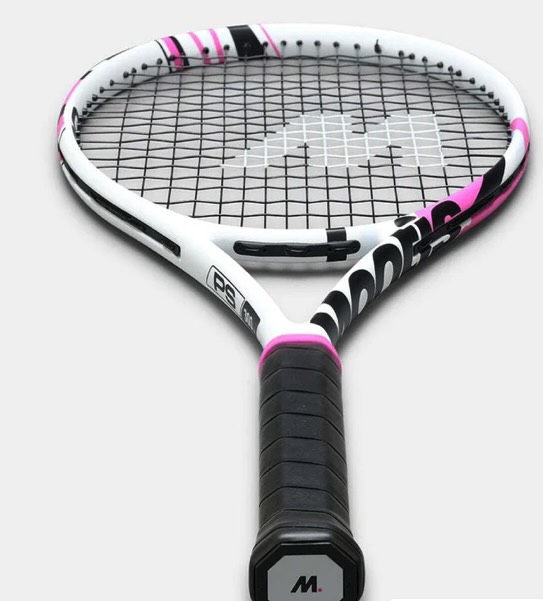
Do you remember the brand Mantis? Well, now they are back with a fresh rebrand and new racquets. We have tested two of them in this Mantis racquet review.
I first tried a Mantis racquet about five years ago and it played well with good feel and control. This time we tested one Mantis Pro 310 and one Mantis PS 300. The Pro is a stealth cosmetic control racquet, while the PS 300 will give you more power and spin.
The new Mantis racquets come in two different cosmetics per model. The Pro 310 comes in a black “Phantom” design and a black and pink “Team” cosmetic, while the PS 300 comes in a black/grey Tour and there is also a pink/white “Challenge”. So you can choose the color combos that suit you the best.
Both the Pro and PS also have two lighter options, a 295 Pro and a 285 PS.
I want to make a note that the grip shape of these racquets are rather rectangular, more like Tecnifibre racquets than Wilson, for example.
Specifications
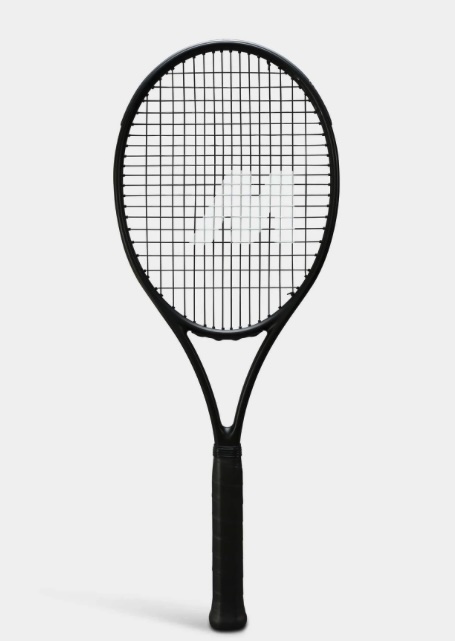
Mantis Pro 310
Head Size: 98 in² / 632.26 cm²
Unstrung Weight: 10.9oz / 310g
String Pattern: 16×19
Length: 27in / 68.58cm
Stiffness: 67
Beam Width: 21mm
Balance: 12.4in / 31.5cm / 8.8 pts HL
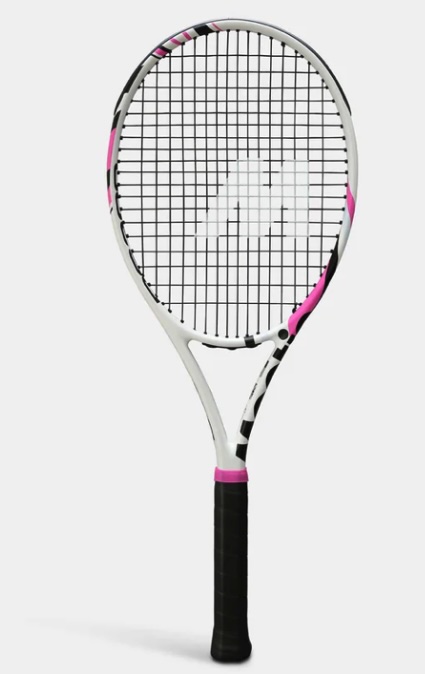
Mantis PS 300
Head Size: 100 in² / 645.16 cm²
Unstrung Weight: 10.6oz / 300g
String Pattern: 16×19
Length: 27in / 68.58cm
Stiffness: 70
Beam Width: 23.5mm / 25mm / 22.5mm
Balance: 12.59in / 32.0cm / 7.3 pts HL
Video review
How do they perform?
Pro 310
The Pro 310 is targeted towards players wanting confidence and feel on their shots. You need to be able to generate your own power. It has a smaller sweet spot and requires better technique than the PS 300.
Competitors of the 310 would be HEAD Radical Pro, Wilson Pro Staff 97 315, Tecnifibre TF40, Yonex Percept 97, Babolat Pure Strike 97, Dunlop CX 200, Nordicdots 98 Pro and Solinco Whiteout 305 —the list goes on of control-oriented 97-98 sq inch racquets.
The Pro 310 offers a nice feel on impact and solid control from the dense string pattern. The sweet spot is not huge, but when you hit it, it feels great. The racquet came in slightly above 330 SW strung with a 1.25 poly so it did not need any customization. I still felt quite punished on off-center hits, but when I hit the sweet spot I was rewarded with some good depth and control. The 21 mm beam is thin and you cannot expect the racquet to give you anything “for free”. It does move pretty fast through the air, though, so if can whip up enough racquet head speed to generate spin and depth.
I tried the Mantis Pro in 2020 and had a similar experience to now. From what I understand, this is the same racquet, or at least the same mold with a different cosmetic. It remains a nice control racquet, but does not stand out among other racquets in a similar spec range. I do think they have improved the cosmetic since I last tried them and the price point at €181 or $224 is excellent. Also you get 15% off using the code TENNISNERD or this link.
PS 300
The PS 300 is your average tweener racquet in terms of specs. It competes with racquets like the Babolat Pure Drive, Wilson Ultra, Dunlop FX 500, HEAD Boom MP, Yonex Ezone 100, Solinco Blackout and more.
This is my favorite of the two racquets because it has easy playability, a good level of power and spin, but above-average comfort for a power racquet. Again, the swing weight was a little higher than I like on these types of racquets. I measured it slightly above 330 on my Metortune with a 1.25 poly, which is higher than average for power-oriented racquets. The higher swing weight will give you more power, but make it slightly less maneuverable.
But in this case, I probably just got a little beefier of a sample. If you buy one, you will likely get it in the 290-295 Unstrung SW range.
Despite it being a little heavier than I wanted, there wasn’t really an issue getting the racquet in place on time. I loved the stability and easy power that the PS 300 provided. I remember liking it five years ago and the same was true here. I could shorten my swing and still get ample depth on groundstrokes.
Also, the PS 300 provides good pop on serve and a stable response on volleys. This racquet was easy to like. It did not have the power of pure Power category racquets, but balanced it with better comfort. I think it compares better to the Boom than the Pure Drive, for example.
Overall, a pleasant experience. I would like a slightly lower swing weight (a standard issue with all racquet manufacturers) but otherwise, this was a good one. For players looking for an easy to use racquet for a good price, the Mantis PS 300 should be considered.
Summary
My opinion has not changed about Mantis racquets in five years. They look better, the website is more modern and the price point highly competitive. But the playability remains and that is not a bad thing.
The PS 300 is my favorite as it had most of the things I would look for in a powerful racquet. The PS 310 felt a little demanding with its thin beam and small sweet spot, but it will find its fanbase, I am sure. Especially the Phantom one with its Stealth cosmetic and classy performance.
Overall, nothing that stands out compared to the vast selection of racquets out there, but still solid performers at a lower price point. I think many club players will find lots to like in the new Mantis racquets. A video review is coming soon.
Have you tried Mantis racquets? Let us know your thoughts in the comments.
Get a discount
The price point of Mantis racquets is already very competitive, but to make them even better we have set up a discount code with Mantis Sport. You get 15% off using the code TENNISNERD or this link.