
We cover tennis obsessively and betting is just another way of engaging with the sport more deeply. The things that make you better at watching tennis also make you better at betting on it, and this page is built around that idea.
Most of you know the basics on how to bet on tennis online but we wanted to provide some more valuable betting tips and information. This is a guide for people who already watch a lot of tennis and want to think about betting in a more structured way.
Don’t miss our own match previews and betting predictions for random matches on the ATP and WTA tour and check also our blog post on the best tennis betting sites for 2026.
Latest from Our Betting Blog





Recommended Tennis Sportsbooks
How Tennis Odds Work
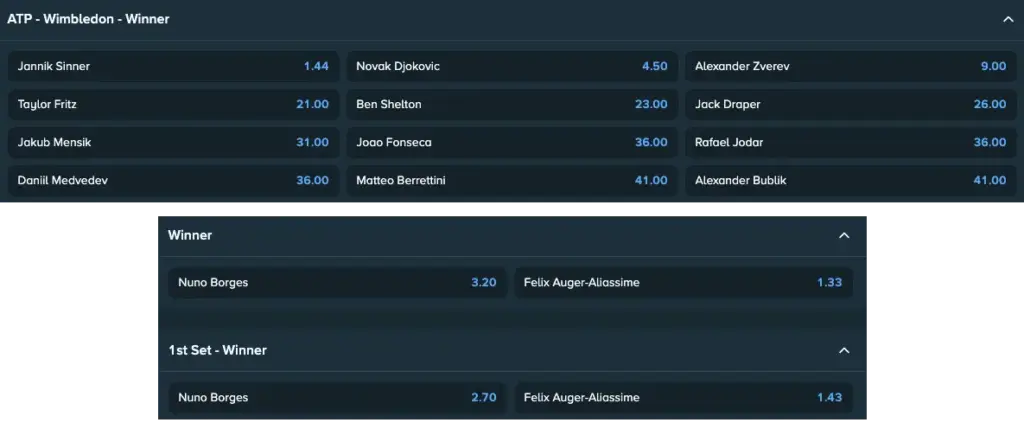
Odds in their most common European decimal format represent what you get back per unit staked, including your original stake. Odds of 1.80 return 1.80 for every unit – a profit of 0.80. The implied probability of any decimal odds is simply 1 divided by the decimal: 1.80 implies 55.6% probability, 3.50 implies 28.6%. If you bet €100 on a player at odds 1.80, you will get back €180 at a win, a profit of €80.
Here is the important part: the implied probabilities from both players always add up to more than 100%. In a well-priced match, Player A at 1.65 and Player B at 2.45 adds up to roughly 102%. That extra 2% is the overround, the bookmaker’s built-in margin. In bigger markets like major Grand Slam matches, the overround is smaller (1-2%) because competition between bookmakers tightens prices. In smaller markets, Challengers, early rounds of ATP 250s, the overround can be 5-8% or higher.
What you are actually trying to do when betting is find situations where you believe the true probability of an outcome is higher than what the odds imply. Not just predicting who wins (the bookmaker already has a view on that) but identifying where your assessment diverges from the market’s. That is what value means, and it is the only framework that makes sense long term.
Odds Formats
While decimal odds represent your total return per unit staked, UK (Fractional) and USA (Moneyline) formats approach the math from different angles.
UK fractional odds (e.g., 4/5 or 2/1) focus strictly on the potential profit relative to your stake; a 4/5 bet means you win 4 units for every 5 you bet (getting back 9 total), while 2/1 means you win 2 units for every 1 you bet.
USA moneyline odds use a base of 100 and indicate whether you are betting on a favorite or an underdog: a negative number (e.g., -125) tells you how much you must stake to win €100, while a positive number (e.g., +200) tells you how much profit you will make on a €100 stake. In essence, while decimals show you the total payout including your stake, fractions highlight your “profit-to-stake” ratio, and US odds anchor the calculation around a standard €100 increment.
A few examples:
| Fraction | Decimal | American | Implied Probability |
|---|---|---|---|
| 1/4 | 1.25 | -400 | 80% |
| 10/11 | 1.91 | -110 | 52.4% |
| 9/4 | 3.25 | +225 | 30.8% |
The Favourite-Longshot Bias
This is a well-documented phenomena in sports betting and it is directly relevant to tennis. The favourite-longshot bias is the consistent finding, verified across thousands of tennis matches, that betting on heavy favourites offers systematically better expected value than betting on big underdogs.
This seems counterintuitive. Surely the favourite at 1.10 is being bet by the entire planet and has no value? In reality, bookmakers load their margin disproportionately onto longshots. The odds on a big outsider are consistently shorter than a fair market would offer, while the odds on strong favourites are kept relatively sharp to attract sharp money. Research across A LOT of tennis matches confirms this pattern holds consistently.
In practical terms: if you regularly bet on underdogs at 4.00 or higher because the payout is attractive, you are fighting the worst mathematical territory in the market. If you bet on clear favourites selectively (particularly in best of five where upsets are rare) your expected return is structurally better. This does not mean betting every favourite blindly. It means being much more sceptical about longshot value than most recreational bettors are.
The Main Betting Markets
Match winner is the simplest market and the most liquid. The largest Grand Slam markets have overrounds as low as 1-2% and are priced very efficiently. Finding value requires real conviction. For smaller events, early rounds, and particularly women’s matches below the top tier, pricing is softer.
Set betting allows you to bet on the exact scoreline – 2-0 or 2-1 in best of three, 3-0 through 3-2 in best of five. This is interesting for people who understand the players well. A match where you expect the favourite to win but to face a tough second set (maybe because their opponent serves well in patches but eventually fades) can offer value on 2-1 even when the winner seems clear.
Game handicap is a spread applied to total games across the match. A -3.5 handicap on the favourite means they need to win by more than 3.5 games across the full match. In matches where the winner seems obvious but the straight win price is too short to be interesting, the handicap market can be more rewarding. More about handicap betting for tennis.
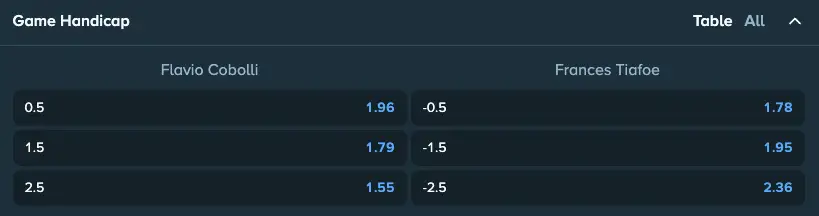
Total games is an over/under on the total number of games played. This is fundamentally a question about competitiveness. A tight three-setter produces 30+ games; a dominant two-set win might produce 17. Surface, serve quality, the players patterns of play and their head-to-head history on that surface all inform this market. It is worth noting that total games markets are voided if a player retires, more on that below.
First set winner and set winner markets allow you to isolate specific sets rather than the match. These can be useful when you have strong conviction about how a specific set will unfold without necessarily backing a player to win the whole match.
Some tennis bookmakers have a lot of more special bet types, such as “Double Result” (1st set winner and match winner), “1st Set – Total Games” and so on.
Surface – The most important variable
Surface is the single biggest driver of outcomes in tennis and the factor most underestimated by bettors who do not follow the sport closely. The same two players can produce radically different results depending on where they play, and the prices do not always fully reflect this.
For example, Taylor Fritz had a quite poor 2026 season especially in the clay swing. Right away in the grass season, his form was peak and he went on a 16-2 win record .
Clay slows the ball and produces higher, kicking bounces. Points are longer, patterns repeat more frequently, and baseline consistency becomes the dominant factor. The serve advantage is significantly reduced because returners have more time. Heavy topspin is highly effective. Physical fitness matters more than on any other surface because rallies are longer and recovery time between points is shorter. A player who looks comfortable winning in straight sets on hard courts can look completely ordinary on clay. Casper Ruud is an example of a classic clay court player.
Grass is the fastest surface and the most serve-dominant. First-strike tennis works better here than anywhere else. Low bounce penalises players who rely on heavy topspin and rewards flat hitters and volleyers. The transition from clay to grass is the sharpest shift on the tour calendar and some players handle it far better than others. The Halle and Queen’s Club events the week before Wimbledon are strong predictors of grass court form and worth watching closely. Djokovic and Taylor Fritz are examples of two great grass court players.
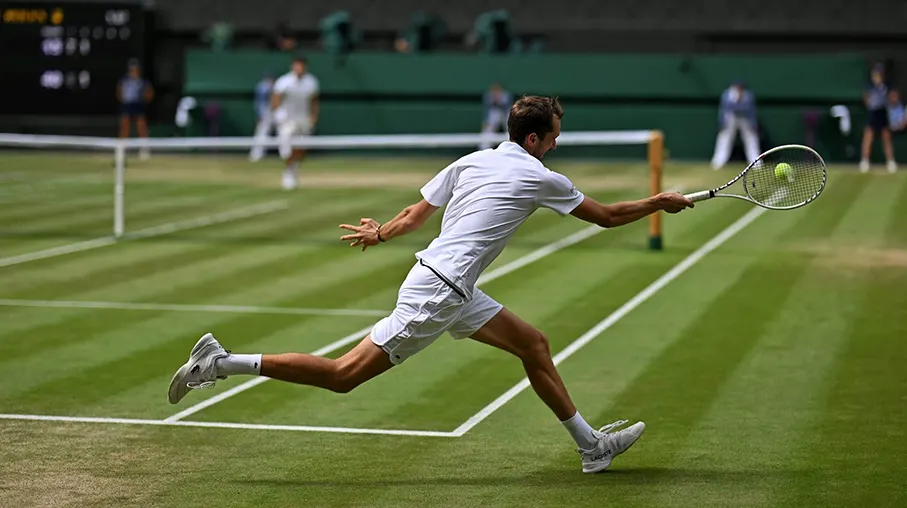
Hard courts vary significantly between venues. Court Pace Index, or CPI, is a statistical measure that quantifies court speed based on ace rates adjusted for player and opponent quality. Brisbane and Adelaide play fast. Australian Open Plexicushion plays medium-fast. US Open Decoturf plays medium and slows significantly under night session humidity.
Madrid Open clay plays faster than any other clay event due to the altitude of 650 metres – the ball flies through the air and bounces differently, effectively rewarding a style of play closer to a fast hard court than traditional red dirt. Mexico City is even more extreme. These venue-specific nuances are rarely fully priced in by bookmakers and are worth knowing.
Indoor hard courts, primarily the European indoor swing in October-November, are the fastest conditions on the tour. Ball movement is predictable, conditions are consistent, and big servers and flat ball strikers have their maximum advantage.
Jannik Sinner has been pretty dominant on hard courts during the 2025-2026 seasons.
This is part of what makes tennis betting fun, having knowledge of not only form, but surface and other aspects such as weather conditions (more on that below).
Read also Bren’s post on how the surface affects your betting.
Best of Three vs Best of Five – Why format changes everything
This distinction actually has implications for how often upsets happen and should change how you evaluate the tennis odds.
In best of three matches – which covers all ATP and WTA events outside Grand Slams – variance is genuinely high. A top player can lose to a significantly inferior opponent in a way that simply does not happen as frequently in best of five. A bad first set in a best of three is a crisis; in a best of five, it is a recoverable situation. Strong players at Grand Slams have more opportunities to work through tactical adjustments, physical discomfort and all of the momentum shifts. This is why the giant-killing frequency at Grand Slams is normally lower than at 250-level events despite the field depth being higher.
When you see a price on a top player that looks generous by their overall ranking and form, consider whether the format explains it. A player who loses regularly at 250-level events against lower-ranked opponents in three sets but reaches final after final at Grand Slams is not inconsistent, they are a best of five specialist, and those exist.
Physical conditioning also plays a larger role in best of five. Five-set matches in early rounds of Grand Slams carry injury risk into later rounds, and players sometimes manage effort strategically across a fortnight. Watching how a player finishes a long five-setter is relevant to how you assess their next match. We’re seeing more and more injuries and cramps on tour in recent years and this is something to really keep a look out for.
Tournament Level and Market Efficiency
Grand Slams have by far the sharpest and most liquid markets. Finding pricing errors at Wimbledon or the US Open is difficult because sharp money from professional bettors globally is active and efficient. The volume of money means bookmakers price carefully and adjust fast.
Masters 1000 and WTA 1000 events are well-priced but not quite as efficient. Mandatory events with full top-player fields, typically best of three throughout except for the final.
ATP 500 and WTA 500 events attract partial fields. Top players choose selectively, and motivational factors – how much a player cares about this particular event given their schedule – become relevant.
ATP 250 and WTA 250 events are the least efficient market tier. Fields are variable, information is less complete, bookmakers pay less attention and the combination of best of three format and weaker fields means upsets are genuinely common. If you know the players in these draws better than the bookmaker’s model does, this is where it shows most.
Challenger and ITF events sit below the main tour and have the softest pricing, but also the lowest liquidity and least available information. The edge can be real if you have specialist knowledge of this level, but it is a niche within a niche.
More on the different levels in pro tennis.
Grand Slams
Below some general info on betting on the four major tennis tournaments, the Grand Slams. This is where you’ll find most betting markets and a lot of liquidity in the markets.
Betting on the Australian Open
The Australian Open is the first Grand Slam of the year and takes place in late January on GreenSet hard courts in Melbourne, rated by the ITF as medium-fast. The key betting context here is that players arrive with very limited competitive match time behind them. The tour restarts in Brisbane, Adelaide and Auckland roughly two weeks before the main draw, and those warm-up results matter more at the Australian Open than warm-up form does at any other Slam simply because there is so little else to go on. A player who reached the final in Brisbane and looks sharp is in a very different position to one who had a first-round exit or skipped the warm-up entirely.
Heat is a genuine factor in a way that is unlike any other Slam. Melbourne can reach extreme temperatures in the opening week and the tournament has a heat policy that allows for breaks between sets once conditions hit a certain threshold.
This tends to favour the physically strongest players and those accustomed to playing in heat – it disproportionately affects European players who have come from an off-season in cold conditions. In 2026, Sinner was very close to an early exit due to the extreme heat, when the heat rule came into effect and they closed the roof.
Night sessions at Rod Laver Arena play significantly faster than day conditions in the heat, which shifts the dynamic in favour of bigger servers and flatter ball strikers. If you know a match is scheduled under the lights, factor that in. The Australian Open also tends to produce the highest retirement rate of any Slam due to the heat and the early-season fitness question marks.
Betting on Roland Garros
Roland Garros is the only Grand Slam played on clay and is widely considered the hardest major to win for anyone who is not a genuine clay specialist.
The context of the clay season leading into Roland Garros is important betting information. The European clay swing runs from Monte Carlo through Barcelona, Madrid, Rome and then Paris, roughly six to eight weeks of clay before the Slam begins. A player who has been grinding through that clay season carries fatigue into Paris. One who has skipped several events to be fresh may arrive with less match practice but more physical reserves. This trade-off is priced inconsistently by the market.
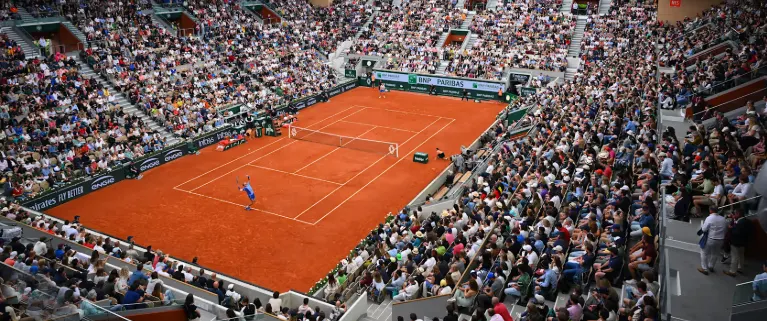
Watch how players finish at the Italian Open in Rome, the last significant warm-up. Weather in Paris also affects the clay surface more dramatically than at other Slams. Quite often we see some rainy days here and it makes the courts heavier and slower, extending rallies further and further disadvantaging players who want short, sharp exchanges.
Betting on Wimbledon
Wimbledon is unique in the tennis calendar and requires a specific betting mindset. The grass is the fastest surface on tour, the bounce is low and skidding, and the serve is more dominant here than anywhere else. Tiebreaks are more frequent, breaks of serve are rarer, and a single break in a set can be the decisive moment. This structural reality means that the set betting and total games markets behave very differently at Wimbledon than at other Slams – lean toward lower game totals and tiebreak markets more than you would on clay or hard courts.
The transition from clay to grass is the sharpest surface shift on the calendar and it happens in under two weeks after Roland Garros. Some players make the adjustment seamlessly; others genuinely struggle. The Halle and Queen’s Club events the week before Wimbledon are the most important form guides of the year for the grass swing. A player who reached the final at Queen’s Club and is now priced similarly to how they were priced on clay may be undervalued (or overvalued if they got there on a fortunate draw).
The other Wimbledon-specific angle worth knowing is that first-week results on outside courts, where the grass dries out more and plays faster, can look different from second-week results on the main show courts. Lower-ranked players with strong serves can look deceptively competitive early before the conditions normalise and the class players assert themselves in the second week.
Betting on the US Open
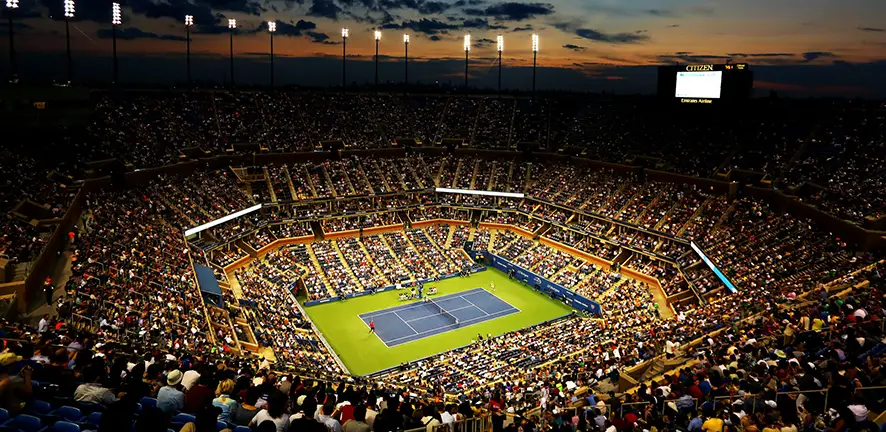
The US Open is the final Grand Slam of the year, played in late August and early September in New York on DecoTurf hard courts. The surface plays medium-fast but slows considerably in the humid conditions of the New York summer, particularly in day sessions. Night sessions at Arthur Ashe Stadium play noticeably faster – the cooler, drier evening air increases ball speed and serve effectiveness. This creates a practical edge for bettors who know the schedule: a serve-dominant player in a night match has a measurably different prospect than the same player in a day match in humid 32-degree heat. Night matches at the US Open also come with the most raucous crowd atmosphere of any Slam, which can affect nervous or younger players more than experienced ones.
The season context is crucial. Players arrive at the US Open having navigated almost a full year. By this point in the season, bodies are tired, minor injuries have accumulated and the players who have managed their schedule carefully across the year to arrive relatively fresh are at a significant advantage over those who have played every week. The US Open also historically produces a higher number of upsets in the women’s draw than any other Slam, partly because the surface does not suit a dominant clay-court game style and partly because the scheduling can be punishing for players with physical issues late in the season.
Retirement and Walkover Rules
Player retirements in tennis create one of the most misunderstood situations in sports betting, and the rules can vary between bookmakers. Knowing your bookmaker’s rules before placing a bet is important – it changes which bets make strategic sense.
For moneyline match winner bets, most sportsbooks apply the First Set Rule: if at least one complete set has been played, the bet stands and the player who was winning at the time of retirement is settled as the winner. If a player retires before a set is completed, most bookmakers void the bet and return stakes. Some bookmakers require at least one set regardless of circumstances; a handful settle all bets as long as the first ball has been struck. Know which rule your bookmaker uses.
For handicap and total games markets, the standard rule is that the match must be completed in full. If a player retires mid-match, all handicap and total games bets are voided regardless of how far the match had progressed. This has practical implications: if you think a player might retire due to injury, backing them on the moneyline with a bookmaker using the First Set Rule (where you get paid if they were winning when they retired) is a different risk profile than betting on total games where a retirement voids your bet either way.
A walkover (where a player withdraws before the match begins) results in all bets being voided and stakes returned across basically every bookie. This is different from a retirement during the match.
The strategic implication: if you are deliberately targeting a match because you suspect an injury might cause a retirement, choose a bookmaker whose rules work in your favour for that specific bet type. And if you want to back a player but are worried about their fitness, a game handicap in their favour can be a safer structure – if they retire, the bet is voided rather than settled as a loss.
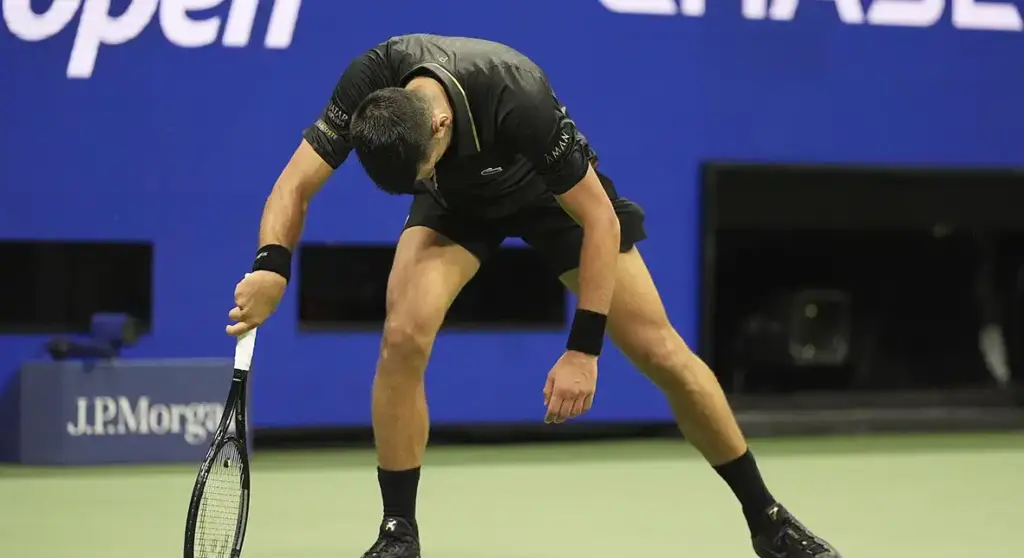
How Weather Affects Tennis and Its Odds
Wind is the most significant and under-appreciated weather factor in tennis betting. Anyone who has played themselves in just moderate wind, should know this. Heavy wind disrupts timing, reduces consistency from the baseline, neutralises spin and topspin-based game styles, and generally shortens matches because both players make more unforced errors. Players who hit flat and take the ball early, who rely on clean, compact swings, tend to cope better in wind than heavy topspin players who need a consistent ball.
This matters particularly on clay, where windy conditions can dramatically level the playing field between a clay specialist and a hard court player. We’ve seen, for example, top players like Aryna Sabalenka struggle in windy conditions on many occations.
If a forecast shows strong wind for a clay event and you see a price that is based on normal clay conditions, there may be value on the player who is typically better in neutral, unpredictable conditions rather than the one who dominates when the conditions are perfect for their heavy topspin game.
Rain delays create two distinct effects. The immediate practical effect is that matches can be suspended and completed the next day, which eliminates most live betting positions. Most sportsbooks keep pre-match and live bets active across the delay, but check your bookmaker’s specific rules. The secondary effect is that rain freshens clay courts, making them slower and heavier, and more suited to grinders and physically dominant players than to flatter ball strikers.
Night sessions, particularly at the Australian Open and US Open, create different playing conditions from day sessions. Ball speed increases when the air is cooler and drier at night. Serve becomes more effective. Players who have an advantage in faster conditions, typically those who serve well and hit flat, should see their edge increase in night conditions compared to day.
Extreme heat creates a different dynamic. Tournaments now have heat policy rules that allow for rest between sets, which can benefit the physically stronger player in a match. It can also impact players from countries not accustomed to extreme heat differently from players who have grown up practising in hot conditions. Jannik Sinner is an example of a top ranked player that seem to have difficulties in longer matches in high temperatures.
Live Betting – How to think about it
Live betting in tennis rewards people who understand the structure of the game better than the algorithm. The market moves in real time based on serve, game score and set score but it does not always reflect what you can see with your eyes about a player’s physical state, tactical adjustments or mental resilience.
The most important structural thing to understand about live tennis odds is the serve cycle. When a player is serving, the odds shift in their favour, not necessarily because the match is going their way, but because the server has a mathematical advantage. This means the odds on a player who has just been broken can look attractive simply because they are now serving. Every time the serve changes, there is a mechanical adjustment in the live price. Understanding this prevents you from reading routine hold-of-serve games as momentum swings.
Live markets can also overreact to injuries and physical problems. Some research show that backing an injured player live, not the player showing no signs of injury who looks fresh, often has positive expected value because the market moves too aggressively. The exception is when you can see clearly that a player’s movement is severely compromised, not just that they are receiving treatment or moving more slowly temporarily after a long rally. Medical timeouts in particular cause market overreaction – the player calling the timeout often benefits from the rest and comes back competitive. Betting against them at the inflated post-timeout price is frequently a mistake.

Hedging a pre-match bet live is worth understanding. If you backed a player at 3.00 pre-match and they are now leading a set and a break at live odds of 1.25, you can back the other player live to lock in a guaranteed profit regardless of the result. The mathematics of this are straightforward. Whether to hedge depends on your confidence in the original bet and whether you think the live price on the trailing player genuinely reflects their chances. If you think the match is closer than 1.25 vs 3.00 suggests, hedging makes more sense than if you think your original pick is completely in control.
Between-set breaks are genuine inflection points and the market often does not price them well. Five minutes of recovery, tactical input and physical assessment can change the trajectory of a match meaningfully. The player who lost the first set does not automatically lose the second, comeback sets and full-match reversals are common, particularly in best of five where the trailing player has more time to adapt.
Following Players on Social Media – An underrated edge
This sounds trivial but it’s not actually. Following players Instagram accounts, and sometimes their partners accounts, can reveal information that is not yet in the public domain and that betting markets have not priced in. A player posting holiday photos the day before their scheduled match at a tournament, or their partner posting that they are watching from the stands when they are supposedly travelling with them, or simply a tone of posts that suggests a player is relaxed and happy versus stressed and overtrained – these are soft signals that sometimes reach the market before official communications do.
This is particularly relevant for lower-tier events where the media presence is smaller and official player communications are less frequent. At a Grand Slam, team announcements and injury updates move through official channels quickly. At a Challenger event, Instagram may genuinely be ahead of the market. (Instagram seem more popular than X among tennis players nowadays)
It is also worth following coaches and fitness trainers who are active on social media, particularly for players who work with well-known coaches who post about training camps.
How Bookmakers Detect and Limit Winning Bettors
This is something most betting guides do not mention because the bookmakers that sponsor them do not want it published. The reality is that most traditional bookmakers and online sportsbooks will limit or close the accounts of consistently profitable bettors. This is not because it is illegal (it is not) but because their business model depends on recreational losers, not sharp winners.
The most sustainable approach for serious tennis bettors is to use a combination of betting exchanges where you are betting against other players rather than the bookmaker and where limits are generally not applied, and other recommended bookmakers that has a reputation of welcoming winning bettors and publish their limits in advance. Betting brokers are worth investigating for bettors who’s looking to bet without account restrictions.
If you are being limited on traditional bookmakers, it is a sign you are doing something right, not wrong. Rotating bookmakers, reducing stake size, taking larger accumulators rather than singles, and focusing on less-watched markets where your edge is clearest are all approaches used by professional bettors to manage this problem.
A Few Practical Tips
Here are some more tennis betting tips that can be useful when trying to find winners.
Head-to-head records require context to be useful. The surface-specific head-to-head is what matters, not the overall career record. And recency matters – a head-to-head record from five years ago involves different versions of both players. The last three or four meetings on the relevant surface tell you far more than a 16-14 career stat. Check all players updated H2H stats on the official ATP tour site, for example the Alcaraz v Sinner h2h here.
Schedule and fatigue are underpriced by betting markets more often than almost any other variable. A player coming off a five-set match two days ago faces a meaningfully different challenge than one who won 6-2 6-1 and rested. This is particularly relevant in the middle stages of Grand Slams where early energy management choices start to show up in match quality.
Motivation is real and quantifiable in some cases. A player who has already secured their ranking objective for the season, who is a set down at a 250-level event the week before a Masters 1000 they care about, and who has a history of early exits in these situations – that is a real edge the market sometimes ignores, we have noticed.
Line movement tells you things the opening price does not. A price that opens at 2.00 and is bet down to 1.70 before the match suggests sharp money on the favourite. A price that drifts from 1.70 to 2.10 suggests sharp money has come in on the other side, or that news you may not have seen yet (injury, scheduling change) has reached the market.
For match predictions, tennis betting tips and tournament previews, see our tennis betting blog.