Where you sit to watch a tennis match has a big impact on your overall experience. Your view of the players, the ball, the angle and trajectory of shots, engagement with the crowd–all of these factors are influenced by where you are seated in the stadium. Below, I break down the factors to consider when choosing seats in tennis, and give my personal verdict at the end on the best place to sit in a tennis stadium.
If you’re interested in visiting any of the four Grand Slam’s or Masters tournament, visit P1 Travel here to see some really go travel packages.
The three main choices
Broadly speaking, there are three main choices when it comes to picking a seat at a tennis match: behind the baseline, in line with the net or in one of the corners.
- Behind the baseline
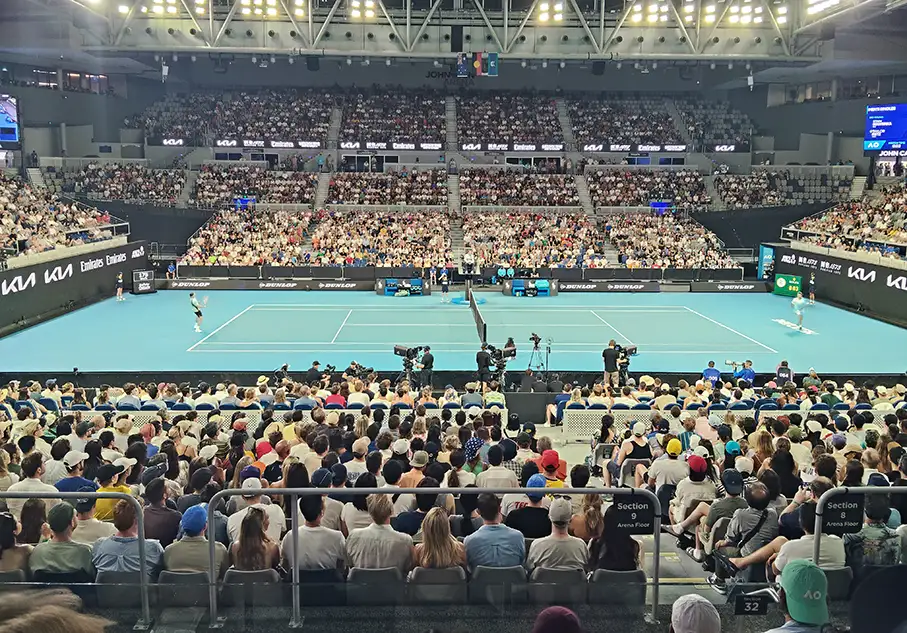
This is the most commonly recommended location to watch tennis from. It’s also the view that TV broadcasts use, so it will be the most familiar for tennis fans heading to watch a match for the first time.
There are pros and cons to this view. The main pro is the ability to watch the entirety of the on-court action without needing to turn your head to track the ball. It’s also a great view to understand the angle of shots, and gives you a real appreciation of how fast players have to move to get to wide balls.
However, behind the baseline, it’s tough to get a handle on the trajectory of balls. At times, you’ll find it hard to see how high balls are travelling over the net. This is much the same as on TV, which in itself can be a con. If you’ve travelled to watch tennis in person, do you really want the exact same view as the one you can get back home on TV?

- In line with the net
Sitting on the halfway line is traditionally the best seat in the house when it comes to sport in general. But for tennis, it’s a little more nuanced.
This position is the polar opposite to sitting behind the baseline. Here, you get a great view of how high balls are travelling over the net. This makes for real heart-in-mouth moments when heavy topspin shots are hit – initially, they all look like they’re flying out, only for them to spin down into the court at the last second. It’s a unique view compared to TV, and also gives a great perspective on just how hard balls are being hit as well.
However, it can be a tough position to watch tennis from for long periods of time, simply because of all the head turning that’s required. You might get a sore neck, or dizzy, or simply tired of the constant movement. It’s also a bit harder to track the lateral angles of shots from in line with the net.
- In the corners
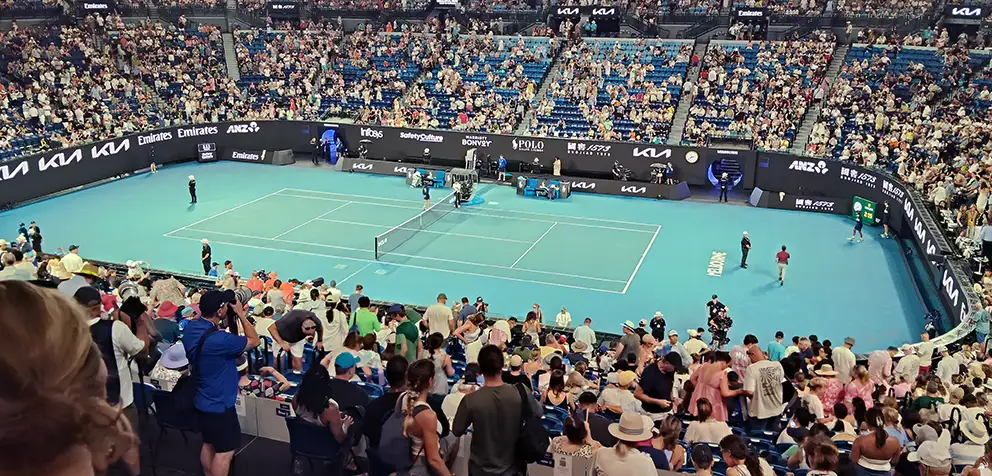
Sitting in the corner of a tennis stadium is the position typically favored by coaches and analysts. Why? Because it combines the benefits of both the options above.
Here, you’ll be able to see the height of the ball over the net as well as get a good gauge of lateral angles and pace of shot. You won’t have to move your head either: everything will be visible from one fixed view.
The only downside is things are a little distorted. Since you aren’t looking at the court square-on from either the back or side, it can be a bit tough to judge whether a ball is going in or out. Some parts of the court are disproportionately further away than others too, which can throw you off a little.

Other things to consider when choosing a seat at the tennis
While those are the three main options for tennis seats, there are a bunch of other factors that will have a big impact on your experience.
- Closeness to the court
By far and away the next biggest influence on your tennis viewing experience will be your proximity to the court. There’s a big difference between being in the front row, or being up in the nosebleeds.
Again, there are pros and cons. If you’re right near the front, you’ll be almost within touching distance of the players. This is epic – particularly if you’re sitting on the baseline – as they’ll pace around near you between serves, or be returning from just a few meters in front of you.


However, oftentimes being close to the court can mean a slightly obstructed view (more on this later). The net can block out one half of the court if you’re on the baseline, or the side fences and umpire chair can get in the way from the halfway point. Moving further away from the front mitigates these issues.
Much of this depends on the type of court. If it’s a big showcourt, it will likely be somewhat sunken down, so even the front row is raised a few meters above the court. Smaller courts have less of this, so things are more likely to get in the way.
- Crowd involvement
Your reasons for attending a tennis match will also have an impact on where the best seat is for you personally. For example, sitting down close to the court means you’ll likely be rubbing shoulders with noisy, passionate fans. This can be brilliant if you’re one yourself, or not so enjoyable if you’re looking to enjoy the action in peace.
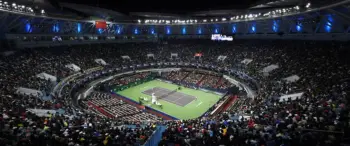
Sitting further back from the court, or in one of the corners, gives you a better view of the crowd as a whole. This can be cool if it’s a particularly good atmosphere, as it allows you to soak it all in.
- Shade
This can be a huge factor depending on the time of day, season, and whether or not the match you’re watching is indoors or outdoors. For example, I was recently at the Australian Open where several days had temperatures well over 35 degrees Celsius. In these conditions, the best seat was a seat in the shade – angles or obstacles be damned!
If you’re going to be in a stadium for a while, consider where the sun will move. Often, you can preempt where it will be and get a seat in a spot that might currently be sunny, but will get shade shortly. This way you can grab an empty seat with a good view, while still benefitting from shade for most of the match.
- Obstacles
I touched on this above, but there are a range of potential obstacles to consider when choosing your seat. The first two are the net, and the sideboards. Depending on the type of court, these can not matter at all, or be quite a big deal. For example, the outer courts at Melbourne Park all have high enough sideboards that from the front row, you can’t actually see the court.
Other obstacles to consider are the umpire’s chair, and cameras. Usually you’ll be able to find a map or a picture of the court in advance, so if you’re planning to sit in line with the net, you can make sure it’s not right behind the chair. Typically there will be one big TV camera on the baseline, so it’s best to sit at the other end of the court from this. Bigger courts can have swinging-arm cameras in the corners too.
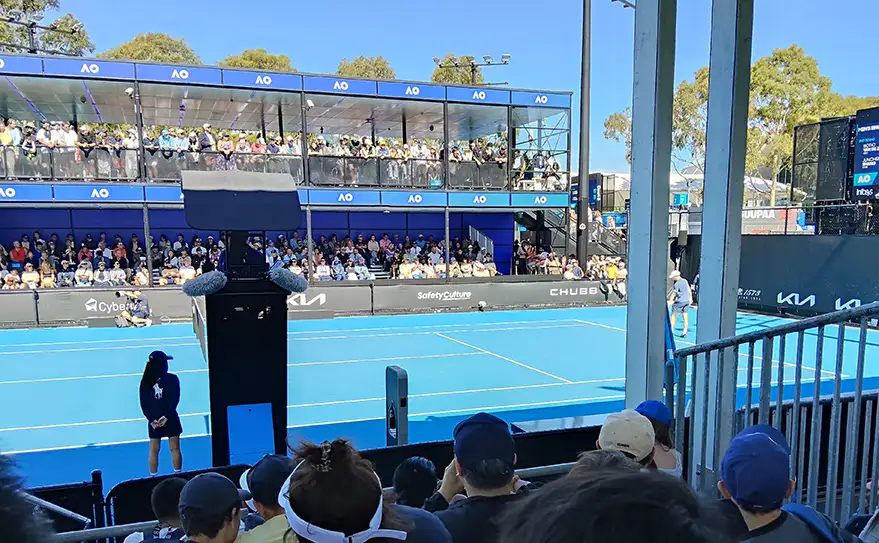
Depending on the type of court, you’ll find some have a lot of pillars and supports that hold up various shade structures. Sometimes these don’t matter, but if there are enough in the way, it can be a pest.
Where the players sit between games can also obstruct your view in some courts. Unless it’s a showcourt or an indoor match, they’ll likely have umbrellas that stay up, which will block out some of the court if you’re sitting down low enough.
- Access
This is a minor one, but if you’re planning to pop in and out, you may want to consider how easy that will be from a particular seat. Most tournaments still only allow movement every two games, and a reasonable queue can form to get back to your seat from the toilet or a food stop. Sitting up the back close to a door, or near to an aisle, can mean an easier path in and out of the stadium.
My verdict: The best seat to watch tennis from
If you’ve read this far, you’ll have figured out that the best position to watch tennis from largely depends on what you’re looking for. A peaceful time? Understanding of power, or spin? The ability to analyze movement?
For me, however, there are two spots that take the cake, and I’ll explain why:
- Front row, behind the baseline
This is the best place to watch tennis if you want full engagement with a match. You can hear the players talking to themselves, see the sweat on their foreheads, hear the power of their rackets contacting balls in return. You can even be heard by the players, if you’re confident enough to shout out bits of advice or encouragement.
There are the least number of obstacles when you’re sitting on the baseline too. Yes, the net might get in the way a little, but that’s OK: you’re basically watching the match from the player’s POV, which is a real rush. You’ll likely be right next to some other fans who are equally as interested in the match, making it a very visceral experience. Chances are you’ll get on TV too, given your proximity to the court.
As a bonus, many courts have better leg room in the very front row, so you won’t be as crammed up as other parts of the stadium (and will have easier access walking along rows).

- Two thirds of the way back, in a corner
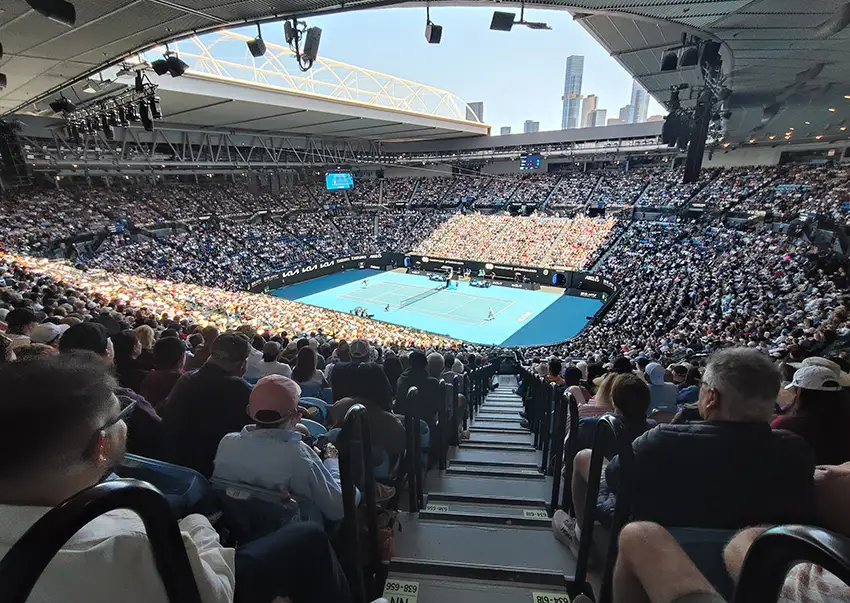
This is the best seat in the house if you’re wanting to soak up the full experience. From here, you can see both players clearly, and shouldn’t have any obstacles in your way. You’ll get a good idea of speed, height, spin and angle, as well as movement of the players.
But the big perk of being up and in the corner is your ability to see all the rest of the stadium. Going to a tennis match isn’t just about what’s happening on court – it’s about the full experience. From the corner, you’re looking down and out at a lot of the audience, and can see how they’re reacting to points in a way that’s not possible from up the front.
Sitting up and in a corner is a great spot if you’re a neutral, there for a good time, as opposed to wanting to track every point perfectly.