
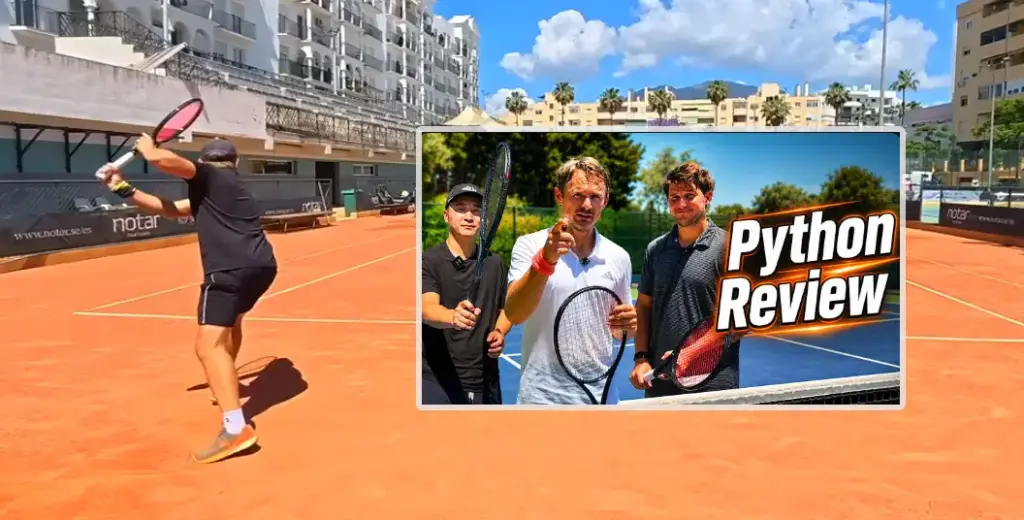
We got early access to Wilson’s upcoming Python racquets, including the P98 and the P100 and these are our thoughts.
Wilson has been running a fairly low-key campaign around its new “Python” series. Which is just the prototype name. We wrote about it in our early post about the new Wilson spin racquet. The racquets will not be black like these and they will not be called Python when they are released in two weeks. We have tested the official cosmetic and will be back with a full review, so make sure to subscribe on YouTube and to our newsletter.
This is perhaps Wilson’s most hyped release ever. If you’ve been paying attention to the college circuit or the pro tour, you’ve already seen these frames in action. Karen Khachanov, Sebastian Korda and young French star Moise Kouame have already switched on the ATP Tour. On the WTA Tour, we have both Potapova and Stearns using the Pythons.
We got our hands on both the P98 and the P100 (in pre-release cosmetics) thanks to Holy Tennis (use the code Tennisnerd5 for 5% off) and put in enough court time to form some real opinions. Short version: the P100 is a genuinely exciting racquet. The P98 is more niche, but also has a lot of potential in the right hands.
Both frames are clearly aimed at Blade users who want more spin and lift without sacrificing feel. That’s a specific brief, and Wilson has largely delivered on it. Let’s break down in more detail what you get with the new “Python” racquets.
Wilson P98: High Ceiling, Low Forgiveness
The Wilson P98 looks different to everything else Wilson has put out recently – thicker beam, a visual departure from the Blade DNA – but it still feels like a Wilson the moment you hit the first ball. That’s intentional. The engineers clearly worked to preserve that plush, connected response that Blade players are used to.
The sweet spot is real but not enormous. Hit the middle and you’re rewarded with beautiful feedback. Miss it and you’ll know… not harsh, but honest. That’s fine for better players. For club-level players who miss the centre a lot, it’s going to feel unforgiving, and that’s where the P100 steps in.
String pattern is 16×20, a wider version than you might expect, which means the gaps between strings are significant. Don’t expect the same bite-and-snapback aggression you’d get from a tight 18×20. In testing, the P98 didn’t deliver quite as much spin as anticipated. Part of that is string choice; we played it strung with a red co-poly that sits somewhere between 4G’s stiffness and Alu Power, but part of it is just the racquet. It’s a spin racquet in its DNA, but not as wild as the Aero 98. You get a pretty controlled launch.
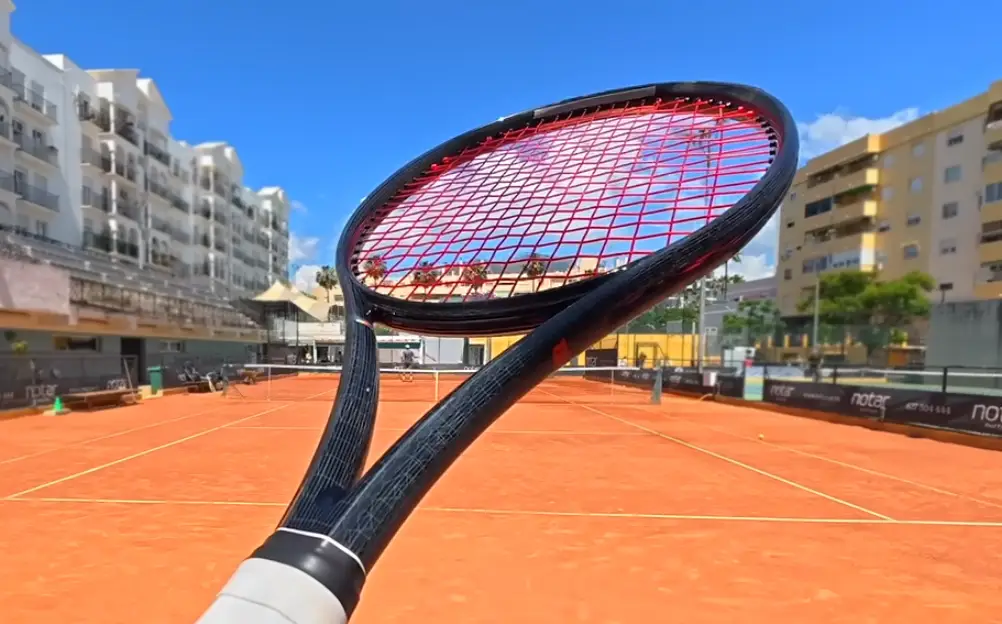
Customisation might be needed to unlock greatness
Stock swing weight on both frames came in at around 293–295 SW, and that’s not quite enough for the P98. Out of the box, it can feel a little light on the sides – not hollow exactly, but lacking the heft that unlocks plow through on high balls and wide contact points. Lead at 3 and 9 makes a meaningful difference. The college players we observed were pretty much all running lead tape on the sides, and many used 4G strings. On the 98, I think a shaped poly makes more sense to get some extra bite, while the 100 I prefer with a rounded string.
On serve and on groundstrokes at low tension (we tried it strung with Toroline A5 at around 52 lbs), the P98 comes to life. Low tension is where this racquet really performs. Push it much higher and the already-tight margin for error gets tighter.
Bottom line on the P98: great racquet for advanced players (college level and above) who want to transition from a Blade Pro or Blade H22 and get a bit more depth on the ball without losing feel. For the rest of us, keep reading.
Wilson P100: Top Three Racquet of the Year
The Wilson P100 is something else. Same DNA as the 98, but the extra head size changes everything. The sweet spot is noticeably more forgiving, the spin comes much more naturally, and crucially, the dwell time is exceptional for a frame with a beam this thick.
We’re talking about a racquet you can shape the ball with. Hit flat, loop it, swing fast or swing slow and the P100 keeps finding the court. That’s the hallmark of a genuinely well-engineered racquet. The ball just keeps dropping in. We had multiple moments on court where someone took pace off their swing mid-rally and the ball still looped over with margin. That doesn’t happen by accident.
The string pattern here is 16×19 and the combination of that pattern with the larger head size produces spin that puts the P100 in a different bracket to its sibling. Strung with A5 at 52 lbs, both of us felt the tension was dialled in. We wouldn’t go up or down from there.
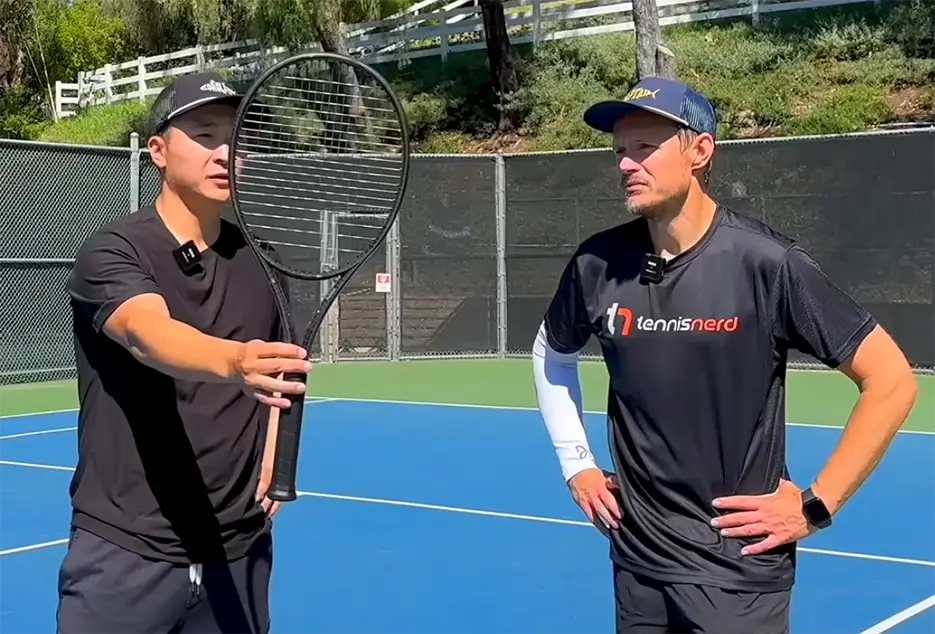
Feel: Plush, Punchy, and Connected
Flex feels like mid-60s, firm enough to generate pace, soft enough to let you feel the ball. The result is a racquet that has both modern response and a somewhat traditional feel. Players moving from the Blade 100, which is quite flexy, will find this transition completely logical. There’s a familiarity to it, even though the specs look quite different on paper.
It doesn’t feel like a spin racquet that punishes control. It feels more like a Speed or a Radical in terms of the creative freedom it gives you. You can shape the ball, play with wrist, flatten it out when you need to. The spin generation is a byproduct of a well-designed frame, not the result of sacrificing everything else.
Depth control is genuinely impressive. On multiple occasions, we were able to push balls close to the baseline without the nerves you’d normally get from a more powerful frame. That confidence translates in matches.
Does the P100 Need Customisation?
Less so than the P98. With an overgrip, the balance comes in pretty much where you want it for a 300g racquet. You might consider adding a small amount of weight in the handle to bring the balance down slightly, but honestly, we’d recommend hitting it stock first. Some of us felt that customising it might actually diminish what makes it special. The specs are well thought through. It always depends on the specifications you get. Although Wilson quality control has gotten better in recent years, you might still get a few grams higher or lower and that might make the need for customization stronger.
P100 vs Aero 2026: The Obvious Comparison
It’s inevitable. Both are 100 sq inch spin racquets with strong audiences.
The Aero 2026 is more powerful. It produces slightly more pace through the ball, has more pop on serve, and has a higher-frequency pitch – you can hear the difference. It’s punchier. If raw power and a slightly more aggressive launch is what you want, the Aero is your racquet.
The P100 is softer. The thud versus the ping. You’re getting better feel, more dwell time, and what feels like a tighter leash on the ball. You can do more with it before it flies on you. For players who want to play creative, shape-heavy tennis, the P100 wins that conversation.
Launch angle is similar between the two. Neither is going to send the ball into the stands unintentionally. But the P100’s control makes it feel more precise in tight moments. That’s the trade: Aero gives you more pop, P100 gives you more ball-pocketing and feedback.
For what it’s worth, both of us came away preferring the P100 for our own games. That’s partly a feel preference, but for most club players, the ability to feel the ball and make adjustments in real time is more valuable than a few extra MPH.
Video Review
Who Are These Racquets For?
P98 – Advanced players. College level and above. Blade or Blade Pro H22 users who want more lift and spin but won’t sacrifice feel or precision. Needs lead tape and attention to string setup to reach its potential. Low tension recommended.
P100 – A much broader audience. Serious club players who want a spin-friendly, forgiving frame that still gives them proper feedback. Blade 100 users will transition seamlessly and appreciate the extra spin potential and aerodynamic shape. Former Aero users who want more feel will be surprised by how much control this thing has. Even some pros are likely to end up on this – we’re already seeing it up and down the college circuit. Kouame and Potapova are allegedly using the P100 on tour.
String Recommendations
We tested both frames with Toroline A5 at 52 lbs and it worked. The P98 might benefit more from a shaped string – something like a Toroline Vamos, to add a bit more bite and snapback, since the frame’s spin potential doesn’t max out on its own. I would prefer a Tour Bite style string over a Luxilon 4G on the P98. The P100, which already launches with plenty of spin, arguably suits a round string better to rein things in slightly and give you more feel. We’ll be doing a dedicated string comparison when the official cosmetic version drops.
Verdict
The Wilson P-series is a genuine release from a company that clearly studied what Blade players actually want. They’re not trying to beat the Aero at its own game; they’re offering something different: more feel, more dwell time, better control, with enough spin potential to be competitive with anything in the category.
The P100 is the standout. It’s one of the best 100 sq inch frames we’ve hit in terms of feel-to-spin ratio. Two thumbs up from both of us, and we don’t give those out lightly.
The P98 is excellent in the right hands – strung right, weighted right, it’s a weapon. But it’s a more specific and demanding instrument.
Both frames are coming out in July with the official cosmetic. We’ll have a full review with proper specs, swing weight measurements, and string testing once they’re in retail form.
Visit the Wilson official shop here.








Former Clash 100 user currently using ezone 98. How would the P100 compare to these?
The Clash is mega flexible but launchy and powerful, while the Ezone 98 is a controlled power racquet. The P100 lands in the middle. If you like to hit flat, there are better options, but for a spin player looking for a soft feel and forgiveness it is a good racquet.
You mentioned it is similar to the speed. So, how do they compare and which one do you recommend?
Jonas, is the model you guys tested already the final version—without the official paint job—or could the official version still change?
Yeah, should be the same racquet but with a different cosmetic
Hey Jonas – in between the Mizuno Acrospeed and waiting for the P100 release.
Can you share some of your experience and thoughts between the two?
Hi Alexandra, they are both good racquets. The Acrospeed does flat shots better with more power and confidence. If you like to hit with more spin and have a little more control overall, I would go for the P100. They are both plush and pretty comfortable.
Is either variant a good option for an aging UTR 6-7 player on a Pro Staff 97? I’m perfectly happy with my v13, but the frames are hard to find now. Tried the Blade and found it too mushy feeling.
The racquets are quite soft-feeling so you might prefer to stay with the Pro Staff 97
Jonas – I bought the new Wilson Redline 100—strung with PTP Black (23/22 kg)—but I wasn’t really impressed with it. Should I string the racket with Völkl Cyclone 1.25, Luxilon Element IR Soft 1.27, or MSV Focus-Hex Ultra 1.15 instead? I’d appreciate any good advice… thanks a lot.
What are you looking for? More power? More spin? More control?
The Redline 100 is not easy to find a string for, maybe try 4G 1.25 like most college guys like but string it 22/21 as it is stiffer. I like Toroline Vamos for more bite on the ball and still a soft response, but it depends on how much you want the string to grab the ball.
I am looking for more Spin + Power (Redline 100). Any String and Tension Suggestions?
I would add a bit of weight to it, 4 grams total at 3 and 9 or 2 grams at 12. I like it with Toroline Vamos at 22 kg.
Hey Patrick, I’m like you. Bought the Defyer 100 and disappointed with launch angle only as I come from Aero 98.
The power is there for sure and way less arm fatigue. I have two string setups that you’ll like:
1. Diadem Solstice Black 1.20mm – hybrid tension of 50lb in mains, 45lb in cross.
2. Solinco Mach-10 1.15mm (main) / Toroline Snapper (cross) – again with hybrid tension 50lb main and 45lb cross.
This will give you the spin closer to what you want. I do feel like you still have to work too hard to get the late dip into court on the ball like Aero’s or Diadem Axis but from a long time (former Wilson sponsored player) this is one the best Wilson’s ever made – string set up above works nicely!!! – cheers, Scott
Hi
Other leaks seem to suggest the P98 will be 305g. This is at odds with your understanding. Any updates on what’s correct? Launch date 09 July? Defyer Redline the name?
305g for the 98, 300g for the 100. The rest will be out in a few days.
Thank you. Unfortunately, i can‘t get Toroline Vamos in Zürich. May you suggest an other string? Thank you ..,
Maybe try a natural gut hybrid with Alu Power or 4G in the mains?
Thank you. I would love to – but too expensive. Shall i try Alu Power full bed @ 21/20 kg instead?
Thank you. I would love to – but too expensive. Shall i try Alu Power full bed @ 21/20 kg instead?
Yes, try that
I’m an advanced club player and I use the Ultra v4 100. But I need a change. After four years of using it, it’s definitely too stiff; my elbow is hurting. I was planning to switch to this new Wilson when it comes out, but I’m torn between the 98 and the 100. I like to hit topspin. What would you recommend?
For Defyer 98, would you suggest Vamos Main (50lbs)+ A5 Cross (48lbs) or Octa Main (50 lbs) + A5 Infrared (50lbs) ?
I like Vamos/A5 a lot as a hybrid so I would go with that. Not as convinced by Octa.