
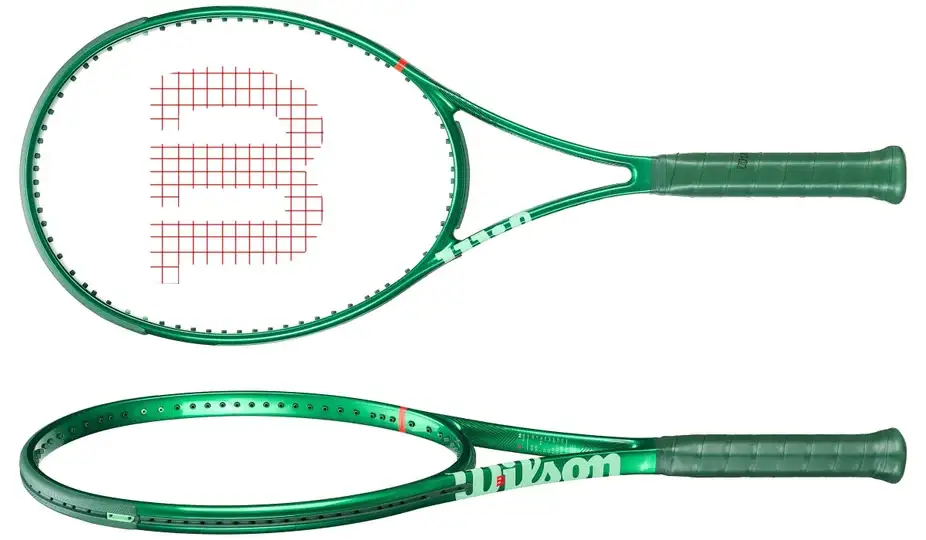
The Wilson Blade V10 continues one of the most recognizable control racquet lines on the market, and as expected, this is not a revolution – but a careful refinement. Based on multiple playtests across different models, the V10 update brings subtle but meaningful improvements, especially in stability and feel.
First impressions and general feel
Right away, the Blade V10 feels familiar. If you’ve used the V8 or V9 racquet, you’ll recognize the DNA instantly. The mold feels similar in hand, but there are tweaks – most notably a slightly thicker beam and a firmer response. The result is a racquet that feels a bit more solid and stable through contact.
Several testers noted that previous Blades often benefited from customization to improve stability. With the V10, that need is reduced. You can pick it up stock and get a more stable, less “wobbly” response, particularly on off-center hits.
The feel has also been adjusted. It’s still on the muted side compared to classic frames, but less dampened than before. There is a cleaner, more direct sensation at impact, without crossing into harsh territory.
In typical Tennisnerd fashion: it’s a tweak, not a transformation. Think 5–10% better overall.
The V10 model is now available from the Wilson website here, or at certain retailers such as Tennis Warehouse (USA, Canada) and Tennis Warehouse Europe (for a 10% discount use promo code TNERD10).
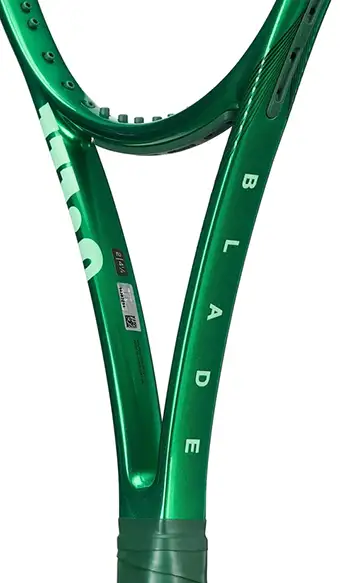
Blade 98 (16×19 vs 18×20)
The Blade 98 remains the centerpiece of the lineup, and the differences between string patterns are quite clear.
The 16×19 version stands out as the most versatile option. It offers easier access to spin, slightly more launch, and a more forgiving response overall. Most testers gravitated toward this version, finding it easier to use in match conditions, especially when under pressure or dealing with wind.
The 18×20, on the other hand, is very much a niche tool. It delivers excellent directional control and a very connected feel, but demands precise footwork and timing. The denser pattern combined with a relatively high swing weight makes it less forgiving and harder to accelerate. For advanced players who like to flatten out the ball and play with small margins, it still has its place, but its audience is shrinking.
Across both models, there is a slight bump in power and stability compared to the V9. The sweet spot still isn’t huge, and this remains a demanding control frame aimed at high-level players.
Blade 100
The Blade 100 is the more accessible option in the range. It offers a larger, more forgiving sweet spot and noticeably more power, while still retaining some of the Blade’s signature feel.
It’s not as sharp or precise as the 98, but that’s not the point. This is a frame for players who want a blend of control and easier depth. It suits intermediate to advanced club players (around 4.0–4.5 level) particularly well, especially those with medium swing speeds.
One thing to note is the slightly rounder head shape, which divided opinion. Some players enjoyed the forgiveness it brings, while others preferred the more traditional feel of the 98.
In terms of playability, the Blade 100 gives you more free power on serves and better performance outside the sweet spot, but sacrifices some maneuverability and pinpoint control.

Blade Pro 100 (early impressions)
The Blade Pro 100, based on the classic Steam mold, is shaping up to be a sleeper hit. Early feedback suggests it is the easiest and most effective racquet in the lineup, combining power, stability, and a more forgiving response.
Compared to the 98 models, it is significantly less demanding and more user-friendly. Players who found the Blade 98 too challenging may find this version much more accessible without losing too much control.
This is one to watch once it becomes widely available.
Video Review of the Blade v10
Playability notes
Across the lineup, a few consistent themes emerged:
The stability is improved. The slightly thicker beam helps, especially in the upper hoop, making the racquet feel more solid on contact.
There is a small increase in power (around 5%) but this is still firmly a control-oriented line. You won’t suddenly get Pure Drive levels of depth.
The dwell time remains a key strength. The ball sits on the strings long enough to allow for excellent directional control and redirection of pace.
However, the Blade still requires proper technique. Especially in the 98 versions, you need to generate your own pace and arrive well-positioned. This is not a racquet that will bail you out.
Downsides
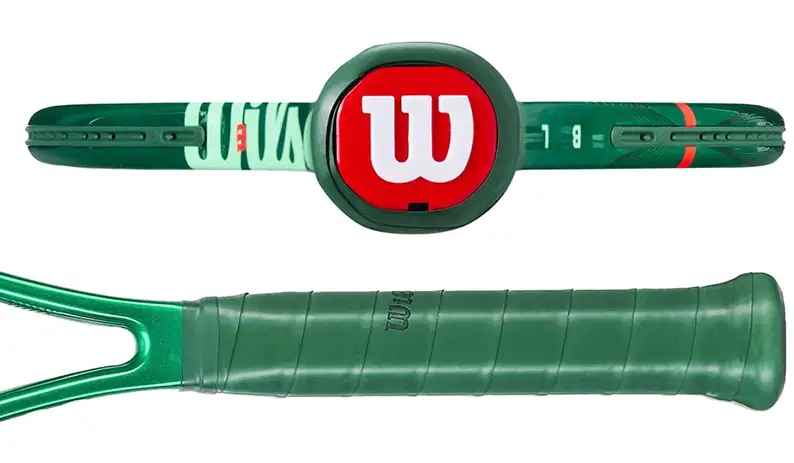
One recurring complaint is the short handle. For players using a two-handed backhand, the grip length can feel restrictive, forcing some to creep up onto the throat. This has been an issue with previous Blades and remains unchanged.
The 98 models are also still quite demanding. Unless you are a high-level player, you may find the Blade 100 or Pro 100 to be more effective in real match play.
Verdict
The Wilson Blade V10 is a classic incremental update done right.
It doesn’t reinvent the Blade formula, but improves stability, slightly increases power, and refines the feel. If you are coming from the V9, the transition will be seamless. If you already love your current Blade, there’s no urgent need to switch – but you’ll likely appreciate the upgrade.
The Blade 98 16×19 remains the standout for most players, offering the best balance of control, spin and usability. The 18×20 is still a precision tool for advanced hitters, while the Blade 100 and Pro 100 broaden the appeal to a wider audience.
In short: a safe, solid evolution of a very popular control racquet.










What swingweights (strung or unstrung) did you find on your 98 16×19? Has wilson improved QC as they say? Thanks!
Mine was pretty spot on at approx 295 unstrung
Hi Jonas,
What steings and tension do you recommend for V10 100? I currently have 4g 1.25 @ 22,5kg in my V10 100 and feel a lack of control and spin.
4G is not very spin-oriented, try a shaped string like Toroline O-Toro Tour, Solinco Hyper-G, Tru Pro Pure Rush or Restring Vivo.
I’m using V7 16×19 for the last four years. I’m looking foward to get a new set of racquets. Is this V10 to much different from V7? Now I’m 42 and perhaps need more power. V10 100 pro can give that power without losing the 98 feeling?
Would you recommend stringing the new blade v10 a bit looser? Tried the blade 98 16*19 v10 yesterday with rpm blast at 52 lbs and it felt boardy, but love the same string setup in the aero 98 2023.
The one that stands out is actually omitted above: its Blade 98S. I tested all of them and this one had an all: improved stability a bit more power and spin. I use 18×20 as my regular piece.
How would you compare the Blade 100 and/or Blade Pro 100 to the TFight 300?
The Blade 100 is more flexible and comfortable, but not as direct and raw as the Tfight 300. I have not tried the Blade Pro 100 yet, so I cannot give my opinion.
Zur Ihrer Information
Wilson Blade 98 v10 (16×19)
Erstes Schlägerpaar:
Stiffness: 66 RA unbesaitet
Die weicheste Rahmen des Wilson Blade 98 v10 lagen bei 63/ 63 RA
Patrik Kühnen Schläger hatten eine Rahmenhärte von 64/65 RA (wo ich die meisten Rahmenhärten liegen)
Ihr Angabe mit 61 RA ist definitiv zu weich gemessen.
Mit einer Messschraube wurde die Rahmenhöhe beim Wilson Blade 98 v10 bei 22,05±0,02 mm gemessen. Hier ist ihre Messung ungenau.
Rückfrage +49 15253989669
The measurements are from TWE. Not sure what you mean by talking about Patrik Kuhnens racquets.
Jonas, do you prefer the Blade 100 Pro, or the new P100?
P100 plays better to me, I am not a huge fan of the Blade 100 Pro after some in-depth testing
One think as a long time blade user you missed on here is you’re stating stability has increased I would disagree massively the change in flex in the throat actually decreases the stability on this model it loses that direct placement feel due to this change there is more access to spin and that flex does help on serving and stable ground shots (when you’re in the right position). But if you’re coming from v8/v9 the playability is more demanding sweet spot is smaller and the flex/forgiveness in rallies means it has less control than previous versions unfortunately.
Hi Jonas,
Great review. Thinking of switching from my RF01 as its sweetspot is just a bit too small and the racquet feels at times unpredictable. Does the new blade offer any incremental benefits over that racquet?
Yes, the sweet spot is larger for sure.
Hey Jonas,
How would you compare the manoeuvrability and sweetspot between the blade 98v10 16×19 and RF01?
Thanks!
Hi, I think the RF01 is a bit faster, but it is less forgiving in terms of sweet spot
Hello from Brazil,
I currently play with a Wilson Blade 98 Countervail (v6, 305g, 16×19). I absolutely love the muted, deadened feel that this frame gives me. Recently, I tried switching to a Yonex VCORE 98 (305g, 16×19), but it didn’t work out as expected. The VCORE requires so much topspin and heavy wrist action just to keep the ball inside the court, and my wrist has really been suffering from the extra torque and demand.
I am considering moving to a newer Blade model, but I am worried: will it feel completely foreign compared to my v6? Will I ever find another racquet that replicates that unique feel of my old stick?
Thank you,