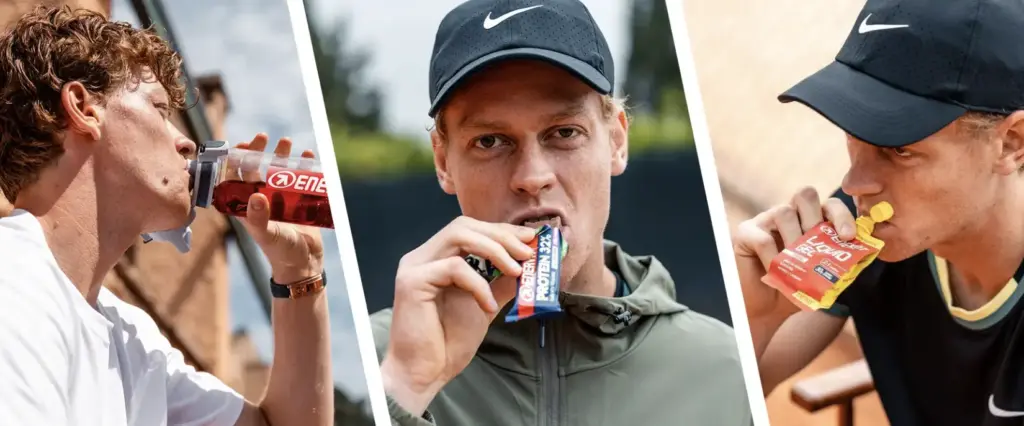
Watch enough professional tennis and the changeovers can begin to look like a mobile nutrition laboratory. Players drink from several carefully labelled bottles. They squeeze gels into their mouths, eat pieces of bars or bananas and occasionally request something from their team that immediately becomes a social media talking point.
Jannik Sinner has an official nutrition partnership with Enervit. Pickle juice regularly appears in discussions about players dealing with cramps. Novak Djokovic once went viral for shouting “creatina” towards his box during a match against Carlos Alcaraz. It is therefore easy to assume that recreational players need a collection of specialised products to get through a competitive match.
Most of us probably do not.
Professional players compete for several hours, train almost every day and work with teams that can calculate their fluid, carbohydrate and sodium intake. Their bottles may be mixed for their individual sweat rate, stomach tolerance and the conditions on that particular day. A club player competing for 90 minutes on a mild Saturday morning has very different requirements. That does not mean we cannot learn anything from the professionals. We simply need to separate useful principles from sponsorships, individual routines and products designed for very specific situations.
Pickle juice and muscle cramps
Pickle juice has become one of the more unusual-looking products found around professional sport. The basic idea seems logical. Players sweat, lose fluid and sodium, begin to cramp and then drink a salty liquid to replace what they have lost. However, the proposed effect of pickle juice is more complicated than that.
Small studies have found that pickle juice can shorten an experimentally induced muscle cramp. But the effect occurred too quickly to be explained by the fluid or sodium entering the bloodstream and reaching the affected muscle. One theory is that the strong, acidic taste activates receptors in the mouth and throat. This may trigger a neural reflex that reduces excessive activity causing the muscle to cramp. In other words, pickle juice may sometimes help interrupt a cramp, but probably not because it rapidly rehydrates the player. It also does not mean that every cramp is caused by an electrolyte deficiency. Exercise-associated cramps can involve several factors, including muscular fatigue, conditioning, previous cramping and the intensity of the activity.
Does a recreational player need pickle juice? Probably not as a standard part of every tennis bag. If you know that you are prone to cramps and have already tested pickle juice successfully in training, carrying a small shot may be reasonable. It is inexpensive and does not require a branded sports product. However, it should not replace a sensible hydration and match-conditioning strategy.
For most club players, the more useful lessons are:
- Begin the match reasonably hydrated
- Prepare for the expected duration and temperature
- Use a drink containing sodium during long, hot or particularly sweaty matches
- Build enough tennis-specific fitness for the intensity you intend to play
- Do not introduce an unfamiliar concentrated drink for the first time during a tournament
Players with high blood pressure, kidney problems or a medically prescribed sodium restriction should be particularly cautious with very salty products. Pickle juice can be an emergency option for some players. It is not a complete hydration plan.
Djokovic and the famous “creatina” request
During the 2023 Cincinnati final against Carlos Alcaraz, Novak Djokovic was filmed shouting “creatina” towards his team. The moment naturally produced plenty of speculation. It also created the impression that creatine might be something a player takes during a difficult match for an immediate physical boost. That is not how creatine normally works.
Creatine helps increase the availability of phosphocreatine in the muscles. This supports the rapid production of energy during short, high-intensity efforts such as sprinting, jumping and strength training. Tennis contains plenty of these explosive actions, so creatine can be relevant to a tennis player’s general training programme. It is also one of the most extensively researched sports supplements, with evidence supporting its use for improving strength, power and training capacity. But these benefits come from increasing and maintaining the creatine stores in the muscles over time. Taking creatine at 4–4 in the third set will not suddenly make the next forehand more powerful.
Does creatine make sense for recreational tennis players? It can, particularly for players who also perform regular strength and conditioning work. A standard approach is to take a small daily dose of creatine monohydrate consistently. Exact dosing and individual suitability can be discussed with a sports dietitian or medical professional, especially where existing health conditions are involved.
The most important points are:
- Creatine is a daily training supplement, not an emergency match supplement
- Plain creatine monohydrate is the form with the largest research base
- Timing is much less important than consistent use
- It should not replace adequate food, sleep or strength training
- Some people experience a small increase in body mass, largely related to water stored in the muscles
For a healthy adult who lifts weights and plays tennis several times per week, creatine may be more useful than many expensive products marketed specifically towards racquet-sport players. But there is little practical reason to put it in your on-court bottle.
Jannik Sinner, Enervit and carbohydrate products
Jannik Sinner’s partnership with Enervit is a good example of how professional nutrition and commercial sponsorship overlap. Enervit produces sports drinks, gels, bars and other products designed to provide carbohydrates and electrolytes around training and competition. These products can fulfil a genuine purpose. They are also products promoted by a sponsored athlete. Both things can be true at the same time.
Carbohydrates are an important fuel source during prolonged and intensive exercise. In a long tennis match, especially after several previous matches or training sessions, consuming carbohydrates can help maintain energy availability. Sports gels, chews and drinks are popular because they provide carbohydrates in a compact, measurable and relatively easy-to-digest form. What they do not contain is a special type of professional-level energy that cannot be obtained elsewhere. A banana, white-bread sandwich, simple cereal bar, dried fruit or diluted fruit juice can also provide carbohydrates.
When do sports products become useful? Convenience is their main advantage. A gel is easy to carry, quick to consume during a changeover and does not require chewing very much. A carbohydrate drink combines fluid and energy. A packaged bar has a predictable nutritional content and is unlikely to be damaged by sitting in a tennis bag.
These advantages become more relevant during:
- Matches lasting longer than approximately 90 minutes
- Tournament days involving several matches
- Hot conditions with substantial sweating
- Matches played several hours after the previous proper meal
- Situations where solid food is difficult to tolerate
For a short club match after a normal meal, water may be all that is required. There is no need to consume two gels, a sports drink and an energy bar simply because they are available. Unnecessary carbohydrate products add calories and can also cause stomach discomfort, particularly when combined in large amounts.

Food versus sports nutrition products
The choice does not need to be ideological. Natural food is not automatically better during a match, and a sports gel is not automatically superior because a professional player uses it. The best option is the one that supplies an appropriate amount of carbohydrate, sits comfortably in your stomach and is practical to consume.
Some useful low-cost choices include:
- A ripe banana
- A plain cereal or oat bar with relatively little fat and fibre
- A small jam or honey sandwich
- A few dates or pieces of dried fruit
- Diluted fruit juice with a small amount of salt
- A standard carbohydrate-electrolyte sports drink
High-fat, high-fibre or protein-heavy foods usually digest more slowly and may be less comfortable during an intense match. Whatever you choose should be tested during practice before it appears in your tournament bag.
Final thoughts
Professional tennis can teach us useful lessons about fuelling, but copying the exact product is rarely the important part. The principles behind the products are much simpler:
- Drink according to the conditions and your individual sweat losses
- Add sodium when matches are long, hot and sweaty
- Consume carbohydrates when the duration and intensity justify them
- Use creatine consistently as part of training, not as a mid-match rescue
- Treat pickle juice as a possible cramp-relief tool, not a replacement for hydration or conditioning
- Test everything in practice before using it in competition
Sinner’s sports nutrition products, Djokovic’s creatine and the pickle juice appearing in professional tennis bags all have an explanation. But for most recreational players, water, an electrolyte drink when required and a familiar carbohydrate snack will cover almost everything they genuinely need.
The professionals may have more bottles.
That does not necessarily mean we need more ingredients.
Check out some new nutrition products and ideas at Tennis Warehouse Europe (code TNERD10 for 10% off) or at Tennis Warehouse (USA, Canada).