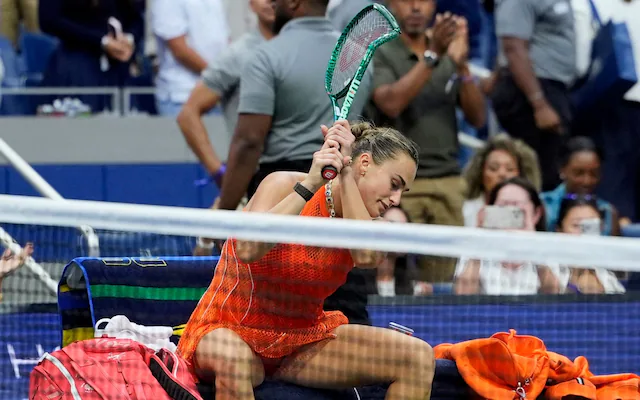
Professional tennis has always had its share of emotional outbursts.. Racquets are smashed, balls are struck into the stands and players occasionally lose their temper with officials or broadcasters. We’ve seen quite a few cases recently and many fans are tired of seeing top ranked players behave like this.
But as prize money continues to rise, we need to ask: do tennis fines actually deter bad behaviour, or have they simply become another cost of competing at the highest level?
Sabalenka’s US Open Fallout
The debate came into focus again at the 2026 US Open after Aryna Sabalenka’s defeat to Elena Rybakina in the women’s singles final.
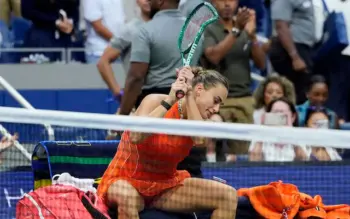
Sabalenka received a warning for ball abuse during the match and later smashed her racquet after the final. She was subsequently fined $7,500 for racquet or equipment abuse.
The amount sounds significant, but… Sabalenka’s runner-up prize was $2.7 million, meaning the fine represented approximately 0.28% of her tournament earnings.
Sabalenka needs a lesson in class. The millions of girls who admire her derseve better than this response to a loss.
— Jon Kalis (@jonkalis) September 13, 2026
Tennis is a sport of elegance and grace. Celebrate Rybakinas first major win. Or at least endure it. This is an embarrassment.
Just wait to break all your… pic.twitter.com/2t0duNjKvd
That raises an obvious question: can a $7,500 penalty have much of a deterrent effect on a player earning millions from prize money and endorsements?
At Wimbledon in 2026, several players were fined £5,600, including Novak Djokovic, Corentin Moutet and Thanasi Kokkinakis. Djokovic’s fine was for audible obscenity, while Moutet and Kokkinakis were among those sanctioned for other code violations.
Wimbledon ultimately recorded fines against 17 players, including Hamad Medjedovic, Pierre-Hugues Herbert and 17-year-old Mia Pohankova.
But £5,600 represents very little to a Wimbledon champion earning £3.6 million. For a player losing in the first round, where the prize money was £80,000, it represents 7% of the prize. For a player losing in qualifying, with first-round qualifying prize money of £20,000, the same fine represents 28%.
The US Open Numbers
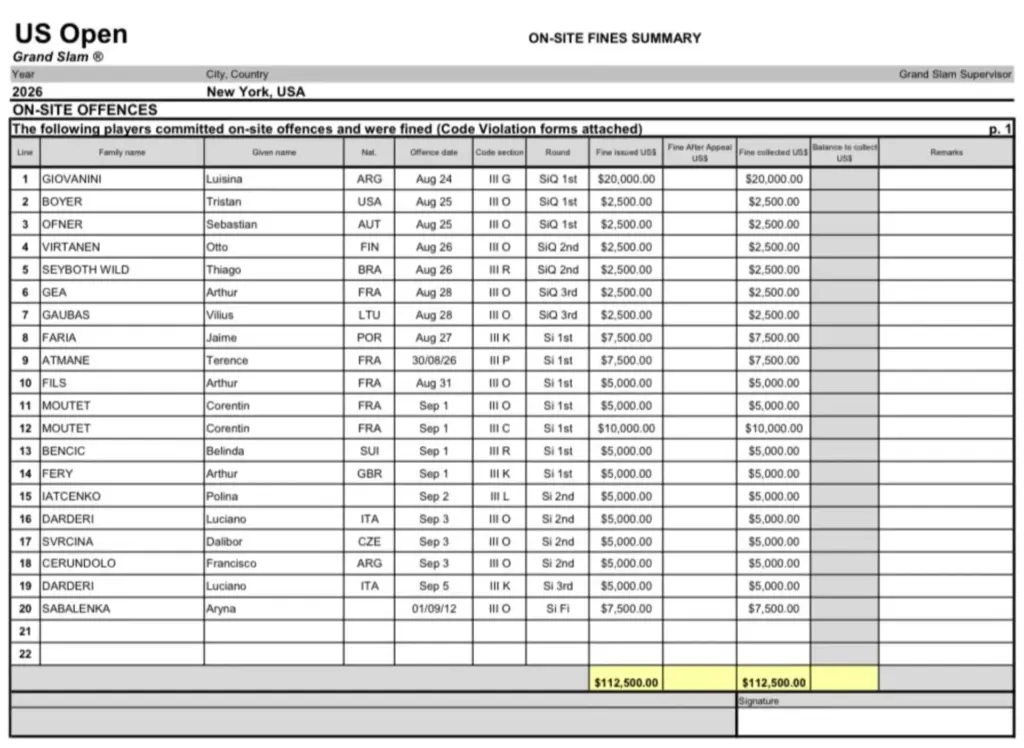
The 2026 US Open provides an even broader picture. The tournament recorded $112,500 in fines across 20 violations.
Sabalenka’s $7,500 was not the largest individual penalty. Luisina Giovannini was fined $20,000 under the First Round Performance rule, after retiring just 17 minutes into her qualifying match while trailing 0–5.
Corentin Moutet accumulated $15,000 in fines at the tournament, while Luciano Darderi was fined $10,000. Several other players received penalties of $7,500.
The figures show that tennis already has mechanisms capable of imposing penalties far beyond the commonly cited $7,500 amount.
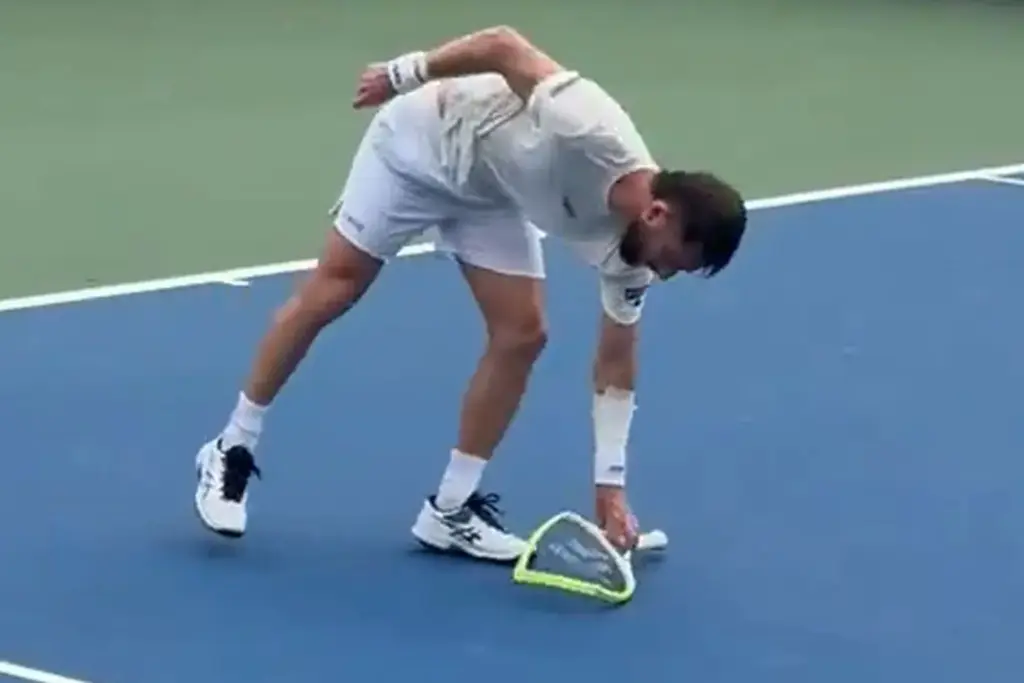
Nowadays, the Grand Slam rules allow a max fine of $50,000 for racket smashing but it’s usually much less. Looking at only these kind of incidents during the recent US Open, Sabalenka’s fines is actually the highest given.
It’s Not Just About Fines
The Grand Slam disciplinary system is broader than financial penalties.
Players can receive warnings, point penalties and game penalties for code violations, with more serious or repeated misconduct potentially leading to a default. The rules also provide for substantially larger fines in certain circumstances.
The “First Round Performance” rule is a particularly interesting example. Players are expected to perform to a professional standard, and a violation can result in a fine of up to the player’s first-round prize money.
Other serious offences can carry penalties of tens of thousands of dollars, and in certain circumstances considerably more.
So the idea that Grand Slam tournaments simply impose a small standard fine for bad behaviour doesn’t accurately describe the system.
The more relevant question is whether the punishment is proportionate to the offence and meaningful to the individual player.
I was just talking about it yesterday…
— SK (@Djoko_UTD) January 27, 2026
Today Coco Gauff destroyed her racket in an empty dressing room after losing the QFs in 59 minutes ?
Not just physically but Mentally Tennis is the toughest sport ever. Feel for Coco ?pic.twitter.com/jKOKMD4VUg https://t.co/nsSOiw2jD4
Above we can see Coco Gauff completely destroying her racquet following her loss at the 2026 Australian Open. At least she went off the court…
The Case for Stricter Penalties
There is a reasonable argument that some fines should become more significant, particularly for repeat offenders.
If a player repeatedly smashes racquets or commits similar violations, a series of relatively small fines may do little to change their behaviour. Escalating penalties could potentially make repeat offences more consequential.
Percentage-based fines are another possibility. A penalty linked to prize money could ensure that the financial impact is more consistent between players at very different levels of the sport.
Even if they would put a fine as low as 5% of the prize money, Sabalenka would have to pay around $140K instead of $7,500. That would not be disastrous to her career at all, but at least it would be felt.
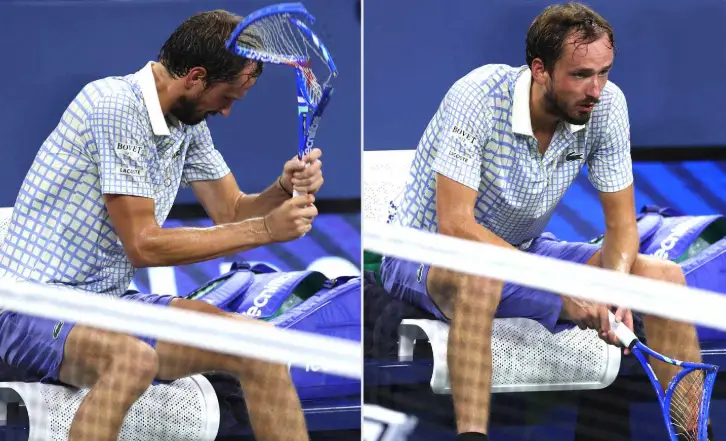
A different example:
Image above shows Daniil Medvedev at the 2025 US Open where he was fined a total of $42,500 by the US Open following a complete meltdown in his first-round exit. The fine was $30,000 for unsportsmanlike conduct and $12,500 for racket abuse. This was then 40% of the $110K he won, much different (and more proportional?) just due to where in the draw he lost.
We need to keep emotion in the sport?
There is also an argument for accepting a certain amount of emotion.
Tennis is an individual sport in which players spend hours competing alone, often under enormous pressure. Anger and frustration are inevitable. A racquet breaking after a difficult defeat is very different from threatening an official, deliberately intimidating an opponent or repeatedly disrupting a match.
The challenge for governing bodies is therefore not necessarily to eliminate emotional reactions, but to distinguish between passion and behaviour that crosses a professional boundary.
Fans may tolerate (or even enjoy) some displays of emotion, while still expecting players to respect officials, opponents and spectators.
This was Sabalenka’s comment after her US Open loss: “It’s really tough to control your emotions when you lose in a final of a Grand Slam and when you were trying to go for 3-peat. If I were to hold it inside, right now or on the court I wouldn’t be able to say a word. I would go not really nice over there. I wanted to let go of all that aggression and disappointment outside.”
Where does the money go?
Another detail often overlooked in discussions about fines is what happens to the money.
Under the Grand Slam rules, final fines are remitted to the Grand Slam Player Development Programme, rather than simply becoming tournament profit.
So the fines are still a punishment for the player, but the money ultimately goes back into tennis development.
There’s plenty of classic racquet smashing throughout the years of course, here’s one we all remember. Marcos Baghdatis in the 2010 Australian Open destroying four racquets after his four-set loss to Wawrinka.
Are tennis fines too low? It’s not a simple question.
For top earners, a racquet-abuse fine of a few thousand is pocket change; for a lower-ranked qualifier, it’s at least a financial blow. Yet recent Grand Slam events prove authorities can impose severe penalties when necessary.
The real debate isn’t about flat-rate increases, but striking the right balance between deterrence, proportionality, and player expression. Ultimately, tennis authorities face a tough challenge: deciding where to draw the line, and when a fine should become a more serious sporting penalty.
As always, fans are divided on the topic, and there’s plenty who just says “who cares” if someone smashes their equipment after a loss. I kind of get this, it’s not always a big deal but I can also think it’s rather pathetic from the players in some cirumstances.
Below we can see Andy Roddick coming to Sabalenka’s defence:
Leave your opinions below. Do you care about this at all? Should this behaviour be less tolerated in the community? Should tennis use larger or percentage-based fines, or is the current system getting the balance right between discipline and emotion?