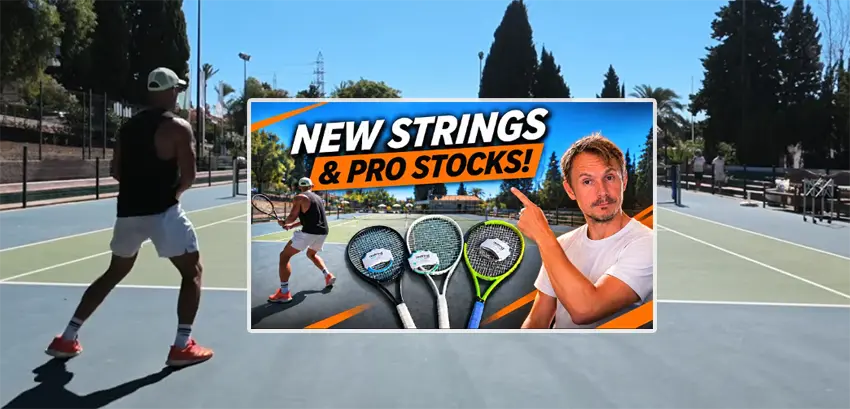
I’ve been on a bit of a string journey lately, testing new releases, some ready-made hybrids from ReString and a few combos I came up with on the fly. In this post I’ll go through what worked, what didn’t, and what to think about when you hybrid two polyesters or bring natural gut into the mix.
Hybrids are everywhere on tour right now. Ben Shelton, Lorenzo Musetti and Casper Ruud all run them, and more and more players are experimenting. There’s also a wave of new strings coming: the red Luxilon string due early next year, the softer polys I’ve been testing, and plenty from smaller brands.
Why does this matter so much? Tennis keeps getting more physical. Lighter and stiffer rackets, heavier balls, bigger hitting and longer rallies all add load to the arm, and we’re seeing more arm issues at club level and on tour. The pros have physios and treatment on site. Most of us don’t. So it’s very smart to think carefully about your string and your tension.
Vamos, and why I hybrid it
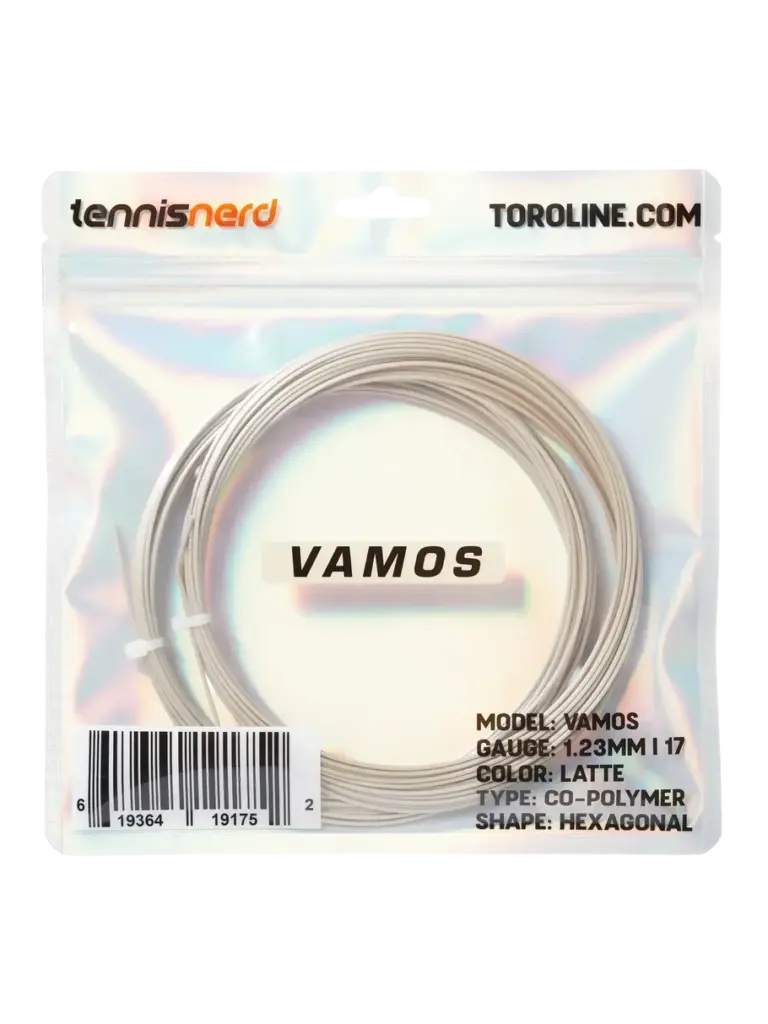
First, a quick word on my own string. Vamos is my collab with Toroline, and I’m pretty proud of it. It’s a six-sided string that sits in the middle between firm and soft, built for extreme bite. You get a lot of grab on the ball without the string feeling super stiff.
That said, a heavily shaped string isn’t for everyone. If you prefer the feel of a round string, or want to take the edge off that crisp shaped-string sensation at impact, hybrid it. I’ve done this in a bunch of rackets.
My go-to: Vamos in the mains, Toroline Snap TF in the crosses. I have tried that in a bunch of racquet and tend to always enjoy it.
Why the pros put the shaped string in the mains
Ruud, Shelton and Musetti all follow the same logic: shaped string in the mains, smooth round string in the crosses. The main string gives the setup its flavour, so that’s where the bite goes.
The slick cross helps the mains move. On most groundstrokes you’re brushing up the back of the ball, so the mains slide along the crosses and snap back. A smooth cross makes that easier, which means more spin potential. Put two shaped strings together and you often get too much friction, because the edges grip each other.
Same reasoning explains why many players run the crosses a little lower than the mains (the crosses are also shorter strings). Carlos Alcaraz strings RPM Team at 55 lbs mains and 51 lbs crosses in his Aero 98. Four pounds, or about two kilos, is about as big a gap as you’ll see. It creates more string movement and snapback, which suits his explosive game.
It won’t suit everyone. Jannik Sinner uses one string at around 28 kg (61–62 lbs) all the way through, because that’s what he likes. Different strokes for different folks.
Some players also mix gauges, for example 1.30 in the mains for durability and 1.25 in the crosses.
The ReString hybrids
ReString now sells ready-made hybrids, all with their round Sync string in the crosses. You pick the main:
| Hybrid | Main string character | My take |
|---|---|---|
| Zero + Sync | Six-sided, pretty lively (their first string) | My favourite. Softer feel, excellent snapback, a good blend |
| Vivo + Sync | The stiffer option | Usually my favourite ReString string. Firm but never harsh |
| Slap + Sync | Lively, a bit less than Zero | Tested in an Extreme Pro. Liked it least |
I tested all three in different rackets and ended up liking Restring Zero + Sync the most. Slap just isn’t a string I’m as big a fan of as Zero and Vivo, which I think are the best in their line-up.
It’s great to see smaller companies like ReString and Toroline doing really well in the market.
Don’t forget natural gut
Gut/poly is the classic hybrid: Novak, Roger and Andy Murray all used it, and plenty of players still do, Tommy Paul included. Where the gut goes depends on what you need.
- Gut in the mains (Novak): more power and feel from a small-headed, control-oriented frame.
- Gut in the crosses (Tommy Paul): keeps the control of a poly main while adding comfort.
Again, the main string is key. Natural gut feels great and adds comfort if you have arm issues, though it’s not the most spin-friendly string on its own. Paired with a shaped poly, it can create a really nice sensation.
Two caveats. It’s expensive, so it’s a premium experience. And it’s trickier to string, so if you don’t fully trust your stringer, it might be a so-so idea. Multifilaments shouldn’t be dismissed either, even if they don’t quite match gut.
Match the string to the pattern
Why did Zero + Sync end up in my prototype racket? It’s a 98 with an 18×19 pattern, so pretty dense. A denser pattern already gives a firmer response, so I don’t want a very stiff string in there. A more flexible string bed balances it out.
With a very open pattern, the logic flips. Lots of string movement and open spaces can cost you control, so a slightly stiffer string often makes sense.
In a dense pattern, a softer poly works, and natural gut would too. For a poly/poly hybrid, Zero + Sync was the one I liked most.
Other hybrids that worked
A few more setups from my bag:
| Racket | Mains | Crosses | Verdict |
|---|---|---|---|
| Python 98 | Toroline A5 Spin (five-sided) | Toroline A5 (round) | Really nice. Same-brand hybrid that plays great in this frame |
| Aero | A5 Spin (red) | A5 | Works really well, and looks cool too |
| Babolat PPO1 | Vamos | RPM Blast | The surprise of the bunch |
| Extreme Pro | ReString Slap | ReString Sync | Didn’t like it as much |
The PP01 combo deserves a word. I put RPM Blast in the crosses to honour Babolat, since it’s their racket. RPM is a bit firmer, Vamos isn’t too stiff, and I strung it low. It’s really low by now and still gives me control, and the setup has held up crazy well.
Sometimes a not-so-logical setup just works. You see it in my pro string tension videos too: some players run really strange setups, and if it works for them, it works. It can come down to the racket specs, the frame or just preference. Stay open-minded.
The frustrating part? Finding the right string sometimes means sacrificing a string job. I string for myself and don’t have a lot of time, so I want to string things I’ll actually like. But experimenting is part of the game.

New strings on my radar
Toroline O-Toro Max (prototype). Toroline sometimes gets slack for only making medium-soft strings. This one answers that. It’s really stiff, with excellent control. Not harsh, but high on the stiffness scale, so think about tension unless you love boardy setups. I tested it in Holger Rune’s racket, which plays a lot like the Aero 98 he used before; the layup feels stiffened up and you notice it after two shots. I liked how it played, but my wrist probably wouldn’t long term in that frame. In a more flexible P98-style layup it would make more sense. If you want to check it out, use the code TENNISNERD for 10% off.
Babolat’s new Feel string (coming in a few months). Tried it in the PP01 racquet and really liked it. It’s smooth and soft rather than shaped, so it doesn’t grab the ball as much. That kind of string was missing a bit from the Babolat catalogue, and if you like soft, smooth strings, you’ll enjoy it.
The new Luxilon. Enjoyed my first hits and will play it more this week when Henrik comes over.
Soft labels, firm strings
Some strings marketed as soft aren’t that soft. Razor Spin is a pretty good string, but despite the PU coating talk it’s quite firm. Solinco Confidential Soft is another string I really like, also on the firmer side.
So don’t trust the label alone. Read reviews (like ours on tennisnerd.net) and check stiffness ratings from Tennis Warehouse University or Racketpedia (account needed, around 50 euros a year).
If you do want a genuinely soft poly, a few I rate:
- Solinco Hyper-G Soft: a favourite, but loses tension quickly. I prefer Tour Bite for tension maintenance.
- Luxilon Alu Power Soft: often overlooked, very soft, not super durable.
- Völkl Cyclone Tour: another soft option.
- Toroline O-Toro: very popular for good reason.
Remember that soft polys generally lose tension faster, and multifilaments are softer still.
How to choose your setup
Think of it like cooking: you’re balancing ingredients. Ask yourself four things:
- Your racket. Stiff frame? Lean towards a softer string. Flexible frame? A slightly firmer string at lower tension keeps it from feeling mushy and muted.
- Your game. Do you want plush or crisp? Control? Lots of bite and dwell time from a shaped string?
- Your injury profile. If your arm is already complaining, go softer, even if it isn’t the string that gives your best tennis. That’s the frustrating part.
- The string itself. Check stiffness data, not just the marketing.
You need patience, some knowledge and a willingness to experiment. Hopefully you get it right sooner rather than later.
What strings are you using? Found a hybrid or tension combo that really works? Let me know in the comments. I’ll keep testing and keep you posted.
Looking to buy any of these strings? Head over to our partners here: Toroline, Restring, Tennis Warehouse and Tennis Warehouse Europe.