
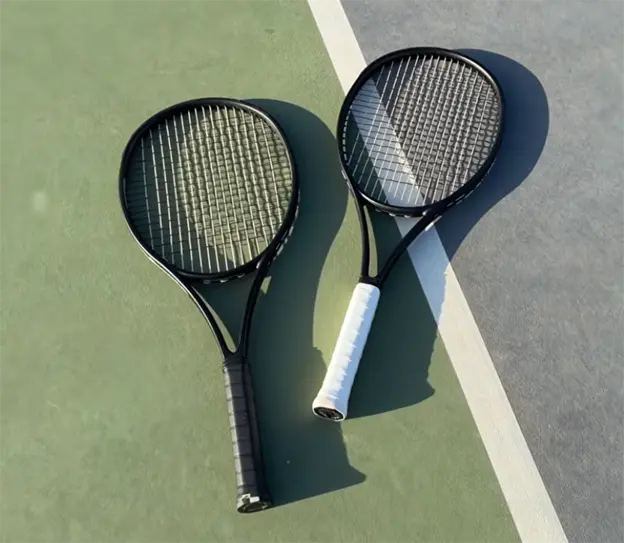
The new Dunlop CX rackets are coming in 2027, and I’ve already spent quite a bit of time with two blacked-out test frames. I’ve had them for a few weeks now, and while I don’t have all the final specifications yet, I’ve played enough to form some pretty strong first impressions. I’ve also measured the frames on my MetaTune device, so I have a decent idea of what’s going on in terms of swing weight and general specs. What I don’t know yet is exactly what Dunlop has changed in the layup, beam construction and mold, so there’s still a bit of guesswork involved. In the end, though, the most important question is how they play, and so far I’m impressed.
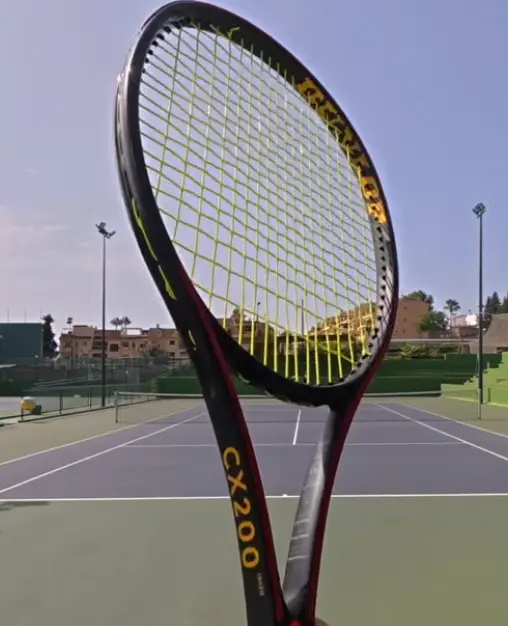
The two racquets I received are the Dunlop CX 200 and the CX 400 Tour. Watch our video review at the end of the article.
The CX 200: a healthier stock spec
The CX 200 is the more control-oriented frame, and it’s the racquet I’ve spent the most time with. Compared to the previous generation, the big improvement for me is that it arrives with a much healthier swing weight. The previous CX 200 could be very light in stock form and often needed quite a lot of customization. This one came in around the low 320s, already much closer to where I want a modern control racquet to be. I still added a little weight at 3 and 9 o’clock, mainly for some extra stability, but we’re talking about a small adjustment rather than rebuilding the racquet, and that makes a big difference.
The new CX 200 feels more stable, more powerful and generally more complete than the outgoing model. You still get the control you expect from the CX line, but there’s more help when you’re stretched or defending, and a little more free depth when you don’t strike the ball perfectly. That’s probably the biggest theme with the new CX generation: Dunlop seems to be moving the line slightly towards modern control. It’s still precise enough that you can swing confidently under pressure, but with more power and spin built into the frame.
The CX 400 Tour: same direction, easier to use
The CX 400 Tour continues in the same direction, although it’s obviously the easier racquet to use. It has a 100 sq inch head, a 16×19 string pattern, a thicker beam and a stiffer layup. That gives you easier depth and more spin than the CX 200, while still sitting firmly in the control category. I’d put it in a similar space to rackets like the HEAD Speed MP or Prince Tour 100, frames that give you some power but still let you play with fairly aggressive targets.
It’s also worth remembering that Dunlop has some interesting players representing the CX line. Jenson Brooksby is one of the most recognisable names, Henry Patten is also using the line, and Daniel Mérida has been climbing the rankings with a CX 200. The message behind the new generation seems quite clear: controlled power, more stability and a little more forgiveness. That’s exactly how the racquets feel on court.
Stability, stiffness and comfort
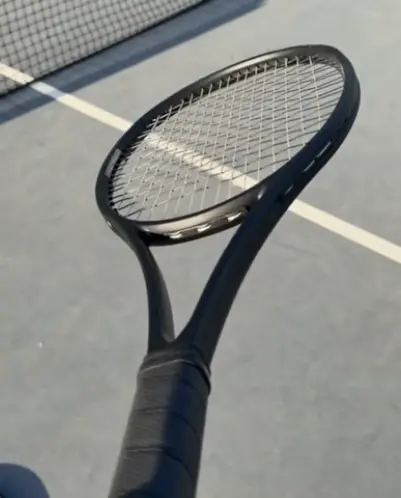
With the CX 200, I get noticeably more stability than I did from the previous version. The racquet doesn’t get pushed around as easily, and there’s more weight behind the ball without the frame becoming sluggish. Dunlop appears to have increased the stiffness slightly as well. From the information I’ve seen on the test frames, the unstrung stiffness seems to be somewhere in the high 60s, and naturally that number drops once the racket is strung. Despite the increase, I haven’t found the racket uncomfortable.
That’s an important point, because a higher RA number on a spec sheet doesn’t always tell you how a racquet actually feels. The new CX 200 still feels well dampened without being overly muted. There’s enough connection to the ball that touch shots and drop shots come naturally, and I never feel disconnected from the string bed.
I’ve tried a few different string setups during the test, including Toroline Vamos with Snap TF in the crosses, and I’ve also experimented with RPM Blast in the crosses. So far the racquet has been easy to dial in, and I haven’t had any comfort issues with these setups.
The CX 200 has actually been one of the more enjoyable racquet tests I’ve done in a while. That surprised me a little, because I liked the previous version, but this one feels more usable without losing the identity of the line.

Specs and comparisons
The basic recipe is still familiar: 305 grams unstrung, a 98 sq inch head and a 16×19 string pattern. The beam does look slightly thicker to me, though. The previous CX 200 was around 21.5 mm, and this one appears closer to 22 mm, perhaps somewhere between 21.7 and 22 mm. I can’t confirm that yet, but visually it looks a touch beefier, and if that’s correct it would help explain some of the added stability and power.
For me, the closest comparison is probably something like a Prince Tour 98. Compared to the Wilson Blade 98 16×19, the CX 200 gives me a little more power and feels more stable. I also find it slightly less muted than the current Blade, which makes it easier to feel what the ball is doing on contact. I played the two side by side, and at least for now, I prefer the Dunlop. It slices well, moves quickly through the air on serve and gives me enough spin without becoming unpredictable. It does most things well, which is exactly what I want from a modern control frame, and there’s no obvious weakness jumping out at me.
Why the 400 Tour is a little wild for me
The CX 400 Tour is also very good, but for my game it can become a little wild. That was my experience with the previous CX 400 Tour too. I liked that racquet enough to consider using it for a longer period, but eventually I struggled with the extra launch and power in matches and tournaments, and the new version still gives me that feeling. When everything is working, the 400 Tour is fantastic, with easier depth, easier spin and more help from the frame. But when I’m under pressure and trying to hit smaller targets, I trust the CX 200 more.
That doesn’t make the 400 Tour a bad racquet, far from it. For a lot of intermediate players, it may actually be the better choice. If you want control but don’t want to work quite as hard for depth, the CX 400 Tour makes a lot of sense. I may even add a little weight to mine, as it’s also around the low 320s in swing weight, and a few extra points could give it more stability without making it cumbersome.
The wider CX lineup
One thing Dunlop has done well with the CX line is offering several genuinely different control frames. Historically, they’ve kept the 95 sq inch models alive, in both 16×19 and 18×20, alongside the 98 and 100 sq inch frames. I’ve always liked that. Not many brands are still willing to produce a proper 95 these days, and it gives the CX line some character for players who enjoy traditional control racquets.
I don’t yet know exactly what Dunlop will do with the full 2027 lineup. There will be an 18×20 version of the CX, which might mean the 95 18×20 eventually disappears, but I don’t have confirmation of that. I’ve also played with another 18×20 CX frame that appears to use the same mold as the upcoming CX 200. It feels softer, denser and more control-focused, and while it needs a little more weight for my taste, it’s a nice racquet if you want maximum precision.
It’s possible Dunlop effectively soft-launched some of the upcoming geometry through that model, since brands occasionally do this with “Legend” or special-edition frames before the full line arrives. That’s speculation for now, though.
Tournament-tested
From a practical point of view, I still think the 16×19 CX 200 is the most interesting racquet in the range. The modern game rewards easy depth and spin. Balls can get heavy, conditions can be slow, and a racket that forces you to create absolutely everything yourself can become hard work over a long match. The new CX 200 gives you a little more help without taking away the confidence you want from a control frame, and that balance isn’t easy to get right.
I’ve actually used the racquet in ITF Masters events already, which probably says more than anything else. I play those tournaments occasionally, and I won’t take a racket into competitive matches unless I trust it. I’m happy to experiment with gear, but I’m not quite crazy enough to experiment with something I don’t like when ranking points are involved. The CX 200 passed that test.
So far, I struggle to find anything that has gone backwards. The stability is better, the power is better and the stock swing weight is better. There seems to be a little more spin, and the racquet still has enough touch and connection to work well at net. If you like control rackets but sometimes wish they had a little more crispness and pop, the new CX line should be worth a serious look.
Final thoughts
Dunlop is still a little overlooked in the racquet market, in my opinion, especially the CX range. I liked the latest FX quite a lot, although the FX 500 could feel a little firm, and the SX spin line was also good, but I didn’t quite get the same “wow” feeling from either. The new CX 200 is different. It’s very close to being a “wow” racket for me. If it had been released as a 2026 frame, it would already be in the conversation among my favourite rackets of the year, and we’ve tested a lot of good rackets recently.
The final cosmetic will be interesting as well. I didn’t mind the previous burgundy/red design, and red generally works well on a CX racquet, so hopefully Dunlop keeps that identity and gives the new generation a strong paint job. For now, though, these blacked-out test frames are doing their job.
The CX 200 is the standout for me. It’s more stable and more powerful than before, still quick through the air and still precise enough that I’m happy going for small targets under pressure. The CX 400 Tour is the easier, more powerful alternative, and for many intermediate players it might be the smarter entry point into the range.
I’ll do a full review once I have the final specifications and more information about the complete 2027 lineup. But based on these first few weeks, Dunlop looks to have made a very good control racquet even better.