
I caught up with Felix Schumann, Product Category Director at HEAD Penn Racquet Sports for North America, for a quick chat in New York during the US Open. He’s been on a fair few podcasts lately, so I tried to skip the usual ground and get into the stuff I actually wanted to know: balls, the supply chain mess, where strings and racquets go next – and, of course, what he plays with himself.
If you’ve spent any time in tennis comment sections over the last five years, you know that nothing (not racquet specs, not string patterns, not even pickleball) generates as much heat as tennis balls. They’re worse than they used to be. They’re inconsistent. They go dead in a set. They cost more than ever. Everyone has a theory and nobody from inside the industry ever seems to want to talk about it on the record.
So when I got a few minutes with Felix Schumann in New York during the US Open, I went straight at it. He’s done the podcast rounds recently, so I skipped the usual territory and asked about the thing we all complain about.
To his credit, he didn’t flinch. What follows is a fairly candid account of why balls have been the way they’ve been, what HEAD and Penn are actually doing about it, and what’s arriving on shelves in the next few months. Including one product he admitted, mid-sentence, that he was probably spoiling.
You can listen to the interview below, but you get a little more context from the written article.
You can visit the official HEAD website here.
Part One: The New Balls
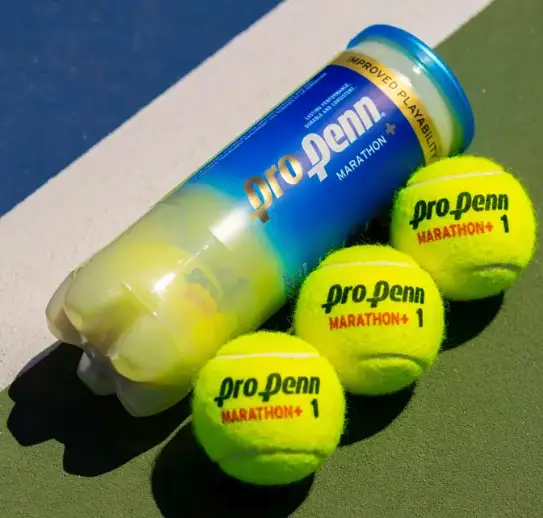
The Pro Penn Marathon gets its first real update in a generation
Let’s start with what’s already here. The Pro Penn Marathon – the workhorse ball for a huge number of American club and league players – has been updated. And Felix framed it in a way that tells you how static this category has been.
“That’s exciting for us, because we really hadn’t updated the tennis ball landscape within the last fifteen years.”
Fifteen years. In a sport where racquet brands refresh their entire lineup every two to three years and can’t stop inventing new acronyms for graphite layup, the ball you actually hit has essentially stood still.
The change is in the felt, and it’s a meaningful one. The Marathon moves to a woven felt, replacing the needle felt that Penn has used in the US for as long as most of us have been playing.
“There we actually went to a woven felt ball, which makes the ball a little softer. It fluffs up a little bit. You can grab the ball more. In the past we’ve always used a needle felt ball in the US, which is a tighter felt, which is stiffer and therefore it plays faster, but also lasts longer.”
Why this matters, if you don’t follow felt construction: needle felt is made by mechanically punching fibres together, which produces a dense, flat, tough surface. Woven felt is actual woven fabric, and it fluffs, grips, and deforms more readily. European and “extra duty” premium balls have leaned woven for years, which is a large part of why balls on the two sides of the Atlantic have historically felt like different products.
So there’s a clear trade-off baked in here, and it’s worth knowing before you commit to a case:
- You gain: a softer feel, more bite on the strings, more spin potential, a ball that feels more alive off the racquet.
- You likely give up: some of the sheer durability that needle felt delivered on abrasive US hard courts.
If you’ve always found American balls skiddy, hard, and unrewarding for a topspin-heavy game, this update is pointed directly at you. If you play four hours a day on gritty concrete and judge a ball purely by how many sessions it survives, keep an eye on wear.
And then the spoiler: the Pro Penn Infinity, arriving in October
Asked about what’s next, Felix paused, decided he’d go ahead, and gave up a launch.
“We have a really exciting project coming up, which is actually coming out in October. And I guess I can spoil it here. It’s going to be called the Pro Penn Infinity ball.”
The felt is similar to the Marathon Plus. The difference is underneath.
“It’s a brand new core that we never had before. So it’s a little bit more lively, so it has more rebound.”
Core changes are the more interesting kind of ball innovation, because the core dictates how the ball stores and returns energy — how it deforms on impact and how quickly it recovers. Felt changes how the ball interacts with your strings and the air; the core changes what the ball fundamentally is.
And according to their testing, the effect showed up somewhere he didn’t expect:
“Actually, it’s really interesting: during our testing, you can really spin the ball a lot more with this ball, even though it has the same felt. But how the felt reacts to the core, and then also to the bounce, you can really see there’s a lot more spin, and therefore also control, in the end, you get from the ball.”
That’s an interesting claim, conventional thinking puts spin generation in the felt’s lap. What he’s describing is a second-order effect: a livelier core changes the dwell time and deformation on the stringbed, which changes how the felt can bite, which changes spin. More rebound and more spin normally pull against each other, so I’ll reserve judgment until I can hit a box of them.
They’ve been seeding it heavily over the past several months, and the feedback has apparently been strong. I hope to test it myself in a near future.
Part Two: The Consistency Problem
Here’s where I expected corporate deflection and didn’t get it. I asked what’s been frustrating from his side of the fence, and whether he sees any light at the end of the tunnel.
“Frustrating, for sure, have been the supply chain issues over the last few years. There has been so much pressure on the suppliers — not only on us as a brand, but also on the suppliers where we actually get the raw materials — to produce in high quantities and at a record speed, which obviously leads to mistakes eventually.”
Then he said something you rarely hear from a manufacturer, and which explains more about ball quality than any press release ever has:
“Because in the end, a lot of you may or may not know, but there are still a lot of people behind it who actually do the work. It’s not all the machines that do it.”
Tennis ball production is far more hand-involved than most players assume. Felt is cut, cores are joined, seams are applied, with human hands at multiple stages. Now run that process at pandemic-era demand, with every raw material supplier stretched, and hiring and training happening at speed. You don’t get a uniformly bad product. You get a variable one.
Which is exactly how it feels at the consumer end. I described the experience most of us have: you buy a box, and it’s a lottery. A few cans are superb. A few are complete duds. Felix agreed and added:
“It’s not like every can of tennis balls that every player is experiencing right now is bad. But I think the frustration within the market is that there’s such an inconsistency of you not always playing with the exact same ball that you feel like you purchased.”
That’s the correct diagnosis, and it reframes the whole debate. The problem isn’t that balls are categorically terrible. It’s variance. And variance is, psychologically, far more corrosive than a consistently mediocre product. You can adapt to a ball that’s a bit slow. You cannot adapt to a ball that’s different from the one you hit last Tuesday out of the same box.
The squeeze nobody sees: raw materials up, price ceiling fixed
There’s an economic vice here too, and it’s worth understanding if you want to know why this hasn’t simply been fixed.
Wool and rubber, which are the two things a tennis ball is essentially made of, have both climbed significantly in cost. Meanwhile:
“Especially in North America there’s a really tight pricing challenge, I would say, where consumers are really only willing to pay so much for a tennis ball before they feel like that is too much. So that puts another challenge on us from an operational standpoint: how can we make the balls as good as possible, but also achieve the margins we expect.”
Input costs rising, retail price essentially capped by consumer psychology. Something in the middle absorbs the difference — and historically, in every industry, that something is quality or consistency.
There’s also the awkward truth that the tennis boom itself is part of the problem. As Felix put it, tennis is “one of the trendiest sports right now, which is great for our industry, but at the same time, with all the exciting things, challenges come with it.” More players means more demand means more pressure on a supply chain that was never built for it.
And for what it’s worth, he’s a customer too:
“I’m a tennis player myself. I hate inconsistency in tennis balls as much as you guys do.”
Part Three: Rubber Trees and the Fix
“From farm to court”
This was the most concrete answer of the interview, and the most encouraging.
HEAD Penn is currently running two facilities in parallel: one in China, one newly built in the Philippines, with a plan to consolidate.
“By probably 2028 we’re going to be fully out of the Philippines. The exciting thing there is that all the raw materials — the rubber trees — are right next to the factory. So we can really have, we call it, from farm all the way to court, have more oversight over the supply chain in general, which obviously is going to increase the quality of the balls.”
This is vertical integration deployed as a quality strategy, and it directly targets the root cause he described earlier. If your variance comes from stretched third-party suppliers delivering inconsistent raw material, the fix isn’t tighter QC at the end of the line; it’s owning more of the line. Growing the rubber next to the factory removes a whole category of variables: transit, storage, intermediary handling, batch-to-batch supplier drift.
It’s not a fast fix. 2028 is a long way out, and anyone hoping the ball problem resolves this season should adjust expectations. But “we’ve restructured where our raw materials come from” is a far more convincing answer than “we’ve increased our focus on quality.”
The long game and the fast competition
I asked how HEAD approaches competition and innovation across categories, given how crowded and fast-moving the equipment market has become.
On balls, his answer was patience bordering on stubbornness:
“Tennis balls, for sure, are a long-term project. Obviously, we have these two new balls that are coming out, and I don’t want to change the ball within the next fifteen to twenty years. Because consistency is the key point there.”
Read that against everything above, and it’s internally coherent. If your customers’ number-one complaint is that the ball keeps changing on them, the worst response is a refresh cycle. Lock the spec, fix the supply chain, and leave it alone. It’s an unglamorous product strategy, and probably the right one.
Part Four: The Waste Question
Every tennis player has had the thought. You crack a can, play a couple of sets, the balls are flat, and into the bin they go. Three lumps of rubber and wool that will outlive you. Multiply by every court in the world. It feels genuinely bad if you think about it.
The first step has been packaging. You’ve likely already noticed HEAD and Penn moving away from the clear can to what they internally call the milky can.
“That one in Europe helps with the recycling portion, but here in the US where there’s not so much recycling, we actually made it also biodegradable. So we have an additive in there from Midori Bio, and after three to five years when it goes to the landfill, it actually biodegrades.”
The obvious next question is whether the same thinking can move from the can into the ball.
“The next step is: how can we get this now put into a tennis ball? Because obviously that would be ideal; when you throw the balls away, they just biodegrade after three to five years. Of course, that one is a lot trickier.”
Tricky is doing a lot of work in that sentence, and it’s worth spelling out why. A biodegradable ball is engineered to break down, and a ball that breaks down predictably in a landfill is one whose materials are, by design, less stable. That runs directly into the thing customers are angriest about right now: consistency and durability.
Those two goals are in tension, and HEAD is being asked to solve both simultaneously by the same frustrated customer base. I don’t envy them the brief.
Part Five: Everything Else
Balls dominated the conversation, but a few other things came up worth flagging.
Strings: an unusually honest take
I asked about competition in the string market, where new releases arrive constantly. His answer was the most refreshingly blunt moment of the interview:
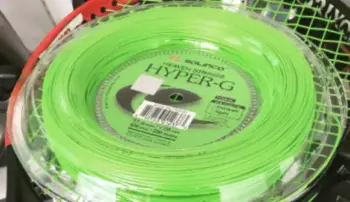
“On the strings, I would say there’s a lot of innovation coming out in terms of colours, packaging, and that’s something that excites the consumer. Do I see that much difference in what a polyester string actually plays like? I don’t think so. But I think it’s more of a marketing spin.”
A product director for a major brand is saying the quiet part out loud about polyester strings. He then credited the competition by name: Toroline and Solinco, for how well they’ve handled packaging and colourways, and hinted that HEAD is heading in the same direction:
“You can look forward to that as well over the next six to twelve months. There’s some exciting projects coming out.”
So: expect new colours and new packaging from HEAD strings, and take any accompanying playability claims with the grain of salt their own product director would.
Racquets: gradual, not revolutionary
He pointed to this year’s HEAD Squared release as genuinely novel, but set expectations carefully for the next few seasons:
“Over the next three years we already have such a strong product stable. Do we see the crazy new innovation? I’m not sure. But I think this gradually improving is the key for us there, because we already have such a great following where people really like our product.”
Which is a polite way of saying: the Speed, Radical, Prestige, Extreme and Boom lines are selling, so don’t expect anything wild. The R&D team, though, is apparently not short of ambition:
“I know the R&D team, they have tons of crazy ideas. Are they actually feasible in the end from a business side? Most of the time not.”
And Finally: What Does He Actually Play?
Mandatory question, and the answer had some real gear-nerd content in it.
Felix plays a Speed MP, and he took a winding route back to it, sponsored by Dunlop as a junior, then HEAD, then a Pure Aero through college.
“I’ve always kind of been a little bit of a tennis nerd, I guess, to figure out setups and stuff. So now it’s back to Speed MP. For me it’s the most versatile racket in the market.”
He keeps the rest of the range in the bag and has real affection for the Extreme Pro and, slightly unexpectedly, the Boom Pro. “I do love the Boom Pro, actually, quite a bit.” But when a match matters:
“If I want to play a match and want to feel as comfortable as possible, I always go back to the Speed MP, because I feel it gives me the most well-rounded setup.”
The string setup is where it gets interesting. He uses HAWK Power, and his tension has fallen off a cliff since his college days:
“In college I used to play more the 58 pound range. Now I’ve dropped to 50, sometimes even 48. It just feels so much more comfortable, it’s way more easy on my arm, and I do get a lot more power and spin potential actually.”
Fifty-eight down to forty-eight is a ten-pound drop. This is is not uncommon these days. And it’s another data point for the low-tension movement, from someone who hits a lot of balls and has access to every string his company makes.
He also rates Lynx Tour, particularly in thin gauges: “I do like Lynx Tour 18 gauge quite a bit.” HAWK Touch gets a nod too, but HAWK Power in the mid gauge is where he’s landed.
The Takeaway
Three things I came away with:
One, the balls are changing, and in a direction most spin-oriented players will like. Woven felt in the Marathon means a softer, grippier ball than Penn has traditionally offered in the US. The Infinity in October adds a new core on top of that.
Two, the consistency problem has a real diagnosis and a real fix, but the fix is slow. It’s a supply chain problem, not a design problem, and the answer, hopefully for HEAD, is owning the raw materials in the Philippines. This is expected to be completed around 2028.
Three, the most encouraging thing he said was a promise to do nothing. Getting the ball right and then refusing to touch it for fifteen to twenty years is exactly what a frustrated market needs to hear.
Thanks to Felix for the time in New York. Hopefully we get him on the podcast for a proper long-form conversation. In the meantime, I’ll be testing the updated Pro Penn Marathon and the Pro Penn Infinity the moment they land.