
Have court speeds become so homogenized over the years that match outcomes have become more predictable? Roger Federer’s recent comments on Andy Roddick’s podcast ‘Served’ during the Laver Cup got me thinking – why is tennis not embracing the variety in game styles that different courts and surfaces bring to the sport?
Well, Roger laid it down to incentives. Tournament directors have more incentive to slow down the court speeds as it would require the weaker player to take more risks in order to hit winners against stronger players. This effectively favours the top players like Sinner and Alcaraz, who have a more consistent and powerful baseline game and have more time to showcase their repertoire, thus leading to a higher likelihood of a Sinner v Alcaraz final.
The question then arises, don’t we want to witness more Sinner v Alcaraz finals at the biggest events in our sport? The way these two gladiators have taken over the sport – winning every grand slam in the last two years – as a tennis fan, you would wish for nothing more right now. And for tournament organisers too, it means more footfall, translating into more moolah. But all this comes at a cost and making the sport uncompetitive should not be the price we pay.
Court Surfaces
By comparison, the grass courts are inherently faster due to the low friction and low bounce, followed by hard courts, followed by the relatively slower clay courts. Also, hard courts of different tournaments on the calendar have varying speeds and conditions. Over the recent years, the speed variation on a particular surface has diminished significantly, mostly converging to medium-fast speeds (as per ITF definitions). By homogenising the court speeds, it takes away the variety that the sport has to offer. While a more aggressive game style would be suited to a faster court, a more defensive playing style with more topspin would be suited to a slower surface.
Encouraging problem-solving in different playing conditions, would lead to more intriguing match-ups and less predictable outcomes in earlier stages of a tournament. As a viewer, I would love watching players adapt their game style to the different playing conditions and surfaces.
Background
During the 1990s, the sport was dominated by big servers, who backed it up with sublime volleying skills. The rallies were short as you would rush to the net on almost every single point, in case you did not end the point with a big serve itself! For context, in the 1998 US Open men’s singles final between Patrick Rafter and Mark Philippoussis, ~78% of the rallies were over within 3 shots. And in the 1998 Wimbledon men’s singles final between Pete Sampras and Goran Ivanisevic, the same metric was a whopping ~85%!
This warranted a change, be it in the balls, the conditions or the courts. The organizers experimented with reducing the court speeds across surfaces in the early 2000s, led by the landmark move by Wimbledon to shift to 100% perennial ryegrass from 70% after the 2001 edition. While Wimbledon claims that the objective was only to get a more consistent ball bounce and to increase court durability, it effectively led to slower ball bounces which in turn triggered a shift in playing style. More players started hugging the baseline as the ball would slow down after the bounce, giving you more time to react. And in case you approached the net too early, you were left vulnerable to an easy pass from the opponent. The rallies became longer, and a wide array of player skills were at display. While clay already had that, tennis on grass became interesting again, rewarding an all-court game.
Court Speed Index Comparison
The tennis court conditions can be very subjective, in terms of how they are perceived by different players. Hence, to get a quantitative comparison, I have shown the Court Pace Index (CPI) for both the hard court slams over the past 10 years. The CPI is a numerical value assigned by the International Tennis Federation (ITF) to describe how fast or slow a tennis court surface plays. The categorisation is as follows:

The rating takes into account two main factors – the friction between the ball and the surface (which slows horizontal speed) and the height of the bounce (higher bounces slow the game by giving players more time to react).
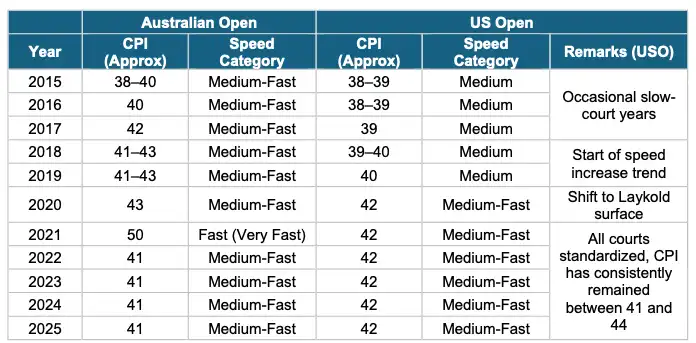
Over the last decade, the court speeds for both the hard court slams have increased from 38-39 levels to 41-42 levels, making them marginally faster from a decade-ago and both play similarly in the category of medium-fast courts.
2021 was an exception for AO, where the courts were extraordinarily fast due to heavier use of the main courts during the lead-up to the event and reduction of sand content in the court’s acrylic surface mix. This was corrected from 2022 onwards.
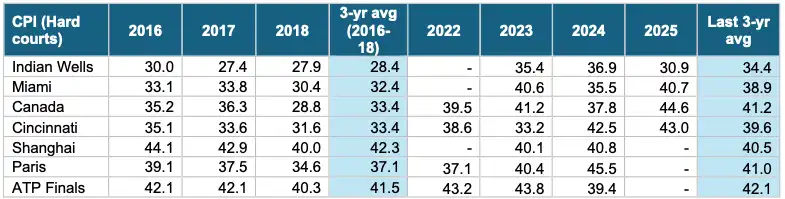
A comparison of the rest of the ATP Masters and the ATP Finals played on hard courts is given below. Based on the data available, I have compared the 3-year average of the CPIs during the period 2016-18 with the latest 3-year average. The court speedfor almost all the key hard court events (barring Shanghai) has increased in recent times, with 5 out of the 7 events in the Medium-Fast category (>=40) during their latest occurrence.
The Cincinnati 3-year average is <40 largely due the outlier year 2023, when the courts turned out to be exceptionally slow due to changes in surface preparation and environmental conditions that year. The latest CPI at Cincinnati held this year was one of the fastest at 43.0. Indian Wells continues to the slowest amongst all the hard court Masters, though it has been relatively faster in recent years.
On clay courts, the speed is generally slower and the variation in speed is also less. It is more driven by the weather, with dry and warm weather speeding up the court slightly, while damp or rainy conditions might slow down the court further. While Roland Garros has largely maintained its court speed in the slow category (as per online sources), there has been an increase in CPIs in the recent years in Masters 1000s held on clay.
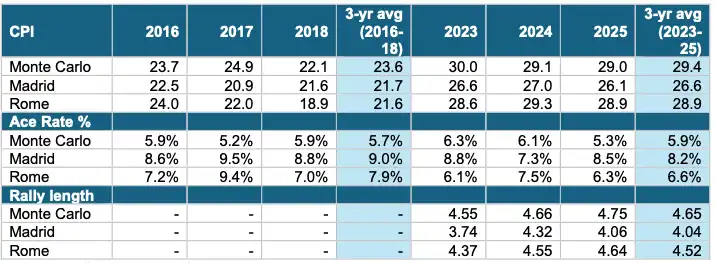
The last 3-year average CPI for all the three ATP Masters played on clay has also increased significantly from 21-23 levels to 27-29 levels. However, the declining Ace Rate (except for Monte Carlo) and largely increasing rally length point towards slower courts. The balls and the weather conditions might be a plausible reason for this aberration.
The CPI data for Wimbledon is not available, however, grass remains the fastest surface overall with Wimbledon having a CPI typically in the range of 43-50, even though it is much slower compared to the 1990s. The trend in the Ace Rate (%) for Wimbledon is given below, which shows a slight decline in recent years.

Conclusion
To conclude, based on the data, the court speeds have increased in general in recent years, across surfaces. And sufficient variation in court speeds across surfaces still exists, which is good for the game. This indicates how talented Sinner and Alcaraz really are, being able to make the required adjustments and playing back-to-back grand slam finals on three different surfaces, with varying court speeds and conditions. The game is definitely not boring and is in safe hands. Having variety in your game will still be rewarded.
However, for a particular surface, like hard courts (where majority of the season is played), the variation in court speeds has reduced drastically over the years. The standard deviation of the 3-year average CPIs (2016-18) of hard court Masters 1000s (including ATP Finals) was 5.06 compared to 2.55 for the most recent 3-year averages. Most of these hard court events are converging to the Medium-Fast category, including both the hard court slams. Indian Wells remains a refreshing outlier on the tour, with slow and high bounces. An even mix of Medium, Medium-Fast and Fast hard court events could be a really exciting prospect.
As a tennis fan, one suggestion to the ATP would be to increase the variance in court speeds between the various hard court events, as it would add intrigue and unpredictability. Players with differing playing styles would have to adapt their games accordingly and it would inevitably lead to a more even playing field, possibly increasing the chances of an upset!
Thanks for reading! Until next time.
More reading: Tennis court surfaces – how they affect play





Epic effort by the author, thumbs up
Not considering the balls, or even conditions like altitude and dry or humid, is a bit of a miss. It’s a matchup balls-surface, not just surface, as if it’s the same which balls are used, and are they ultra slow like at AO, or fast, spinny and bouncy like at Indian Wells, or soft and fluffy like at Wimbledon
Slower balls were introduced practically on the whole ATP tour 2019-2023, surfaces were adapted somewhat to compensate. First editions with new slower balls were too slow and often a disaster in terms of tennis quality
Fast surfaces can’t really come back because new gen doesn’t play with high swingweights any more, they need the ball to float after bounce, otherwise you get an ocean of unforced errors. There are some events with faster surface-ball combo, and it’s obvious that they can’t time their shots with light racquets that need high RHS, players even said it themselves
Wimbledon became slower not only because of the grass change but because they cut it much shorter, to 8mm, and the sand base is firmer, so the bounce is much higher. Also the balls were made super soft, making them easy to put back into court, same year 2002.
It’s difficult to serve and volley because returners now return from shoulder height and hit downwards, which makes constant s&v impossible. It used to be that returners were hitting upwards, returning serves at almost knee height, giving the volleyer a floating ball at shoulder height almost
Andy,
Thanks for the comments and feedback. Appreciate it. Some responses to your points:
1. The balls have become slower overall on the tour now and different tournaments are using different balls. The effect of the balls is more or less neutralised due to this, and hence I have intentionally kept it out of the analysis. Also, it’s difficult to make a quantitive comparison on balls which keep changing within tournaments, let alone separate balls for different tournaments.
2. Moreover, the major reason to make the balls slower was to counteract the increase in speed in ground strokes which was due to improving racket/string technology and more improved player athleticism. This is why the average ace rate % hasn’t changed that much over the years and the average rally length is also at similar levels. The court speed increase/decrease is over and above this and I have given higher weightage to it.
3. Regarding Wimbledon’s grass change, the sand base is firmer due to the grass change itself as the groundskeepers were able to keep the soil drier and firmer because of it. And you’re right – hence the higher bounce.
4. And yes the higher bounce also enables the returner to hit downwards from shoulder height, making it tough to serve and volley. But they are also able to do that because the courts/balls are slower and hence the balls sticks longer in the air.
Hope you enjoyed reading though!
Thanks.