
In September 2024, I transitioned from the Yonex Ezone 98 to the Yonex Percept 100D. The reasoning behind this change was straightforward: I wanted a racket with a larger head size that would provide a more forgiving frame and greater margin for error. (For those interested in a detailed account of that decision-making process, you can read more about it here.)
When making the switch, I kept my existing string configuration: a polyester/polyester hybrid consisting of Solinco Tour Bite Soft 1.25 in the mains and Diadem Evolution 1.25 in the crosses. (You can find my full review of the outstanding Diadem Evolution here.) By doing so, however, I underestimated the degree to which strings can potentially enhance (or tame) the playability of a given frame.
After some weeks of playing, I began to notice something interesting. Even with the larger head size of the Percept 100D, I was still able to play my strings until they reached the end of their natural lifespan without breaking. Combined with the denser 18×19 string pattern of the Percept 100D-the “D” stands for dense-this observation prompted me to experiment. I thought to myself: why not try a thinner gauge in order to regain some of the feel and spin I had lost in moving from a 98 to a 100-square-inch racket?
A conversation with a friend of mine, who is also a great stringer in Italy, directed me toward MSV. He had been recommending the German brand to many of his clients with notable success, and several of them had switched to MSV permanently after testing their setups.
Curiosity piqued, I explored the MSV website. I found it to be remarkably well designed: every product page provides clear and precise information about the characteristics of each string, supplemented by independent, data-driven reviews from players, coaches, and professional stringers. I was particularly impressed by the diversity of their user base, which spans junior players, ATP and WTA professionals, ITF Masters competitors, and national-level athletes across several countries. Their endorsement covers not only strings but also accessories such as grips and overgrips.
Encouraged by this, I contacted MSV, explaining my current setup in detail, describing my needs, and clarifying what I was seeking in my next configuration. To my surprise, I quickly received a personal and friendly reply from the company’s owner himself. This correspondence developed into a highly informative exchange about MSV’s string offerings and the optimal ways to maximize their performance.
With the guidance of this conversation, along with the input of my Italian stringer friend, I decided to test two specific hybrid combinations:
- MSV Focus Hex 1.23 (mains) / MSV Go Max 1.20 (crosses)
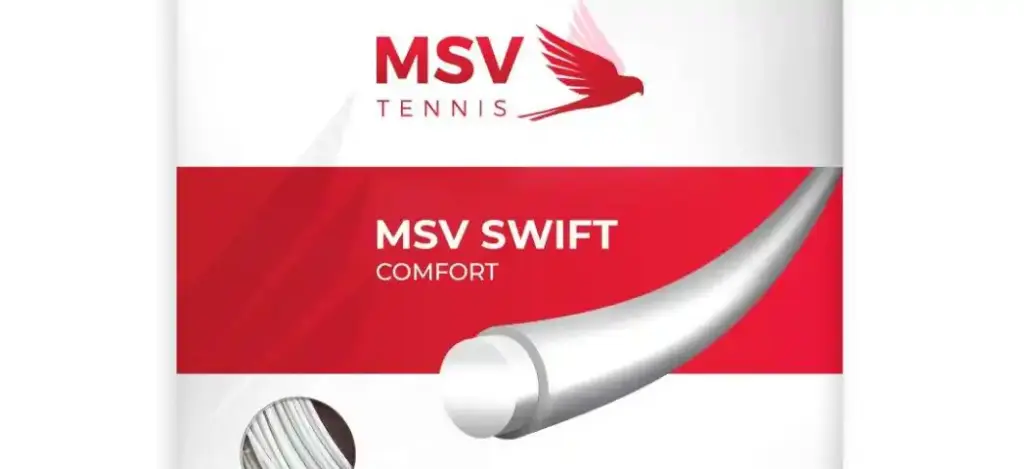
Focus Hex is MSV’s best-selling strings. It is a relatively firm polyester with a hexagonal profile, here in the interesting 1.23 millimeter gauge. Go Max, in contrast, is a slightly softer, round polyester available in 1.20 millimeters. - MSV Bussard 1.25 (mains) / MSV Swift 1.25 (crosses)
Bussard is a firmer, round polyester, while Swift is somewhat softer. Both were tested in a 1.25 millimeter gauge.
Setup 1: Focus Hex 1.23 @ 21 kg / Go Max 1.20 @ 20 kg
This first hybrid setup quickly became my preferred configuration, and it is the one I continue to use today.
The initial twenty minutes of play, however, were not promising. My shots alternated between being excessively spin-laden and falling short, or conversely flying too flat and too long. The feel was stiff and unresponsive, and the sound of contact was metallic. It was, frankly, discouraging.
Yet, almost suddenly, everything changed. The strings seemed to “settle,” and the racket came alive in my hands. I was able to generate a level of spin with the Percept 100D that surpassed any of my previous hybrid string setups.
The power was equally impressive. The ball launched from the string bed with explosive pace, yet without requiring additional effort in my swing.
The overall result was the ability to hit heavy, looping groundstrokes that bounced high and pushed opponents deep behind the baseline, while still maintaining excellent control and speed when flattening the ball for an attacking shot. My immediate reaction – and that of my hitting partners – was just, wow!
Playability, therefore, was outstanding. But how about comfort?
As someone who is prone to injury, this is a decisive factor for me. Fortunately, I experienced no discomfort, even after 10 to 11 hours of play. Beyond that point, I did begin to notice a decline in performance: reduced spin on looping strokes and diminished precision on flatter shots. Although I could probably have extended the lifespan for another two or three hours, with a match approaching, I chose to restring instead.
The only drawback I identified was in touch and feel. Drop shots in particular lacked subtlety, unless executed with especially sensitive hands. Nevertheless, the overall performance of this hybrid setup was so strong that I immediately ordered reels of both strings and have not looked back since. And as a personal request: MSV, please consider offering 100-meter mini reels!
Setup 2: Bussard 1.25 @ 21 kg / Swift 1.25 @ 20 kg
As you might expect, this second combination did not become my go-to setup. The reason was comfort.
According to Racketpedia’s extensive database (and I must express my gratitude to both Racketpedia and MSV for providing such reliable data), this configuration was expected to be stiffer. While not punishingly rigid, my sensitive arm immediately registered the firmer response. After an intense ninety-minute session, I began to feel early signs of soreness. Although the discomfort disappeared after rest, the comparison with the greater comfort of the Focus Hex/Go Max hybrid made it difficult to justify further use.
As a result, I can only share first impressions:
- Spin: noticeably lower than with Focus Hex/Go Max. Bussard does not grip the ball to the same degree.
- Touch and feel: slightly disappointing. I had expected an improvement, but it was not significantly superior to the first setup. A thinner 1.20 millimeter gauge might have provided better results.
- Power: solid, but with less explosive pop. Probably the slightly thicker gauge likely contributed to this difference.
To be fair, I do not believe I gave this hybrid enough time to truly show its potential. I am certain that other players will extract more benefits from it, particularly given the consistent quality I have observed across MSV’s string line. For those who prefer round polyester strings, it remains an option worth testing – especially considering its attractive price point.
Final Thoughts
My conclusion is clear: the Focus Hex/Go Max hybrid has become my string setup of choice. It complements both my racket and my playing style, allowing me to play more effective and enjoyable tennis.
MSV distinguishes itself not only through performance but also through value. Their products are priced more affordably than many mainstream brands while maintaining a quality that often equals or surpasses them. This is an important advantage for recreational players, who frequently face high costs when purchasing equipment.
Moreover, MSV’s commitment to customer support is exemplary. My direct exchange with the company’s owner was both informative and enjoyable. After I mentioned that I had not yet tested the Focus Hex Ultra, he generously sent me a set of it, along with a booklet containing Racketpedia’s comparative data. These charts clearly demonstrate how MSV strings often perform on par with, or even better than, competing top-tier brands.
In summary, MSV delivers a rare combination: technical excellence, affordability and outstanding customer care. For me, this makes them one of the most compelling options in the string market today.
Chapeau, MSV.










Have you ever played a 1.23 MSV Hex/Co Focus-Hybrid? Couldn’t it be even better then your favourite setup?
I have not tried that myself, but it does sound like a great setup to me.
Hi Erik, thank you for your idea. No I haven’t tried it yet. Have you? What are your feedback on it? Curious to hear. Thanks!