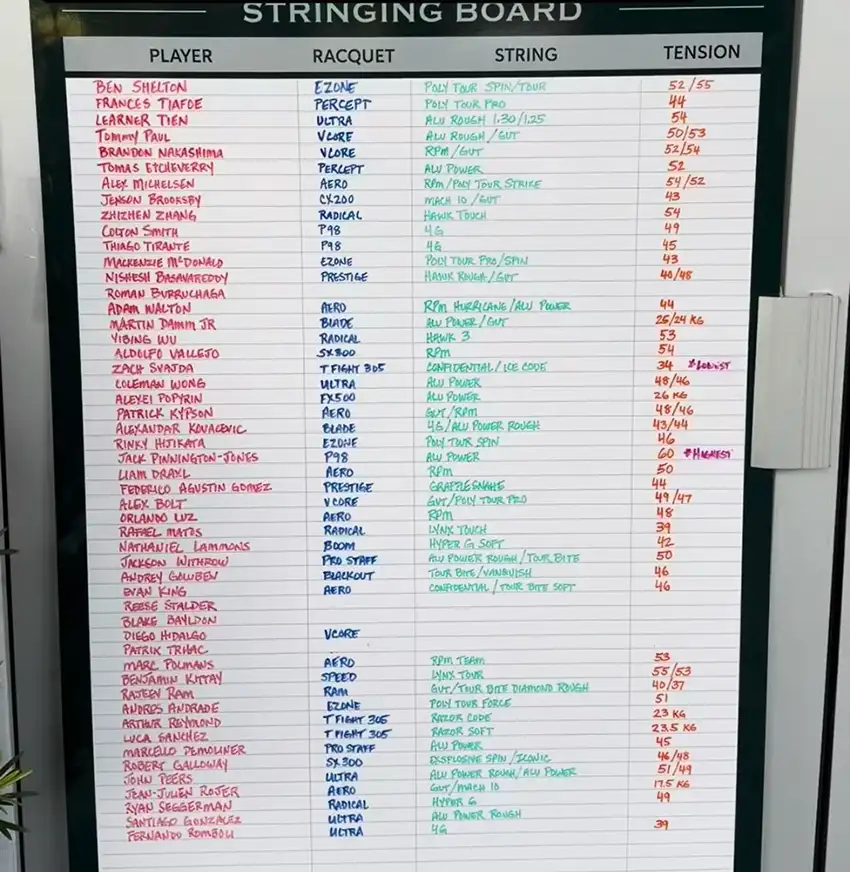
The Houston ATP tournament has once again posted string tensions on a handwritten board, and as tennis nerds, we have to take a closer look.
Below you have the string tensions from the Houston ATP 2026.
Player
Racquet
String
Tension
Ben Shelton
Ezone
Poly Tour Spin / Tour
52 / 55
Frances Tiafoe
Percept
Poly Tour Pro
44
Learner Tien
Ultra
Alu Rough 1.30 / 1.25
54
Tommy Paul
VCore
Alu Rough / Gut
50 / 53
Brandon Nakashima
VCore
RPM / Gut
52 / 54
Tomas Etcheverry
Percept
Alu Power
52
Alex Michelsen
Aero
RPM / Poly Tour Strike
54 / 52
Jenson Brooksby
CX200
Mach-10 / Gut
43
Zhizhen Zhang
Radical
Hawk Touch
54
Colton Smith
P98
4G
49
Thiago Tirante
P98
4G
45
Mackenzie McDonald
Ezone
Poly Tour Pro / Spin
43
Nishesh Basavareddy
Prestige
Hawk Rough / Gut
40 / 48
Roman Burruchaga
—
—
—
Adam Walton
Aero
RPM Hurricane / Alu Power
44
Martin Damm Jr
Blade
Alu Power / Gut
25 / 24 kg
Yibing Wu
Radical
Hawk 3
53
Adolfo Vallejo
SX300
RPM
54
Zach Svajda
TFight 305
Confidential / Ice Code
34
Coleman Wong
Ultra
Alu Power
48 / 46
Alexei Popyrin
FX500
Alu Power
26 kg
Patrick Kypson
Aero
Gut / RPM
48 / 46
Aleksandar Kovacevic
Blade
4G / Alu Power Rough
43 / 44
Rinky Hijikata
Ezone
Poly Tour Spin
46
Jack Pinnington-Jones
P98
Alu Power
60
Liam Draxl
Aero
RPM
50
Federico Agustin Gomez
Prestige
Grapplesnake
44
Alex Bolt
VCore
Gut / Poly Tour Pro
49 / 47
Orlando Luz
Aero
RPM
48
Rafael Matos
Radical
Lynx Touch
39
Nathaniel Lammons
Boom
Hyper-G Soft
42
Jackson Withrow
Pro Staff
Alu Power Rough / Tour Bite
50
Andrey Golubev
Blackout
Tour Bite / Vanquish
46
Evan King
Aero
Confidential / Tour Bite Soft
46
Jesse Stalder
—
—
—
Blake Bayldon
—
—
—
Diego Hidalgo
VCore
—
—
Patrick Trhac
—
—
—
Marc Polmans
Aero
RPM Team
53
Benjamin Kittay
Speed
Lynx Tour
55 / 53
Rajeev Ram
Ram
Gut / Tour Bite Diamond Rough
40 / 37
Andres Andrade
Ezone
Poly Tour Force
51
Arthur Rinderknech
TFight 305
Razor Code
23 kg
Luca Sanchez
TFight 305
Razor Soft
23.5 kg
Marcelo Demoliner
Pro Staff
Alu Power
45
Robert Galloway
SX300
Explosion Spin / Ionic
46 / 48
John Peers
Ultra
Alu Power Rough / Alu Power
51 / 49
Jean-Julien Rojer
Aero
Gut / Mach-10
17.5 kg
Szymon Walkow
Radical
Hyper-G
49
Santiago Gonzalez
Ultra
Alu Power Rough
39
Fernando Romboli
Ultra
4G
39
What can we learn from these pro player string tensions?
Let us start by looking at the average string tension. Remember that this is a combined sheet for both doubles and singles players.
Average Tension
Typical range: 42–54 lbs (approx 19–24.5 kg) Estimated average: ~47–48 lbs (approx 21.5–22 kg)
What stands out: Most players cluster tightly around 44–52 lbs A few outliers: Very low: Rajeev Ram (~40/37), Zach Svajda (34) Very high: Jack Pinnington-Jones (60)
Takeaway: Modern pro tennis is clearly trending toward lower tensions for spin, power, and comfort, especially compared to the 55–60 lb era.
GREAT OFFERS ON TENNIS PRODUCTS
Don’t miss our new deals and discounts for some of our favorite tennis products!
Good discounts on new racquets, strings, bags, apparel or other tools and services such as coaching or training equipment.
Trend: Polyester is used by ~90%+ of players, often in hybrids.
Hybrid vs Full Bed
Hybrid setups are very common: Poly + gut (e.g. RPM / Gut, Alu Rough / Gut) Poly + poly (different textures/gauges)
Full poly setups: Still widely used, especially among big hitters and baseliners
Estimate: ~60–70% hybrid ~30–40% full poly
Poly + Gut Hybrid Seen with players like Nakashima, Tommy Paul, Kovacevic Why: Gut provides power and feel, poly adds control and spin
Full Poly (spin-focused) Seen with players like Ben Shelton, Frances Tiafoe, many doubles players Why: Maximum spin, durability, and predictable response
Softer / Control Polys Emerging Strings like Hyper-G Soft, Lynx Touch, Hawk Touch Trend: Players want more comfort without losing control
Racquet + String Pairing Trends
Babolat Aero are often paired with RPM Blast, Rough or Team.
Yonex frames (Ezone, VCore) are mostly paired with PolyTour family
Wilson Blade / Pro Staff are often paired with ALU Power or 4G hybrids
Brands tend to stay within their ecosystem, but Luxilon still dominates across brands.
Notable Outliers
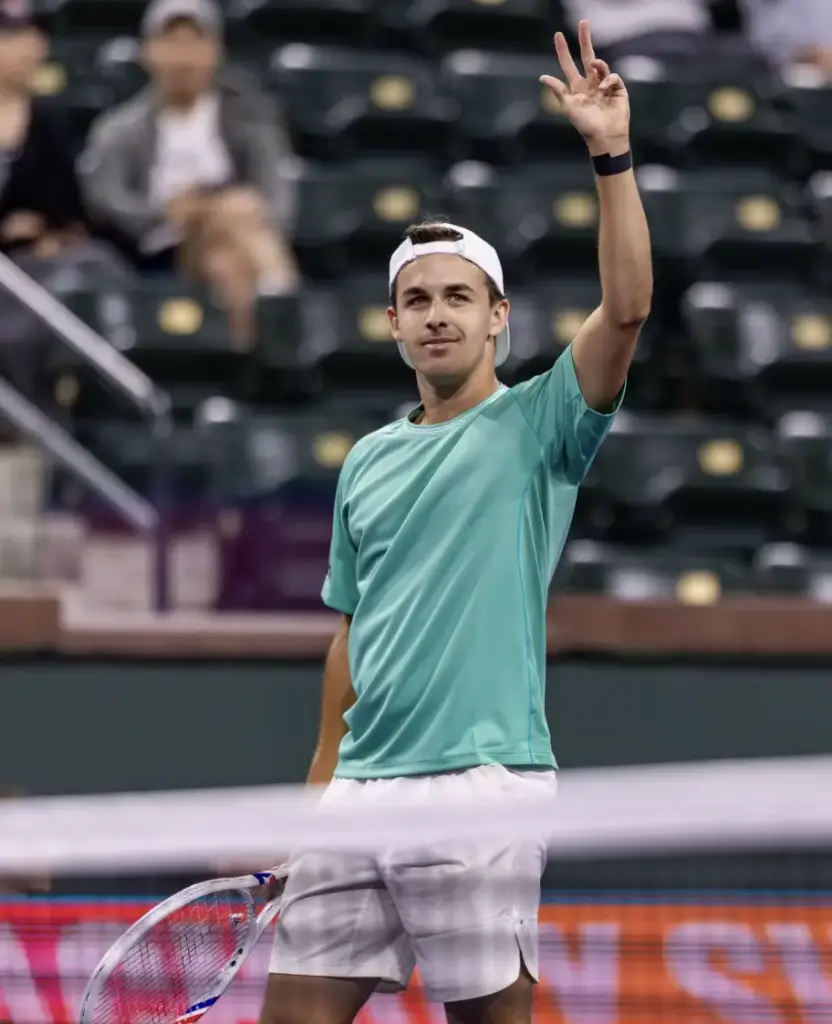
Jack Pinnington-Jones: 60 lbs (very old-school) Rajeev Ram: very low tension (~40/37) Zach Svajda: 34 lbs (lowest on board)
These extremes usually reflect feel preference or specific playing styles, especially in doubles.
Zach Svajda
Big Picture Summary
The modern pro setup typically uses polyester strings, often in a hybrid with gut or as a full bed. Tensions generally sit around 45–50 lbs (20–23 kg).
What This Means for You (Intermediate Player)
You probably shouldn’t copy pro setups exactly. Some pro setups are more user-friendly than others, but you need to find your own way. If you are experimenting with different racquets or strings, keep the parameters as small as possible. Start by changing the tension on your current racquet. Maybe try the string in a hybrid? Maybe try a new string entirely. Consider adding a little bit of weight to your racquet (starting small is important; 2-4 grams can make a big difference). Only when you have done these thing is it time to consider a new racquet. You can find our recommended racquets here.
In terms of strings, the recommendation for most amateur players is to
Use a softer poly or hybrid. Check out our recommended strings here. Tension around 48–52 lbs for more control Tension around 45–48 lbs for more power, comfort, and spin.
The tension obviously depends on your racquet, level and playing style, but this is a good reference to have.
Jonas, what do you make of surface (Houston clay) in these tensions? I just read this article via mobile so haven’t cross checked past ones, but wondering if the broad brushstrokes are different than what IW or Miami would’ve been — ex. if tensions may be higher to account for grind style points.
As we gear up for clay courts in the Northeastern US, I’m curious the applicability of any insights.




Jonas, what do you make of surface (Houston clay) in these tensions? I just read this article via mobile so haven’t cross checked past ones, but wondering if the broad brushstrokes are different than what IW or Miami would’ve been — ex. if tensions may be higher to account for grind style points.
As we gear up for clay courts in the Northeastern US, I’m curious the applicability of any insights.