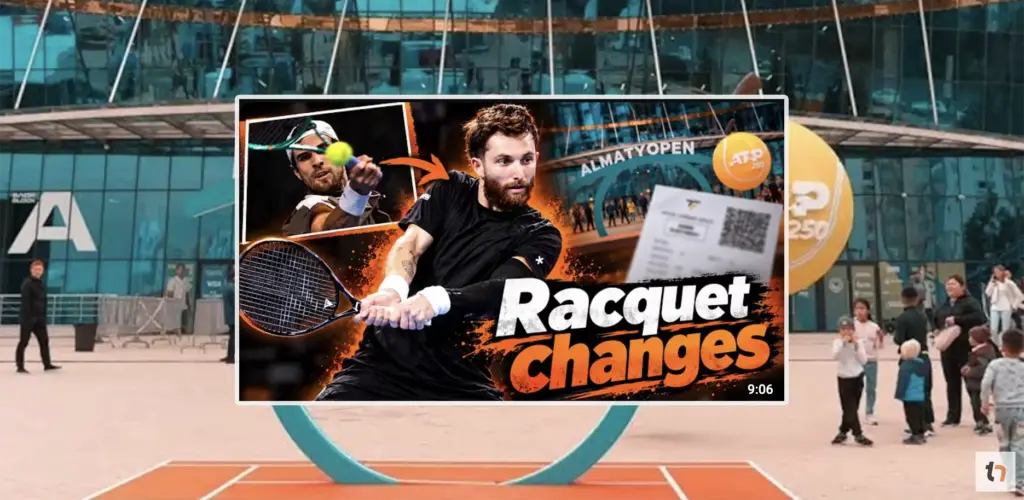
Corentin Moutet and Hamad Medjedovic have been spotted testing HEAD Speed racquets, while several ATP players are dropping their string tensions. Are we seeing a shift towards larger head sizes, more powerful racquets and softer string setups on the pro tour?
It’s time for another pro player racquet update! It’s been a while since the last one, mostly because there hasn’t been much switching or experimenting since the US Open. But we do have a few interesting updates from the ATP Tour, including two players testing HEAD Speed racquets and some surprisingly low string tensions from recent indoor events.
I’m currently in Lyon, France, attending the ATP tournament and spending a few days with Babolat. It’s always fun to get a closer look at what the pros are using, especially when they start experimenting with new equipment. Let’s start with the racquet changes and then get into the string tensions.
Corentin Moutet Testing a HEAD Speed?
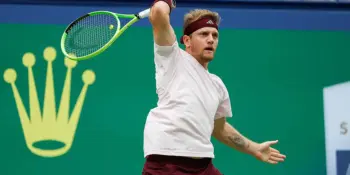
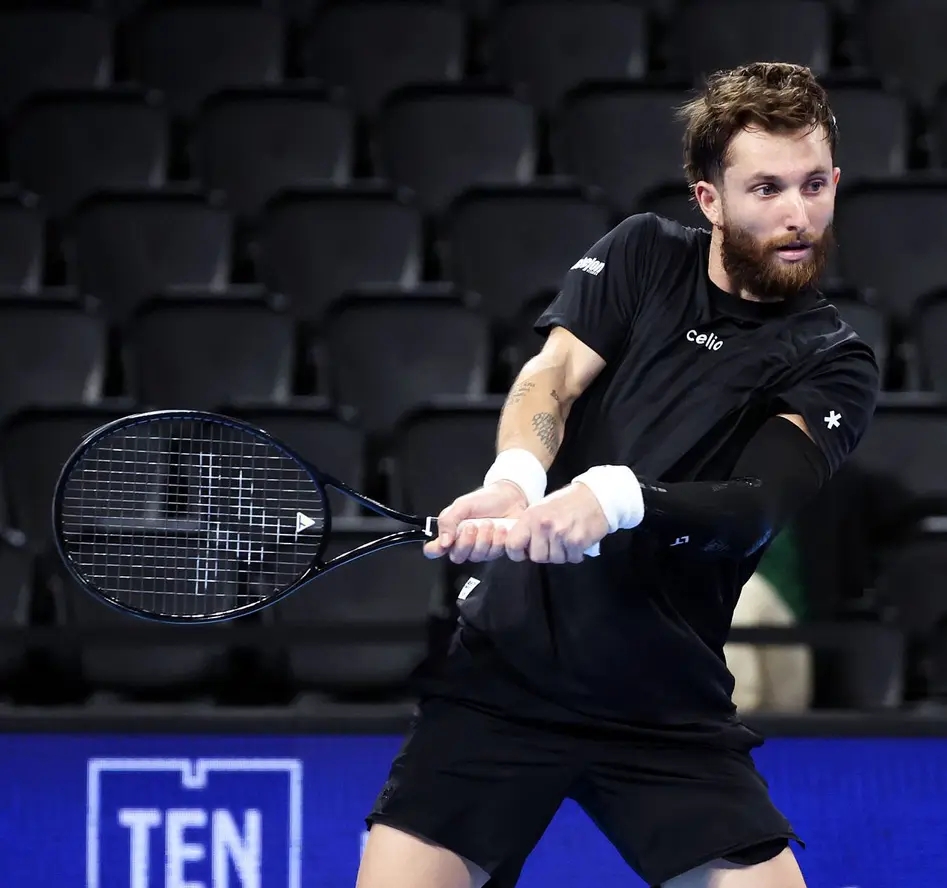
One of the most interesting recent developments is Corentin Moutet showing up in Lyon with a blacked-out racquet. Moutet has been using the Tecnifibre FIRE for the past season or two, so a different frame immediately caught my attention.
At first glance, you might think he’s testing the new spin-oriented Tecnifibre prototype that has been circulating among some of their sponsored players. But if you look closely at the grommets, the string pattern and the overall shape of the frame, it appears to be a HEAD Speed MP with a 16×19 pattern. It looks like the newer Speed mold, possibly the PT339, although I can’t confirm the exact layup. What seems pretty clear is that Moutet is testing a Speed rather than another Tecnifibre prototype.
That’s interesting, because the HEAD Speed continues to be one of the most popular racquet lines on the pro tour. Jannik Sinner famously uses an older Speed mold, the TGT 301.4, Novak Djokovic endorses the Speed line despite using a different racquet underneath the paint, and there are plenty of other Speed users on both the men’s and women’s tours.
Why is the Speed so popular? I think it comes down to versatility. You get a good combination of power, spin, control and forgiveness without going too far in any one direction, which makes a lot of sense for the modern game.
Moutet has already won a match with his blacked-out racquet, so the experiment seems to be going well so far. Of course, we’ll have to see whether he sticks with it. Players sometimes test a new frame for a tournament or two before returning to their old setup – we saw something similar with Karen Khachanov at the US Open, where he went back to his old Wilson Blade despite his association with the Tecnifibre FIRE. And knowing Moutet’s tendency to break racquets, we might see a few of those new Speeds destroyed along the way!
Hamad Medjedovic Also Testing the HEAD Speed
Moutet isn’t the only one. Hamad Medjedovic, who has been using a Babolat Pure Strike, has also been spotted with a HEAD Speed.
That makes me wonder whether we’re seeing a broader trend. Are more players moving away from traditional 97–98 sq inch control racquets towards 100 sq inch frames? I think there’s something to it. There are obviously still players using smaller head sizes – we have players with the Yonex Percept 97, and both Denis Shapovalov and Marcos Giron have been associated with the Yonex VCORE 95. But my feeling is that the game is moving towards slightly larger, more forgiving racquets that offer easier power without sacrificing too much control.
The HEAD Speed is a great example of that category. Another is the new Babolat PP01, which I’ve been testing recently. Like the Speed, it combines control with a bit more accessible power than your typical control frame. That seems to be exactly what many players are looking for: not going all the way to something like a Pure Drive, but getting some extra help while keeping a predictable response.
It will be fascinating to follow these experiments as we approach the 2027 season. The off-season is always one of my favorite periods as a tennis nerd, because that’s when we see the most racquet testing and switching.
ATP String Tensions – October 2026
Now to the string tensions. Thanks to Danika for sending over some recent stringing information from the Almaty tournament. There are some interesting numbers here, especially compared to what these players have used in previous seasons. What stands out most is how many players have moved towards lower tensions, even on indoor hard courts.
Recent ATP Player String Tensions
| Player | String | Tension (kg) |
|---|---|---|
| Karen Khachanov | Solinco Tour Bite 1.25 | 22.5 / 20.5 |
| Roman Safiullin | HEAD Lynx Tour 1.25 | 21 |
| Andrey Rublev | HEAD Lynx Tour 1.30 | 26 / 25 |
| Tomás Martín Etcheverry | Poly Tour Strike | 23.5 (52 lbs) |
| Marin Cilic | Natural gut / Luxilon ALU Power | 25 / 25 |
| Adrian Mannarino | Luxilon ALU Power 1.25 | 10 (reported) |
| Alexander Bublik | Not confirmed | 20 / 21 |
| Stefanos Tsitsipas | Luxilon 4G 1.25 | 22 / 21 |
| Luciano Darderi | Luxilon ALU Power Rough | 22 / 21 |
All tensions are in kilograms, listed as mains/crosses where available. These are reported tournament stringing tensions, not necessarily the players’ permanent setups – players can change tensions depending on conditions and personal preference.
Khachanov Going Lower
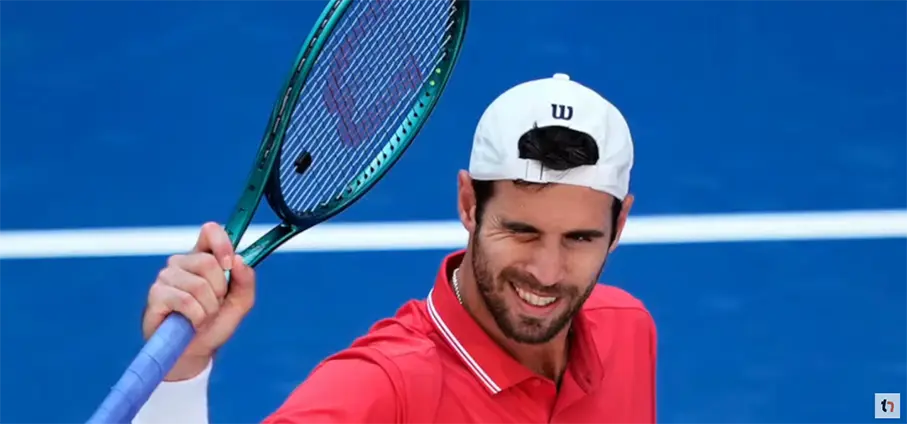
Karen Khachanov is still using his Wilson Blade with Solinco Tour Bite 1.25, but his reported tension was 22.5 kg in the mains and 20.5 kg in the crosses. That’s quite low compared to what I’ve seen from him before. The two-kilo difference between mains and crosses is also interesting: a lower cross tension changes the response of the string bed and can create a slightly higher launch angle. For a player looking for more lift on the ball, that’s well worth experimenting with.
Safiullin at 21 kg
Roman Safiullin continues with HEAD Lynx Tour 1.25, but his reported tension was just 21 kg. I remember seeing him closer to 24–25 kg in the past, so that’s a significant reduction – and he’s not the only one heading in this direction.
Rublev Sticking With a Firm Setup
Andrey Rublev is one of the exceptions. He’s still using HEAD Lynx Tour 1.30 at 26 kg in the mains and 25 kg in the crosses, which is a relatively firm setup, especially with the thicker gauge. But Rublev is a powerful player who likes to swing big, so it makes sense that he prefers a controlled, predictable response. Not everyone is going lower.
Mannarino – Still the King of Low Tensions
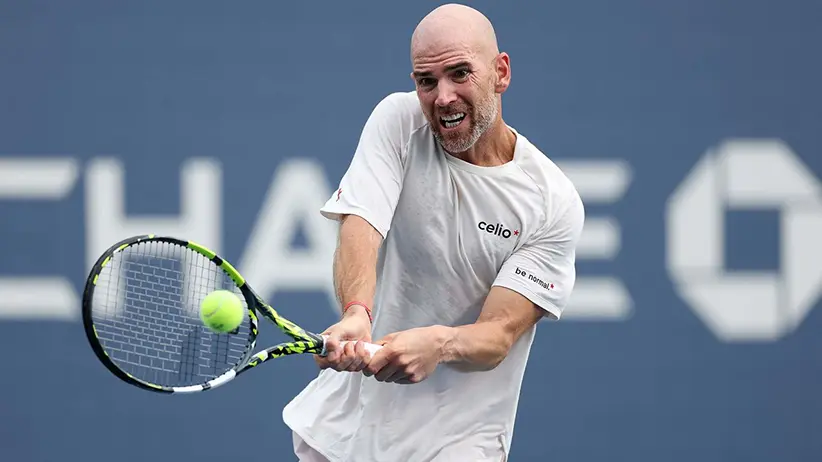
We can’t talk about pro string tensions without mentioning Adrian Mannarino. He’s famous for incredibly low tensions, and his reported tension was around 10 kg with Luxilon ALU Power 1.25 – roughly 22 lbs! He’s also known for experimenting with big differences between mains and crosses, sometimes reportedly stringing the crosses much tighter. It’s a very unusual setup, and I’d love to know more about his thinking behind it. I’ve experimented with low tensions myself, but very few pros go anywhere near Mannarino territory.
Bublik and the Launch Angle
Alexander Bublik is another interesting case. His reported tension was 20 kg in the mains and 21 kg in the crosses. Bublik uses the Babolat Pure Aero 98, a racquet with plenty of spin potential and a fairly lively response, yet he tends to hit the ball quite flat. By stringing the crosses slightly tighter than the mains, he may be trying to keep the launch angle a little lower and the response more controlled.
If you’re experimenting with your own setup, the relationship between mains and crosses is something you can play with. A lower cross tension can help create a higher launch angle, while a higher cross tension can make the response feel flatter and more controlled. That said, it’s not a universal rule – the result also depends on the racquet, string type, string pattern and how the strings interact.
Tsitsipas and Darderi Also Going Lower
Stefanos Tsitsipas was reportedly stringing his Luxilon 4G 1.25 at 22/21 kg, lower than the 24–25 kg range we’ve seen from him in the past. Luciano Darderi was also at 22/21 kg with Luxilon ALU Power Rough, which seems slightly lower than his usual setup.
The overall pattern is interesting. A few years ago, 24–25 kg felt like a standard range for pros using polyester. Now we’re seeing quite a few players around 20–22 kg. That doesn’t mean everyone should immediately drop their tensions, but it’s worth paying attention to.
Are Indoor Courts Getting Slower?
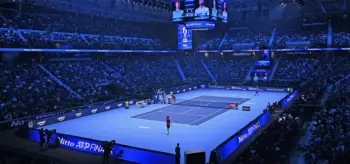
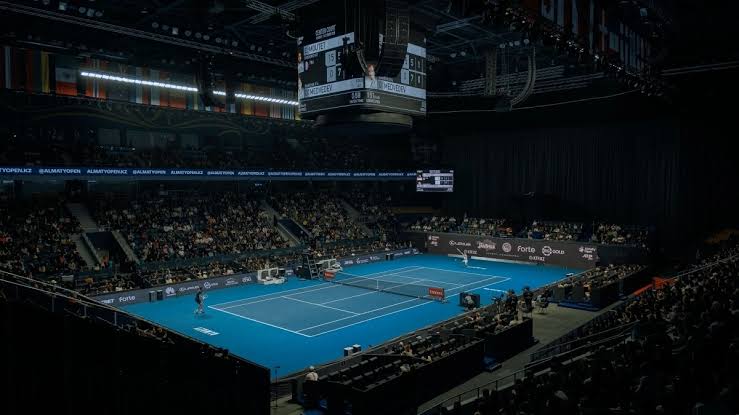
What surprised me about these numbers is that they come from indoor tournaments. Historically, we associate indoor hard courts with fast conditions: the ball skids through the court, points are quick, and players would often raise their tensions to gain a bit more control.
My impression, though, is that many modern indoor courts play significantly slower than they used to. I’ve had the chance to hit on some tournament-style indoor surfaces, and they can feel quite different. Some have a kind of plywood construction underneath, and both the sound of the ball and the feel of moving around are a bit unusual – not necessarily better or worse, just different. What stands out is how hard it can be to hit clean winners on some of these courts. Combine a slower surface with a heavier or slower ball, and you naturally get longer rallies.
Slower Conditions, Lower Tensions and More Powerful Racquets?
I think these trends are connected. When conditions get slower, players need to generate more of their own pace, and there are a few ways to do that: lower the string tension, use a slightly more powerful racquet – or play with a livelier ball.
I’ve talked before about how the Wilson US Open balls used at the actual tournament seemed noticeably livelier than the retail version you can buy in a shop, and I’ve also had feedback from pro players about differences in how tournament balls behave. Some love a lively ball because it helps them generate pace and finish points. Others prefer something heavier and slower because it gives them more time and makes it harder for opponents to hit winners. It really depends on your playing style.
Overall, though, I do feel that many conditions on tour are slower than they used to be. That could help explain why more players are experimenting with lower tensions and racquets that offer easier power. It’s definitely something worth following.
What Does This Mean for Recreational Players?
There are a few lessons here for us tennis nerds. First, I think the trend towards versatile 100 sq inch racquets makes a lot of sense. You don’t necessarily need a traditional 97 or 98 sq inch control racquet to get precision – modern 100 sq inch frames like the HEAD Speed MP can offer a very good balance of control, power, spin and forgiveness.
The same goes for string tension. If you’re using a firm polyester at 25 kg and struggling to generate depth, or finding the setup uncomfortable, it could be worth trying a lower tension. You don’t have to go all the way down to Mannarino levels – even 1–2 kg can make a noticeable difference. Of course, lower isn’t automatically better. If you’re already struggling with control or hitting long, look at your complete setup rather than just the number on the stringing machine.
As always, matching your racquet and strings to your game matters more than copying what the pros use.
More Racquet Changes Coming?
I expect we’ll see plenty more experimentation as we head into the off-season and the start of 2027. Will Moutet stick with the HEAD Speed? Will Medjedovic make a permanent switch? And will more players move towards larger head sizes and lower tensions? I’ll keep following it all.
If you’ve spotted any interesting racquet changes or have stringing information from recent tournaments, reach out on Instagram at @tennisnerdinsta or leave a comment below. You can also follow our YouTube channel for more pro player racquet updates, reviews and equipment discussions.