We have a guest post by Eric, founder of Toroline, about two tennis string metrics that really matter: spin potential and stiffness. I hope this helps you understand tennis string theory better. The article was posted in a slightly different format and wording on the Toroline substack.
This is a general article covering all kinds of strings, but it also provides an understanding of Toroline’s strings and product development. You can check out Toroline strings on their official website. You get 20% off your purchase when using the code TENNISNERD at checkout.
Terminology overload
If you’ve ever looked at a string spec sheet and thought:
“Why does choosing strings feel harder than choosing a racquet?” You’re not alone.
We’re bombarded with terms like:
- Spin potential
- Coefficient of friction
- Stiffness
- Dwell time
And all we really want to know is:
Will this string help me hit heavier spin?
Will it feel firm or comfortable?
Can I swing big without the ball flying long?
The good news? You can ignore most of the noise. Two metrics explain the majority of how a string will play:
Spin Potential
Stiffness
Understand how these two interact, and string selection becomes far simpler.
Spin Potential – Where Your RPMs Come From
Spin in modern tennis is not just about “grip.” It’s about snap-back.
When you hit topspin, the main strings don’t stay fixed. They:
• Slide laterally on the crosses
• Store energy
• Snap back into place
• Brush the ball during that return
That snap-back is the main source of heavy spin.
What the Number Really Measures
Spin potential is based on two types of friction:
String-to-string friction
How easily the mains slide on the crosses
String-to-ball friction
How well the string grips the ball
In simple terms:
Ball grip ÷ Internal slipperiness = Spin Potential
What a High Spin Potential Gives You
A higher value generally means:
• Easier access to spin
• More RPMs
• Higher net clearance
• A heavier, more aggressive ball
Technique still matters, but the string is no longer limiting your topspin.
Why Shape & Surface Matter
This is why we see:
• Shaped profiles = better ball bite
• Smooth or coated surfaces = lower string-on-string friction
• Certain polymers = more consistent snap-back over time
The best spin strings combine:
High ball grip + Low internal friction.
That’s the performance sweet spot.
Spin Alone Is Not Enough – Enter Stiffness
A common reaction:
“This string spins great… but it doesn’t feel right.”
That’s because spin potential tells you what the string can do.
Stiffness tells you how it does it.
Think of stiffness as the suspension of your racquet.
Stiffness: Feel, Control & Comfort
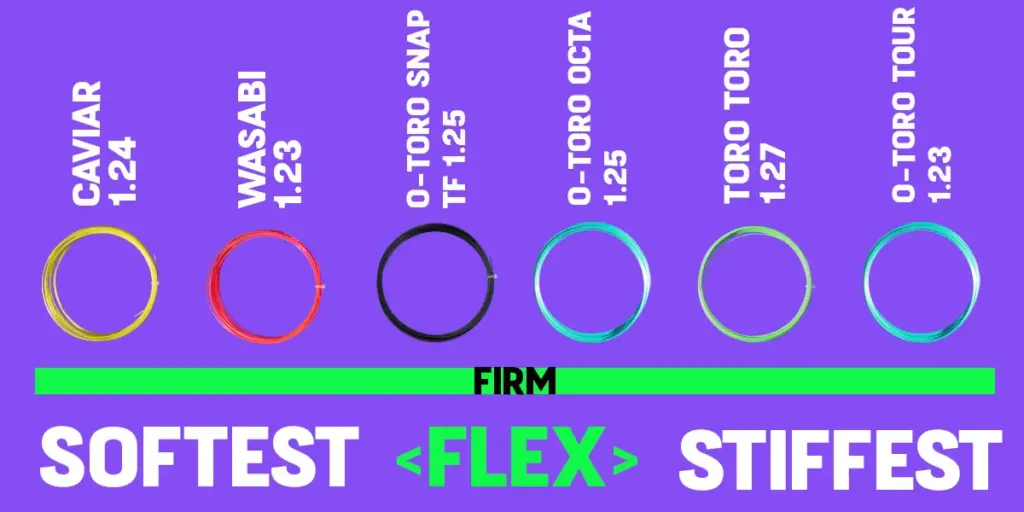
Stiffness describes how much the string resists deformation at impact.
Stiffer string = firmer ride
Softer string = more cushioning
Higher Stiffness?
• Less string deflection
• Shorter dwell time
• Lower trampoline effect
On court, this translates to:
• More control
• Lower power
• Crisper response
• Less comfort
This is why many advanced players prefer firmer polys, they allow full swings without over-hitting.
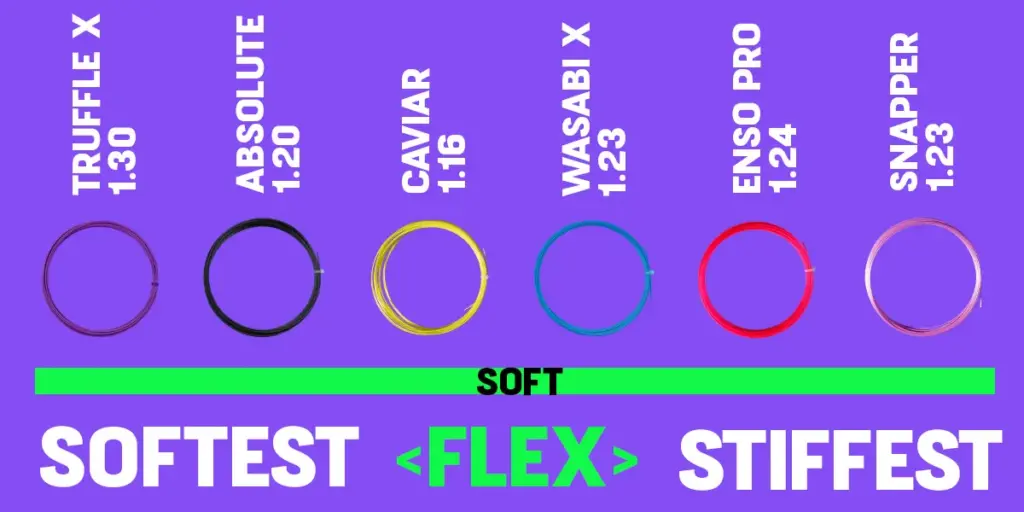
Lower Stiffnes?
• More string movement
• Longer dwell time
• More energy return
On court, you get:
• More power
• More pocketing
• More comfort
• Slightly reduced directional precision
Excellent for arm-friendliness and feel, but sometimes less predictable at high swing speeds.
Why These Two Must Be Read Together
This is the key takeaway:
Spin potential = how much spin is available.
Stiffness = how that spin is delivered.
Typical profiles:
High Spin + High Stiffness
Heavy spin, lower launch, firm and controlled, ideal for aggressive hitters.
High Spin + Lower Stiffness
Heavy spin, higher launch, more comfort and forgiveness.
Lower Spin + High Stiffness
Flatter trajectories, maximum control, smaller margin for error.
Looking at one number without the other often leads to the wrong choice.
Want to Compare Strings Objectively?
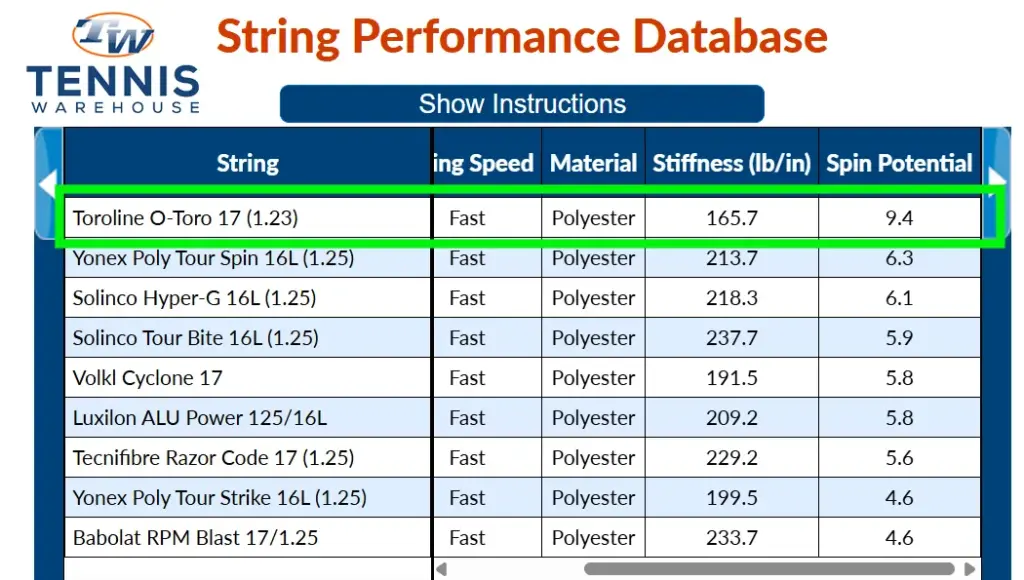
For players who like data, there’s a very useful public resource:
Tennis Warehouse University’s String Performance Database
It contains lab-tested results for hundreds of strings, including:
• Spin potential
• Stiffness
• Power
• Tension loss
You can compare multiple models side by side and quickly see why two strings that “feel similar” can perform very differently.
(Well worth bookmarking.)
A Quick Note on Hybrids
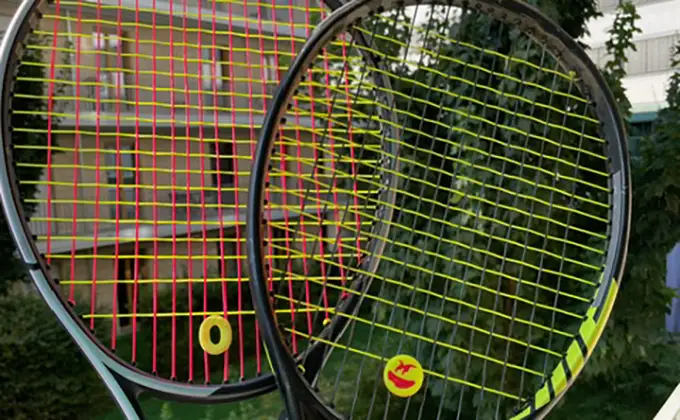
Most lab numbers are measured in full beds. In real play, hybrids change everything.
Different materials interact differently:
A string that isn’t very slick against itself may slide extremely well against another string.
This is why hybrids can provide:
• More snap-back
• Better comfort
• Improved tension stability
The data is a starting point — combinations are where performance is truly optimized.
How to Use This in Practice
A simple, effective approach:
- Choose your spin potential
How much spin assistance do you want? - Adjust with stiffness
How firm or comfortable should the response be?
Then fine-tune with:
• Shape
• Gauge
• Full bed vs hybrid
Final Thoughts
Strings are not just about power or spin in isolation.
They are about how the stringbed moves, snaps back, and releases the ball — and how that sensation translates into confidence.
Understand spin potential and stiffness, and you understand the foundation of modern string performance.
Everything else is just dialing it in.
_______
Thanks, Eric, for this! Check out our Recommended Strings here. Keen to hear your thoughts about this tennis string theory in the comments.