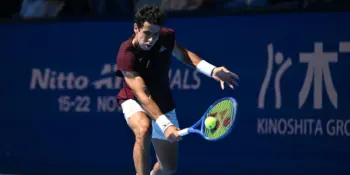
Professional tennis demands extreme cornering and rapid recovery. At Flushing Meadows, straight sprints rarely decide a modern baseline rally; instead, players like Carlos Alcaraz and Jannik Sinner rely on explosive sideways lunges and immediate changes of direction. To build lateral power away from the court, a growing number of competitive players and coaches are turning to an unexpected cross-training method.
While traditional distance running builds linear endurance, it does little to prepare the lower body for the sideways demands of a grueling three-set match. This has led fitness experts to seek alternative ways to condition hip abductors and ankle stabilizers. Training on wheels forces the body to push laterally to generate forward momentum, closely mirroring the specific muscular demands of high-level baseline tennis.
Replicating the Sliding Mechanics of Professional Clay Courts
During the European clay swing, players rely heavily on sliding into an open stance to recover wide shots. Executing this slide on crushed brick requires immense eccentric quad strength and exceptional ankle stability. Replicating this exact muscle tension off the court without access to traditional clay can be a challenge for many athletes.
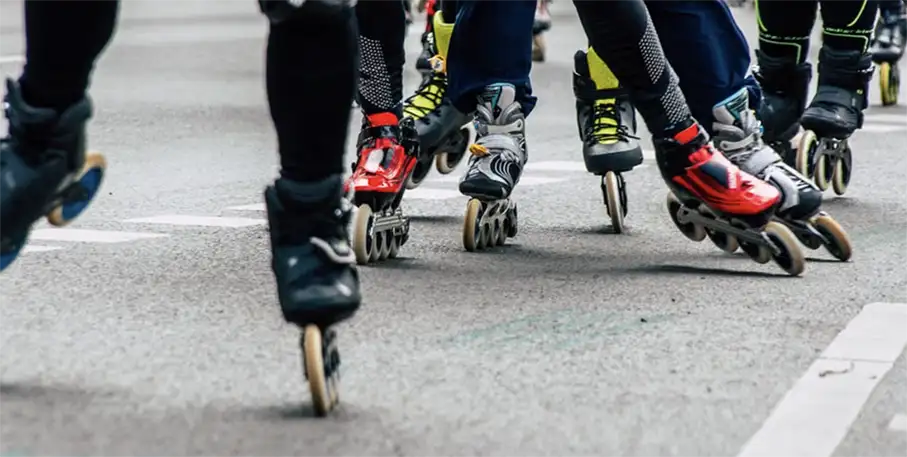
Using wheels inherently shifts an athlete’s plane of propulsion. While a runner pushes backward off their toes, a skater must drive the foot outward. This angled push mirrors the explosive first step a tennis player takes when chasing a wide forehand. The naturally lower stance drops the center of gravity, training the athlete to maintain balance under dynamic loads. Because a soft recreational boot will collapse under the pressure of intense cornering, rigid ankle support is essential for safety and performance. Equipment from USA Skate Shop’s inline skate selection provides the hard-shell boots needed to handle aggressive lateral push-offs and safely replicate court movements on pavement.
Building Balance and Ankle Strength for Sharp Directional Changes
High-level tennis biomechanics require constant, rapid footwork adjustments. As a competitor sets up for a groundstroke, their feet must instantly adapt to the spin, speed, and depth of the incoming ball. This physical adaptation occurs primarily through the stabilizing muscles surrounding the ankles and knees.
Stepping into inline skates instantly destabilizes the base of support, requiring the gluteus medius and core to engage simply to remain upright. Movement amplifies this effect, forcing deep lower-leg stabilizers to fire rapidly to prevent the ankle from rolling inward or outward. Navigating winding paths or slight inclines serves as effective agility conditioning. Skates with hard plastic shells lock the heel firmly in place, mimicking the secure fit of a premium tennis shoe and ensuring maximum energy transfer into the ground during aggressive push-offs.
Protecting Joints From the Severe Impact of Hard Surfaces
The North American hard-court season takes a heavy toll on the body. Cement courts finished with acrylic resin provide maximum traction but also send significant shock waves through the tibial and patellar tendons. Players who log heavy practice hours on these surfaces frequently experience tendonitis and chronic hip pain.
Cardiovascular conditioning remains essential, yet adding long-distance pavement running to a busy tennis schedule often compounds joint stress. Gliding on wheels eliminates harsh foot strikes entirely. This low-impact motion elevates the heart rate into the aerobic zones required for baseline rallies without subjecting the knees to repetitive shock. Players can comfortably sustain an elevated pulse for forty minutes on a paved trail while keeping the shear load on their joints low. By treating this activity as active rest, athletes can physically prepare for weekend tournaments while minimizing impact fatigue.
Integrating Wheel Sessions Into a Regular Practice Schedule
Careful integration ensures that this conditioning complements rather than hinders on-court practice. Fitness trainers often advise scheduling lateral endurance sessions once or twice a week on active recovery or light hitting days. Instead of focusing on intricate drills, athletes should prioritize maintaining a low athletic stance and practicing sustained lateral pushing over extended distances.
Players can use this training time for shadow movement drills, incorporating crouched gliding phases to simulate dropping the hips for a low slice return or volley preparation. The goal is to maintain muscular tension in the core and thighs over a sustained duration rather than simply chasing top speed. Substituting traditional jogging with this lateral exercise protects the joints and reinforces the stabilizing muscles used to plant, slide, and recover defensively during tense rallies.