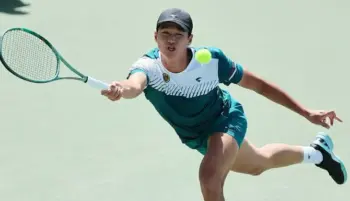
You watch a tennis match and you see rallies. What you do not see is the accumulated damage those rallies deposit over five hours on a hard court, in summer heat, after 10 previous matches in the same two-week tournament. Professional tennis is one of the most physically punishing sports on the planet. It just does not look that way from the broadcast booth.
The sport involves thousands of explosive directional changes per match, repeated overhead and lateral loading on the shoulder and elbow, and the kind of sustained high-intensity aerobic output that would challenge a competitive distance runner. A five-set match at a Grand Slam can involve 400 to 500 individual sprints. The cumulative neuromuscular cost of that, on top of the contact forces transmitted through the playing arm with every groundstroke, creates a physical demand that requires as much recovery science as any contact sport.
Nutrition is where recovery begins, and protein is the foundation. The muscle damage from repeated explosive efforts and the tendon stress from thousands of strokes per match both require amino acid availability to repair. Whey protein is a practical tool for professional tennis players precisely because it is fast-absorbing and leucine-dense: it delivers the anabolic signal quickly after a match or practice session, before the repair window closes, without the GI load that heavier food carries in a sport where players sometimes return to court the next morning.
What the Physiology of Tennis Actually Looks Like
Tennis is classified as an intermittent high-intensity sport, but that classification undersells the sustained demands of long matches. A study by Kovacs (2007) published in Strength and Conditioning Journal analyzed the physiological demands of professional tennis and found that elite players sustain heart rates between 60 and 90 percent of maximum for the majority of match play, with repeated spikes to near-maximal during points. Aerobic capacity, measured by VO2 max, was a significant predictor of performance in longer matches, particularly as the third and fourth sets progressed and fatigue began to differentiate players.
The work-to-rest ratio in tennis is highly variable and sport-specific. On grass, points are short and the aerobic demand lower. On clay, rallies are longer, points last more exchanges, and the metabolic cost is substantially higher. A five-set clay court match can produce energy expenditure equivalent to a half marathon, distributed across a playing time of four to five hours. The physiological profile of a clay court specialist and a grass court serve-and-volleyer are genuinely different athletes.
The Upper Extremity Problem
What separates tennis from most other sports physiologically is the asymmetric loading of the dominant arm. Every forehand, backhand, and serve transmits force through the wrist, elbow, and shoulder on the same side, thousands of times per match and hundreds of thousands of times per year. The structural adaptations this produces, including increased bone density and muscle hypertrophy on the dominant side, are well documented. So are the injuries.
Tennis elbow, rotator cuff tendinopathy, and stress fractures of the dominant arm are the occupational injuries of professional tennis. They develop gradually from repetitive microtrauma that accumulates faster than the body can repair it, particularly during the high-volume tournament blocks where players compete on consecutive days with minimal recovery. Managing the inflammatory load in the upper extremity is a constant priority for the sport’s medical staff.
Nutritional anti-inflammatory support, including adequate protein for tendon collagen synthesis and omega-3 fatty acids for inflammatory modulation, is a component of how elite players manage this chronic loading. Tendons are slower to adapt than muscle and slower to repair when damaged, which makes preventing overload more important than treating it after the fact.
The Lower Extremity Load on Hard Courts
While the upper extremity gets more attention in tennis injury discussions, the lower extremity absorbs the majority of the total physical load. Hard courts, which host the US Open and Australian Open and the majority of the ATP and WTA tour events in terms of weeks played, produce ground reaction forces that are significantly higher than clay or grass. Every split step, every lateral sprint, every hard stop transmits through the knees, hips, and lumbar spine.
The cumulative effect across a season of over 30 weeks of competition is significant. Hip flexor fatigue, patellar tendon stress, and lower back strain are among the most common complaints in professional tennis by the middle of the season. Players who manage their surface exposure, court time, and physical maintenance proactively sustain better physical availability across the year than those who respond reactively to problems as they emerge.
Sleep and the Tournament Schedule Challenge
The tennis tournament schedule creates sleep challenges that are distinct from team sports. Players travel individually, often across multiple time zones in a single week as they chase ranking points across different continents. A player might finish a night match in New York at midnight local time and have a flight to a European tournament the next morning. Managing circadian disruption while maintaining the physical and cognitive performance that professional tennis demands is one of the discipline’s least discussed challenges.
Night matches are particularly disruptive. The combination of physical arousal from competition and the artificial light exposure of an evening match delays melatonin onset and pushes sleep timing later, compressing the recovery window before the next day’s practice or match. Players who have developed deliberate sleep routines and circadian management habits hold up better across long tournament stretches than those managing sleep reactively.
Heat Therapy in Tennis Recovery
Regular sauna use has become part of the recovery toolkit for a growing number of professional tennis players, particularly during the clay court season when matches run long and the physical toll is highest. The heat shock protein response, improved peripheral blood flow, and growth hormone stimulus from regular traditional sauna sessions support the tissue repair work that a demanding match schedule continuously demands. The anti-inflammatory effects documented in the sauna literature are specifically relevant for a sport where chronic tendon and joint inflammation is an occupational reality.
The timing matters in tennis more than in once-weekly sports. Heat therapy is most useful in the 24 to 48 hours after a match, not immediately after, when the body is transitioning from acute recovery to tissue repair. Players with back-to-back match days use heat differently than those with a rest day available, which is where individual protocol design matters more than a blanket recommendation.
The Nutritional Framework Around a Tournament Week
A professional tennis player competing in a Grand Slam might play seven matches over 14 days, with matches potentially on every day that is not a scheduled rest day. The nutritional framework has to support daily performance and daily recovery simultaneously, which creates different demands than a once-weekly competition schedule. Protein targets stay consistently high throughout. Carbohydrate intake is periodized to match days, with higher intake on competition days and slightly lower on rest days. Hydration management is aggressive, given the heat and sweat demands of summer hard court tennis.
The players who navigate this best are the ones who have built enough nutritional discipline that the framework runs automatically, without requiring deliberate attention in the middle of a tournament when cognitive bandwidth is fully occupied by match preparation and execution. Building those habits in training is what makes them available under competitive pressure.