

I’ve used synthetic and leather base grips on an assortment of racquets, from classic 98 sq in control frames to lighter, more modern spin sticks. My goal was to give a real, honest perspective on what really changes when you change your base grip, not simply regurgitate spec sheets and forum myths.
| Attribute | Leather base grip | Synthetic base grip |
|---|---|---|
| Material | Natural leather, firm and dense | PU / foam / composite synthetics |
| Typical weight | Roughly 20–25 g, some up to ~30 g installed | Often around 10–15 g installed |
| Cushioning | Very firm, low shock absorption | Softer, more damping and comfort |
| Feel of bevels | Very pronounced, “classic” handle feel | Bevels more muted, smoother feel in hand |
| Balance effect | Makes racquet more head?light, raises static weight | Keeps closer to stock specs, lighter overall |
| Cost | Higher, premium product | Lower cost, widely available |
What Actually Changes When You Go Leather?
The addition of something like 8 to 12 grams to the handle is usually from the removal of a stock synthetic replacement grip and the addition of leather . The amount of increase may vary depending on the brand and how tightly the grip is wrapped .
So the static weight goes up and swingweight is hardly affected as all the weight is in the handle. Tests and expert advice always say that the overall weight goes up about 10 g and it gives a slightly more head-light feel rather than a slower swing through the air.
That’s exactly the feel you get on the court. The racquet is more stable against pace, more solid in the hand, but it doesn’t suddenly become a sluggish plank if you were used to the original weight.
The court consensus is in agreement here: point-and-shoot accuracy, incredible tension maintenance and a firm but pocketing impact feel that provides ultimate confidence when taking dead aim at the lines. I have personally tested this extensively in my Defyer 98 Pro and have also loaned it out to a few big-hitting clients.
Leather vs Synthetic: Core Differences
As far as the material is concerned, synthetic grips and leather grips serve different purposes.
Leather is denser, firmer and generally thinner, providing a more direct connection to the handle and a sharper bevel definition. Synthetic grips use layers of soft polyurethane or similar material to add cushioning, shock absorption and tackiness.
Synthetic bases have a more forgiving, plush feel, while leather is more uncompromising and traditional. This is beneficial if you want feedback and control, but less so if you want maximum comfort.
How the Extra Weight Feels On Court
The synthetic base was replaced with leather on modern 300 g, 100 sq in frames giving a much more planted feel in the hand. The racquet twisted less on heavy returns and blocks and counter-punch shots felt more solid without being more difficult to accelerate.
The mass moved toward the handle and took just a bit of weight off the racquet-head so I could keep the racquet-head speed for topspin but also have more control when I really went for the shot.
When trading pace from the baseline, the biggest difference I noticed was the leather gave the frame a more “tour”-like stability, even though the swingweight numbers didn’t go up much.
Feel, Feedback and Grip Changes
If you like the feel of “reading” the handle with your fingertips and prefer clean grip changes, leather is a clear upgrade.
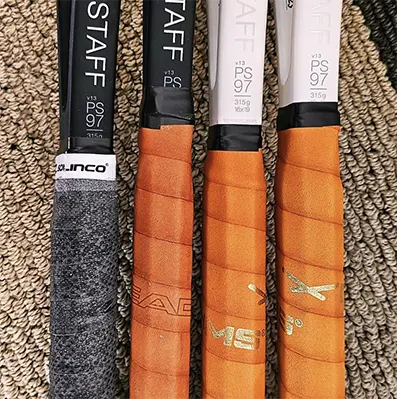
The bevels are more pronounced and the sharper geometry makes for easy locking into continental, semi-western or eastern grips without looking down or second guessing. That is why many advanced players and pros still like leather under their overgrips.
The extra feedback helped me improve my face angle on flatter drives, sliced backhands and touch volleys. I was able to catch slight errors in my grip earlier, which allowed me to correct my grip on the next shot.
Comfort, Shock and Arm Health
The bad news is that leather is unforgiving, especially when paired with a full poly string bed and a stiff frame.
I felt more raw impact in my palm and forearm when using just leather and a thin overgrip, which is consistent with published findings that leather transmits more vibration into the hand than thicker, softer synthetic bases.
The return to a high quality synthetic base on these racquets immediately softened all aspects including a more “pillowy” feel on defense and a reduction of sting on mishits. For players with sensitive wrists or elbows, this added damping will often outweigh the gain in precision.
Different Racquets, Different Outcomes
The leather felt like the missing piece on the already head-light, control-oriented 98–100 sq in frames in the 305–315 g unstrung range. I could get the classic bevel feel and more stability without making the racquet unwieldy.
But the frames for improvers, which were feather-light and balanced, sometimes had to add leather, which led to a static weight that was rather high, making the longer hitting sessions more tiring, despite the frames still being maneuverable, thanks to their more head-light balance.
Thus, the same leather grip that feels just right on a thin-beam player frame may feel “too much” on an entry-level racquet that wants to stay ultra-light and cushioned.
So…Is the Extra Weight Worth It?
Considering all of the above and my own feelings of using different racquets, I would argue that if you value feel, feedback and a more stable, head-light response and if your arm can take a stiffer ride, then the extra weight of a leather base grip is worth it.
If comfort, shock absorption and ease of use are your priorities, or you play with very stiff frames and harsh string setups, then a synthetic base grip with an overgrip on top is probably a safer bet.
For players who are already fiddling with balance, string choice and swingweight for performance, leather is not just ‘extra weight’ but a precise tool for changing the personality of the racquet towards control and feedback. This is exactly the feeling I had when I started to swap them around on my own frames.