Somewhere between training and rehabbing existing injuries, there is a hidden champion of preparation that often goes unmentioned. Prehab, as the name suggests, should prevent you from serious injuries and extend your performance, without necessarily being heavy training itself. Especially in tennis, there are structures that get loaded every time that we step on a court, and these should be prepared for it. Therefore, I wanted to give you a rough idea what prehab could look like for your 2026 season and give you a few sample exercises for shoulders, hips and knees – three of the most used joints in tennis.
Check our fitness blog to find more good tips for your training!
Shoulders – make them bulletproof
Arguably, the shoulder takes most of the stress for tennis players – especially if you are competing and serving a lot. The joint is one of the most complex structures in the human body, with many very fine tendons that need to work together perfectly. This makes training this joint rather difficult, as you cannot simply load it heavily in all directions. After sustaining a grade 1 SLAP tear, I have established this routine that helps with rotator cuff and joint strength.
2 rounds total, no rest between exercises, rest as needed between blocks/rounds:
| Block 1 | Block 2 | Block 3 |
| 10 Banded Rows | 10 external band rotations /side | 10 banded front raises |
| 10 Banded Face Pulls | 10 internal band rotations /side | 10 banded side raises |
| 10 Banded Reverse Flys | 10 Banded Cuban rotations Band Cuban Rotations | 10 scapular push ups Scapular Push Up |
I usually complete the exercises right after each other, with no rush but no dedicated rest either, to get used to repeated movements as in rallies. You should feel a slight burn but no pain towards the end of each block. Especially with the shoulder, you want to choose a rather light band to keep the movement controlled and not go for broke here.
Hips – the new tennis elbow?
We have seen plenty of hip injuries in past years, starting with Andy Murray, but now more and more players seem to get injured in this area. Of course, this is linked to the aggressive hard courts we are seeing and the enhanced movement of players. We might not move the same as recreational tennisnerds, but our hips should still feel good and be treated well. For good hip health, I swear by a mixture of accessory work and stretching, as the joint likes to get stiff by daily office work and sitting, which are very prevalent in the western world.
Strength work: 2 rounds total, 30s rest between exercises, 2 mins between rounds:
10 single leg banded glute bridge / side
Single Leg Banded Glute Bridge
10 banded hip abductions / side
Band Standing Hip Abduction
10 banded hip march / side
Banded Hip Flexor March
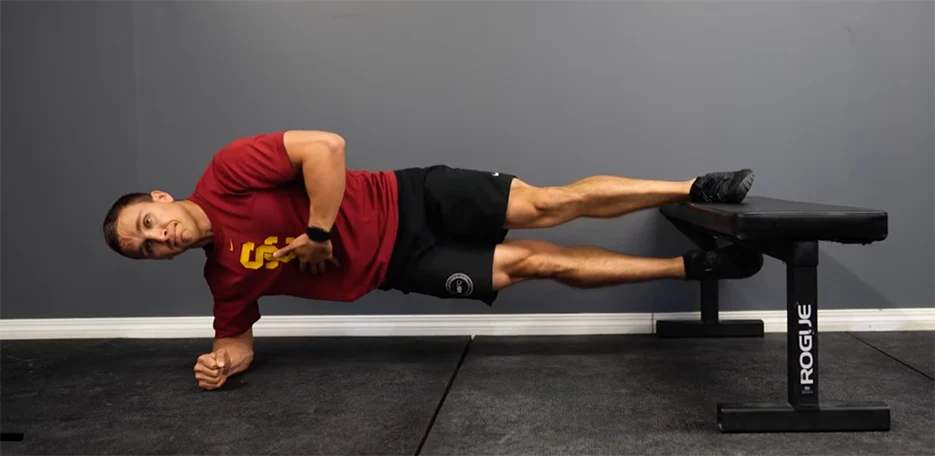
20-30s Copenhagen plank / side (image on top)
Copenhagen Plank
For flexibility and stretching, I vary exercises daily and I usually either stretch first thing in the morning or right before going to bed. It needs to be noted that especially with static stretches, you should not do these right before physical activity or straight after but rather wait and do these as a separate session. If I had to choose three stretches that will give you an all-around help for tight hips, these are my go-top options:
Couch Stretch / 2-3 mins per side
Pigeon Stretch / 2-3 mins per side
Frog Stretch / 2-3 mins
Knees – it isn’t all about the big muscles
For the knees, which are notoriously demanded in tennis, we tend to think that we are doing enough by squatting, deadlifting and training the bigger muscles around them. And while it definitely pays to do heavy leg extensions, leg curls etc., there are some exercises that can leverage your entire knee ability. If you want further inspiration on this, I highly recommend following the Insta account “knessovertoesguy”, who has tons of great stuff to further dive into. Due to time restrictions, I mainly stick with these short variations for my personal training:
2 rounds total, 30 seconds rest in between exercises, rest as needed between rounds
10 full-range calf raises / side
Full Range Calf Raise
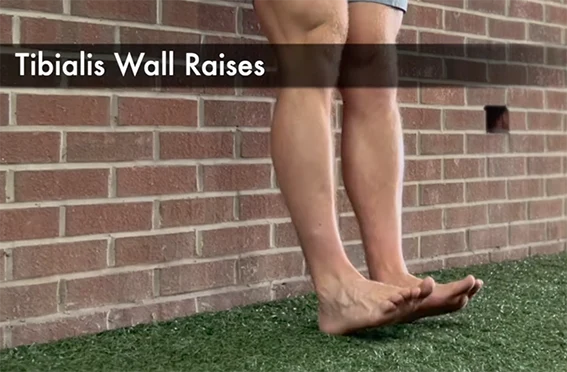
20 wall tibialis raises
Tibialis Wall Raises (Exercise Demo)
8-10 box step downs with light weight / side
ATG Basics – The Reverse Step Up #atg #workout #footwear #sneaker #kneepain #vertical
If you want further work on your knees, I highly recommend any training for the hamstring, to counter the quad-heavy load of tennis day-in-day-out. Please note that for all these trainings, these do not represent a standalone training method and if you are unsure, be sure to consult a local trainer before starting with these right away. Have fun, stay healthy and don’t forget to play some tennis ?