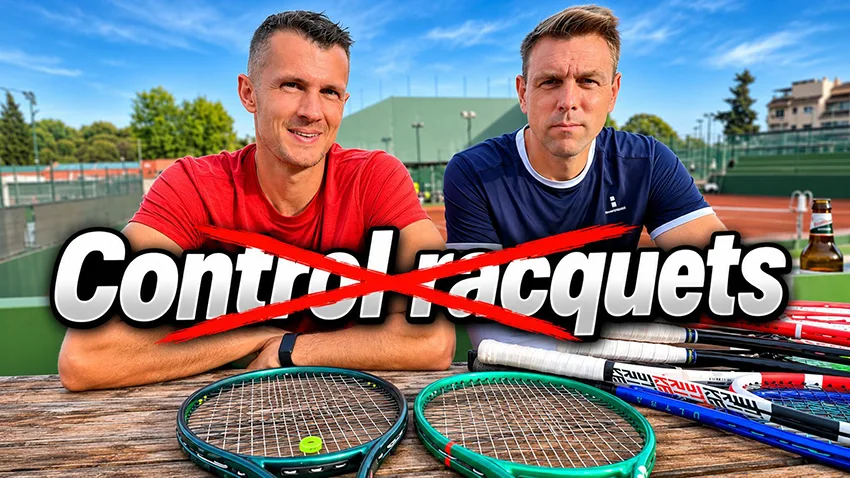
Modern tennis is increasingly about power, spin, and forgiveness. Many of us who grew up playing with traditional control racquets have moved toward more powerful, accessible frames. But are we missing something in the process?
I recently spent some time on court with Henrik, gear expert for the Swedish Davis Cup team, and Willy from Holy Tennis, testing a bunch of interesting pro-stock racquets. It turned into a discussion about control racquets, confidence, playing styles, and what we actually need from our equipment.
And perhaps control racquets aren’t quite as dead as some of us thought.
The racquets we tested
We had some rather beautiful tennis racquets at our disposal for this session.
- HEAD Prestige MP pro stock (345.2)
- HEAD Speed Tour (375.1)
- HEAD Prestige pro stock (334)
- Wilson H19
- Wilson H22
These are quite different interpretations of the control racquet. While traditional control frames often came with smaller head sizes and dense 18×20 string patterns, several of these racquets offer more open string patterns and larger hitting surfaces.
They still deliver that controlled, connected response that many racquet nerds appreciate, but with some concessions to the modern game.
Rediscovering the confidence of a control racquet
Perhaps the most interesting takeaway from our testing came from Willy.
He played some of his best tennis with the HEAD Prestige 293.2, based on the older Prestige IG MP. However, like many advanced players, he has become increasingly interested in more modern racquets offering easier access to power and spin.
Testing these control frames challenged that thinking.
What he rediscovered was the confidence to accelerate fully through the ball. Rather than holding back or trying to manage the power of the racquet, he felt comfortable committing to his shots.
That is an important aspect of racquet choice that can sometimes get lost when we focus too much on specifications.
A racquet with less inherent power might actually help certain players produce a more aggressive ball because they feel comfortable swinging faster. The confidence to go after your shots can be worth more than a little extra assistance from the frame.
Willy played some excellent tennis with these racquets. He could hit through the court, attack the net and serve with authority.
Whether this means he will move away from his Wilson Defyer 98 Pro remains to be seen, but the test certainly gave him something to think about.
Are control racquets too demanding?
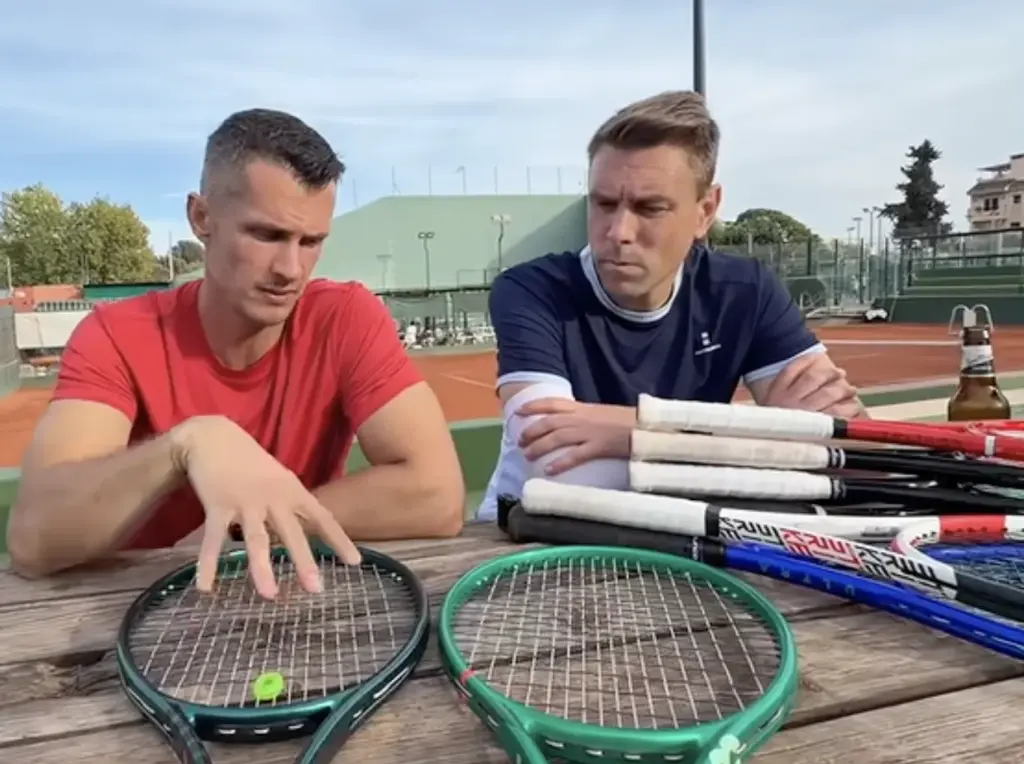
The other side of the conversation is that most recreational players probably shouldn’t rush out and buy a heavy, thin-beamed pro stock racquet.
These frames require good preparation, acceleration, timing and consistent contact with the ball. When you are late or out of position, they tend to give you less help.
It is relatively easy to fall in love with the feel of a control racquet during a cooperative hitting session. Playing a competitive match against someone who puts you under constant pressure is a different proposition.
This is something I have experienced many times in my own racquet journey. I love the sensation of hitting a clean ball with a traditional control frame, but that doesn’t necessarily mean it is the best racquet for my competitive tennis.
Finding the balance between enjoyment and performance is one of the great challenges of being a racquet nerd.
The HEAD Speed Tour – a more accessible control racquet
Henrik’s favorite of the four racquets in our initial control-frame test was the HEAD Speed Tour.
Despite generally gravitating towards more forgiving 100-square-inch racquets, he played some excellent tennis with the Speed Tour, particularly on serve.
With his relatively compact strokes, he appreciated how easy it was to generate racquet-head speed with the lighter setup.
The Speed Tour is an interesting proposition because it offers a greater degree of control without going all the way into traditional Prestige territory. The slightly thicker beam and more accessible response make it an appealing option for players who want control but don’t necessarily want all the demands of a classic player’s racquet.
Of the four frames in that part of our test, this was the one Henrik felt he could comfortably take into a tournament.
It is a good example of how modern control racquets can offer a useful compromise.

The HEAD Prestige pro stocks
There is still something rather special about hitting with a good Prestige.
The 345.2 pro stock we tested offers the kind of controlled response that makes you want to accelerate through the ball. It also happens to look fantastic in its glossy, dark burgundy cosmetic. It is based on one of my personal favorite racquets, the HEAD Prestige 2019.
The 334 (the current Prestige MP 2023) was another interesting frame, with a 99-square-inch head size and an 18×19 string pattern. Despite its control-oriented design, we found the launch angle a little less predictable than some of the other racquets.
This is another reminder that head size, string pattern and beam width only tell part of the story.
Two racquets with relatively similar specifications can behave quite differently depending on the mold, layup, string spacing and weight distribution.
And this is, of course, where the pro stock rabbit hole becomes particularly interesting.
Wilson H19 vs H22
We also spent some time comparing two of Wilson’s most famous pro stock racquets: the H19 and H22.
Both of our test racquets had 16×19 string patterns, slightly extended lengths and swingweights of around 340. They were also strung with the same hybrid setup of Toroline VAMOS and Tecnifibre Snap at the same tension.
Despite these similarities, they offered quite different experiences on court.
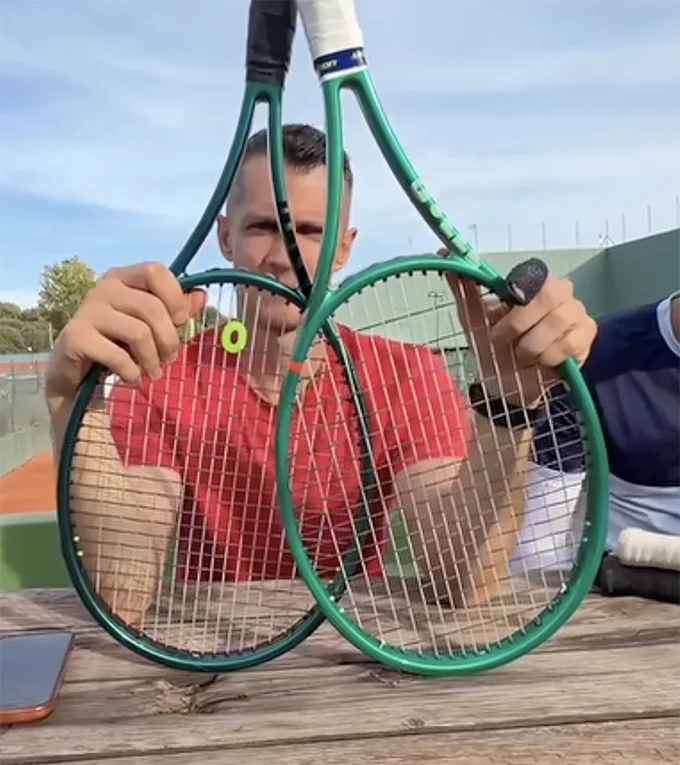
Wilson H19
The H19 feels closer to a traditional HEAD Prestige. It has a thin beam, a controlled response and a lovely feel when you strike the ball well.
During our testing, we found it to be the more versatile of the two racquets.
It was particularly enjoyable when moving forward, hitting volleys and varying the pace of the ball. We also preferred it for the one-handed backhand.
Willy found that the H19 offered better depth control while still allowing him to generate plenty of spin.
It is by no means an easy racquet to play with, especially in the extended and relatively high-swingweight configuration we tested. But for advanced all-court players who appreciate a traditional response, there is a lot to like.
Wilson H22
The H22 is a rather unique racquet.
It has a thicker, constant beam and offers an interesting combination of flexibility, feel and forward penetration.
One of the challenges with the H22 is that some examples come with a relatively high unstrung swingweight. This can limit your customization options and make it difficult to achieve a more manageable playing specification.
Henrik has never quite connected with the H22. He finds the 18×20 versions demanding and low-powered, while the 16×19 can become rather lively. We experienced some of that during this session. The open-pattern H22 could produce a very penetrating ball, but controlling the depth wasn’t always straightforward.
It also felt somewhat sluggish when trying to change direction quickly, particularly with a one-handed backhand.
However, I can understand why aggressive baseliners who like to hit a heavy ball might appreciate this frame. There aren’t many racquets that deliver quite the same combination of feel and penetration.
Wilson H19 vs H22 – comparison
| Wilson H19 | Wilson H22 | |
|---|---|---|
| Playing style | Aggressive all-court | Aggressive baseline |
| Feel | Traditional and connected | Plush and unique |
| Power | More controlled | More forward penetration |
| Depth control | More predictable | More demanding |
| Net play | More versatile | Can feel sluggish |
| One-handed backhand | Our preference | More challenging |
| Customization | Build dependent | Can be limited by stock swingweight |
| Difficulty | Demanding | Demanding |
These impressions are based on the particular setups we tested. Pro stock racquets can vary significantly in specifications, so it is important not to generalize too much from individual examples.
Willy preferred the idea of a 16×19 H19 and an 18×20 H22, which highlights how much of a difference the string pattern can make within the same mold.
Interestingly, although both of our test racquets were 16×19, the distribution of the strings was different. One had three main strings passing through the throat area on each side, while the other had four.
The number of strings only tells part of the story. How those strings are distributed across the hitting surface can also influence how a racquet responds.
The impact of extended length
Both Wilson pro stocks were slightly longer than standard length, which was another interesting variable.
Extended length can help create additional leverage and power, particularly on serve. However, it can also increase swingweight, change your contact point and make quick adjustments more difficult.
For my one-handed backhand, I generally prefer standard-length racquets.
The extra leverage can be useful, but I don’t always feel that it compensates for the reduced maneuverability. This becomes particularly noticeable when playing against someone who gives you less time to prepare.
Again, this is highly individual. Some players love extended racquets and wouldn’t consider going back to standard length.
Finding the right string for a control racquet
Another interesting takeaway was how well our Toroline VAMOS string worked in several of these control frames.
Willy had tested VAMOS in his Wilson Defyer but didn’t feel it was the ideal combination. In the control racquets, however, he really enjoyed the response in both full-bed and hybrid setups.
This illustrates something we frequently discuss at Tennisnerd: a good string isn’t necessarily a good string for every racquet.
The interaction between the frame, string pattern, string stiffness and tension is extremely important.
Finding the right combination can transform how a racquet plays, and it is often worth experimenting with strings before deciding that a particular frame isn’t right for you.
Are pro stock racquets better than retail racquets?
Not necessarily.
Pro stock racquets are fascinating because they offer different molds, layups, string patterns and customization possibilities. They can also provide a level of feel that is difficult to find elsewhere.
But they are not automatically the best tennis racquets.
A well-chosen retail racquet that suits your playing style and physical capabilities will often be a better option than an exotic pro stock that is too demanding.
There is absolutely nothing wrong with collecting or experimenting with rare racquets because you enjoy them. I certainly understand that part of the hobby.
But if your main objective is winning tennis matches, it is worth separating the enjoyment of testing racquets from the practical requirements of competitive tennis.
Are control racquets dead? Summary
Our session was a good reminder of why so many of us still love control racquets.
For Willy, it was about rediscovering the confidence to swing freely and play aggressively. For Henrik, it was the discovery that a more accessible control frame like the Speed Tour could work surprisingly well with his game.
Personally, I still gravitate towards more modern racquets when thinking about competitive tennis, but there is something incredibly satisfying about the response of a good traditional control frame.
Of the two Wilson pro stocks, I generally preferred the versatility of the H19. The H22 is a fascinating racquet, but in the setup we tested, it required more from me than I was comfortable giving consistently.
Modern racquets offer plenty of advantages. Easier power, spin and forgiveness are all valuable, particularly as the game becomes faster and more physical.
But power isn’t everything. Confidence, predictability and the ability to commit fully to your shots are also important.
Control racquets are definitely not dead. You just need to be realistic about whether they suit your game.
What do you think? Are you still playing with a traditional control racquet, or have you moved towards more modern power and spin frames?
And if you had to choose between the Wilson H19 and H22, which one would you pick?
Let me know in the comments below.