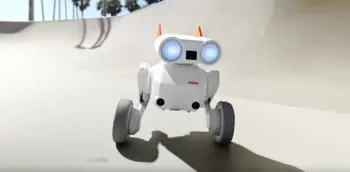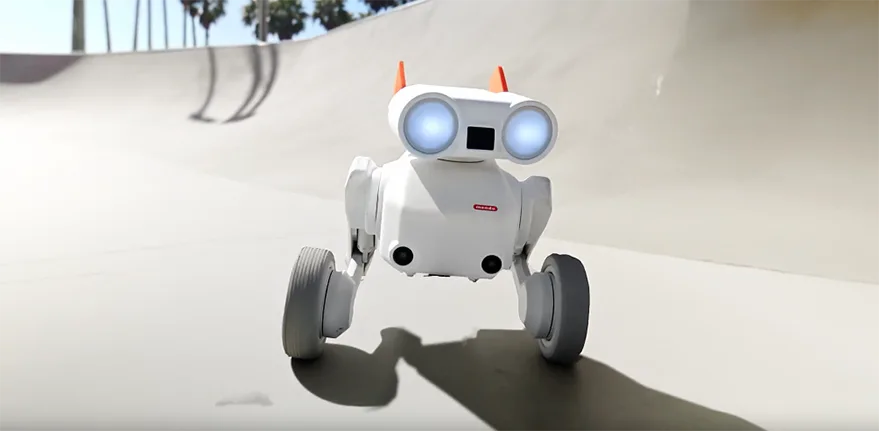
Most cameras that film you without a camera operator either stay put on a tripod or fly overhead as a drone. Beni, the first consumer product from Mondo Robotics, takes a third route: it is a small, two-wheeled, self-balancing robot that drives along the ground, follows a chosen subject and records stabilized video as it goes.
Below we’ll cover what Beni does, its technical specifications, its known limitations, and how it might (and might not) fit into tennis practice.
You can visit their website here, for a 5% discount when ordering the Beni robot.
Background
Mondo Robotics is a startup with offices in Palo Alto and Shenzhen and, by its own account, around 150 engineers and designers. Beni was announced in July 2026 with a Kickstarter campaign that went on to raise just over $5 million from about 7,900 backers. Early hands-on coverage noted that the product began life closer to a children’s toy before the company repositioned it as a personal camera robot for creators, families and active users.
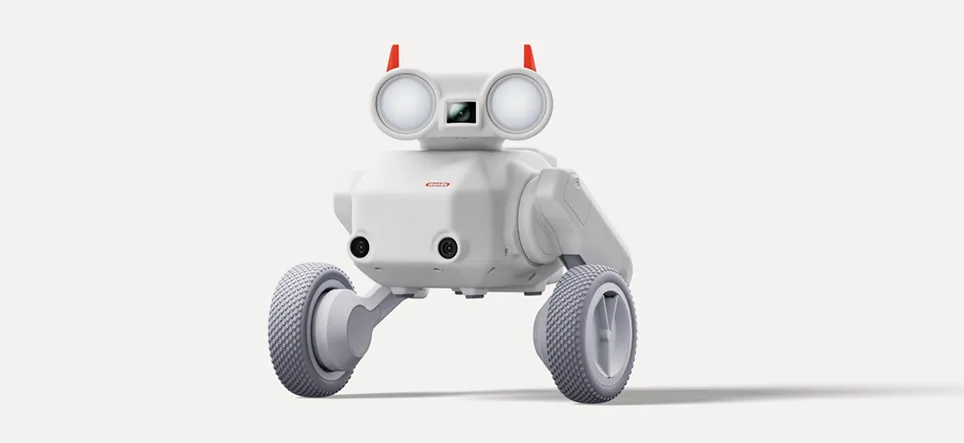
That history shows in the design. Beni has a blocky “head” with a screen face, changeable expressions and colored eyes, it can nod and shake its head, and it has a built-in game mode. The personality features are part of the appeal for some buyers, but they have no bearing on how well it films, so the rest of this article concentrates on the camera and the robotics.
How it works
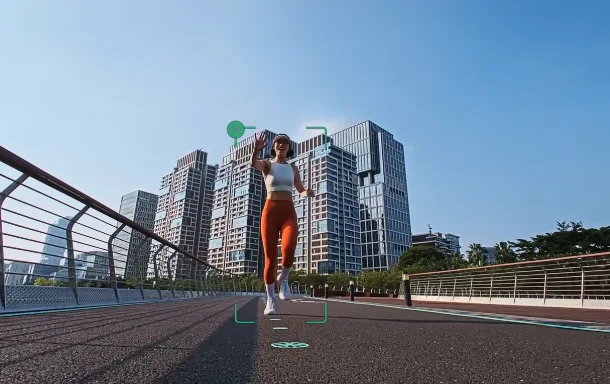
Beni balances on two wheels and uses depth sensing to follow its subject. Tracking and obstacle avoidance are handled by two sensor cameras with a 150-degree field of view, separate from the main recording camera. You choose who to follow in the companion app (iOS at launch), and Beni can then follow from behind, from the side, from ahead, or circle around the subject.
A wearable Motion Tracker acts as a beacon. Besides giving you buttons to start recording, drive the robot manually with a joystick or trigger actions, it helps Beni find you again after you briefly disappear from view, for example behind another person. Beni can also be controlled from a phone, an Apple Watch or a game controller.
Other features include:
- HybridFlow stabilization, which combines mechanical and electronic stabilization to smooth out bumps as the robot moves.
- Obstacle avoidance using its optical and spatial sensors, marketed as “Smart Path.”
- Self-righting: if it is knocked over, it gets itself back up onto its wheels.
- Jumping: Mondo lists an automatic stair or curb jump of up to 10 inches. Note that an early hands-on review from TechRadar described automatic jumping over obstacles as a future goal at the time of testing, so how well this works on shipping units is worth checking in independent reviews.
- AI editing, which assembles selected clips into a short highlight reel automatically.
- On-device processing: the company says filming and tracking are processed on the robot itself rather than in the cloud.
- Accessory mounts for 360-degree, action and mini cameras, plus support for third-party wireless microphones.
Technical specifications
The figures below are the manufacturer’s published specifications.
| Specification | Detail |
|---|---|
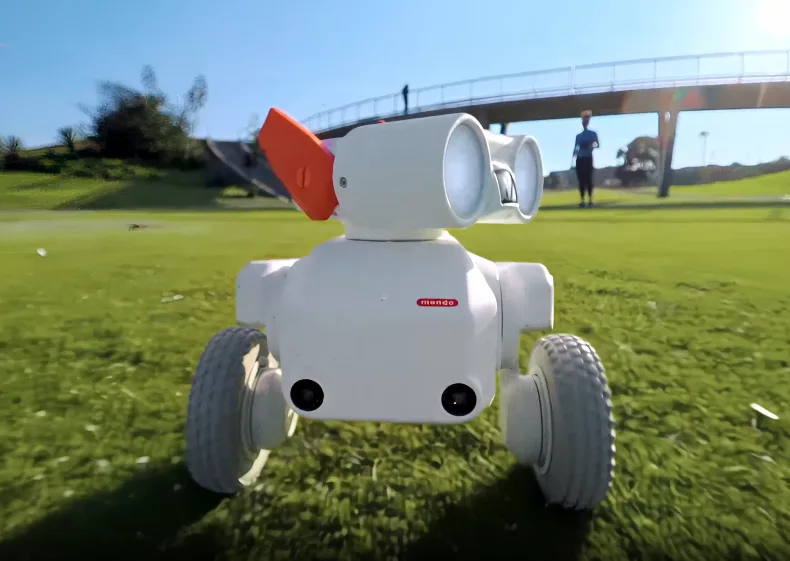
| Dimensions (standing) | 16.6 × 21.5 × 21.8 cm (6.54 × 8.46 × 8.58 in) |
| Weight | 1.8 kg (4 lb) |
| Top speed | 28.8 km/h (17.9 mph) |
| Max jump height | 25.4 cm (10 in) |
| Camera sensor | 1/1.3-inch CMOS, 10-bit color, 2x zoom |
| Video modes | 4K/60fps HDR; 3K/60fps (16:9 or 9:16 vertical); 1080p/120fps |
| Tracking sensors | Two sensor cameras, 150° field of view |
| Battery life | About 90 minutes per battery (measured at 1080p/30fps, continuous auto-follow) |
| Charge time | About 60 minutes |
| Storage | 32 GB internal (slightly less usable), plus microSD slot |
| Water resistance | None — not for use in rain, snow or standing water |
| Recommended surfaces | Flat pavement, packed dirt, short grass, gravel |
| Warranty | 1-year limited, water damage excluded |
Two points stand out. First, the 90-minute battery figure was measured at 1080p and 30fps; recording at 4K/60 or driving on rough ground will shorten it. The batteries are removable, so spares are the practical answer for longer sessions. Second, some early coverage quoted different frame rates (for example 4K at 30fps), which likely reflects pre-production specs. The figures above are from Mondo’s current product page.
How much does it cost?
Beni is sold in two bundles:
- Standard Combo — $799 / €799 / £699. Includes the robot, standard wheels, one battery, the Motion Tracker, a hat accessory and a chest protection plate.
- Explore Combo — $959 / €959 / £829. Adds two extra batteries, a charging hub and off-road wheels.
Known limitations
From what we know so far, the main caveats are:
- Tracking has conditions. Mondo says tracking is optimized for people and domestic dogs in good lighting, and that fast occlusion (the subject being quickly blocked from view) and low light reduce accuracy. So basically, it’s possible to lose the tracking and collide with stationary objects in certain conditions.
- The camera angle is fixed low. Beni films from ground level, looking up at the subject. That is a distinctive look, but it is not a substitute for a camera at eye level or above, and therefore not suitable for all content.
- It is not waterproof, and water damage is excluded from the warranty.
- Terrain is limited to reasonably firm surfaces. Mud, loose sand and deep snow are off the table, and the standard wheels are fairly smooth; the off-road wheels come only in the more expensive bundle.
- Track record. This is a first product from a new company. A successful crowdfunding campaign says nothing about long-term software support, so firmware updates and after-sales service are worth watching.
Beni and tennis
Mondo does not market Beni specifically for tennis and it’s fairly limited in this regard. Its product page talks about walking, running, skating and “sports” in general. Even so, many club players and coaches already film practice sessions, so it is fair to ask how a following camera robot might fit.
Where it could be useful
- Footwork and movement drills. Beni’s ability to follow from behind or beside a player could suit ladder drills, side-to-side shuffle work, or fitness sessions off the court, where the point is to see how someone moves rather than where the ball goes.
- Slow-motion stroke review. The 1080p/120fps mode is enough to slow down a serve or groundstroke for basic technique review, similar to what many players already do with a phone.
- Surfaces. Hard courts fit the “flat pavement” category, and short grass is on the supported list. Well-maintained clay is firm, but loose surface material could affect traction, so treat that as untested.
- Speed. A top speed of 17.9 mph is above what most recreational players reach while sprinting, so raw speed is unlikely to be the limiting factor.
Where it is less suited
- Match and rally analysis. Coaches usually want an elevated view from behind the baseline that shows both players, the ball and court position. A low, moving camera that follows one player shows none of that well. A fixed camera on a fence mount or tripod, or a dedicated tennis analytics app that tracks shots and ball placement, is still the better tool for that job.
- Tracking conditions on court. Tennis involves sharp changes of direction, and in doubles the subject is often briefly blocked by a partner, exactly the fast occlusion Mondo says reduces tracking accuracy. The Motion Tracker beacon should help it relocate a player, but this has not been widely tested in racket sports. Indoor courts with uneven lighting may also be harder for it than bright outdoor courts.
- On-court safety. A 1.8 kg robot moving around a court is a trip hazard and a likely target for stray balls. Anyone trying it should keep it outside the playing area or use it for solo drills, and check whether their club allows it at all.
- Session length. A typical 90-minute practice session is right at the edge of a single battery’s rated life, and less if filming in 4K. Players planning regular use would likely want the bundle with spare batteries.
In short, Beni is clearly not made for tennis specifically but it could be a cool alternative in some cases. It’s better thought of as a moving camera for individual movement and technique clips.
Is it worth it?
Beni is a well-specified camera robot: a 1/1.3-inch sensor with 4K/60 HDR, combined mechanical and electronic stabilization, a 17.9 mph top speed, and a self-righting, two-wheeled design that weighs about 4 lb. Its strengths are hands-free, ground-level follow shots of people and pets on firm surfaces. It really looks fun to use in a lot of every-day activities, certain sports or with families and pets.
Its limits are a fixed low viewpoint, tracking that depends on light and a clear line of sight and no water resistance.
For tennis players, it is an interesting option or alternative for some drills and movement footage, but probably not something we would use often for court footage. Check the recommended use cases that really suit this robot before purchasing.
We have not yet tested the Beni robot ourselves but we plan to make a test in the near future and will review it on the site!
For now, visit the Mondo Robotics website to find out more.