
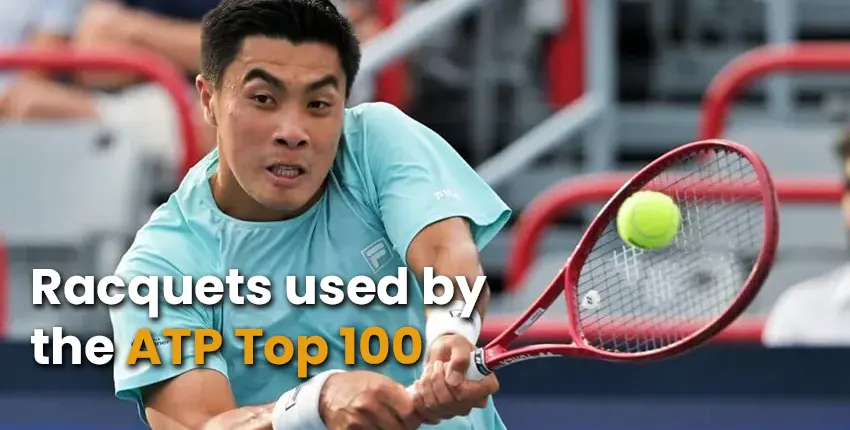
Which racquets are actually being used by the ATP Top 100 in 2026?
It is an interesting question because the professional tour does not always reflect what is most heavily marketed at retail. Also, most pros use older racquets painted to look like the latest models. Still, if you use a Blade from 2007 and it is painted like a Blade V10, you are still a Blade user. Some players do endorse one line and play with something else, like Lorenzo Musetti endorsing a Boom and using an Extreme. Or Reilly Opelka, using a Tfight, but endorsing a TF40. Djokovic is playing an old Radical mold and not a Speed. But, for this exercise, we focus on what they endorse.
I went through the ATP Top 100 as of August 13th 2026 and manually counted which racquet family each player is using. The result is a pretty fascinating snapshot of the current racquet landscape.
There are exactly 100 players represented in this count, divided between seven brands:
- Wilson: 25
- Yonex: 25
- HEAD: 21
- Babolat: 17
- Tecnifibre: 7
- Dunlop: 4
- Diadem: 1
The headline is obvious: Wilson and Yonex are tied at the top with 25 players each. But once you dig into the individual racquet lines, things become much more interesting.
Wilson and Yonex Lead the ATP Top 100
The biggest takeaway from this exercise is just how strong both Wilson and Yonex are at the top of men’s tennis. Each brand has 25 players inside the Top 100, meaning that between them they account for exactly half of the players in this sample.
But they get to that number in very different ways.
Wilson’s tour presence is led overwhelmingly by one racquet family: the Blade. Yonex, meanwhile, has a more balanced split between the VCORE, EZONE and PERCEPT, although the VCORE is clearly the biggest line.
That difference says quite a lot about the positioning of the two brands. Wilson has one extraordinarily dominant control-oriented franchise, while Yonex has three clearly established racquet silos that are all finding meaningful adoption on tour. Will the Wilson Defyer change that? Maybe.

Wilson: 25 Players
Wilson has the joint-highest representation in the ATP Top 100 with 25 players.
The breakdown is:
Blade: 14
Mensik, Humbert, Buse, Van Assche, Tsitsipas, Halys, Landaluce, Carreno Busta, Hurkacz, Molcan, Diaz Acosta, Sonego, Kovacevic and Damm.
Defyer: 6
Fery, Khachanov, Atmane, Korda, Tirante and Rune.
Ultra: 4
De Minaur, Tien, Wong and Gaston.
Pro Staff: 1
Lehecka (Dimitrov is outside top 100 these days).
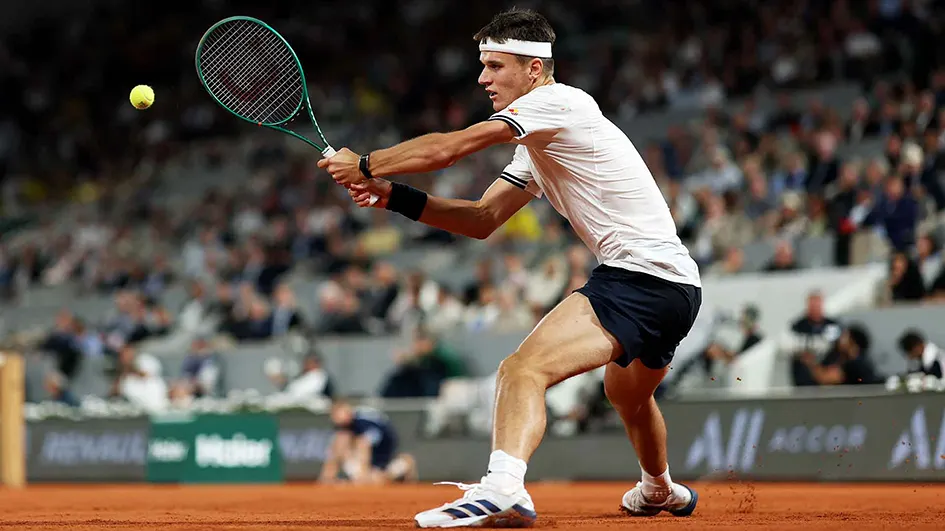
The Blade Is Still the King of the Tour
The most remarkable Wilson statistic is not really that Wilson has 25 players. It is that 14 of them are using the Wilson Blade, making the Blade the single most represented racquet line in this ATP Top 100 count. (Check our review of the new Wilson Blade V10).
This is worth highlighting because there has been so much attention around newer racquet concepts and higher-launching frames. The modern professional game is increasingly built around spin, movement and heavy baseline patterns, yet the Blade remains enormously successful. That tells you something about the continuing appeal of a controlled, predictable response.
Players at this level generate their own racquet-head speed. They do not necessarily need the racquet to produce extreme power or launch for them. Instead, many want confidence. They want to know what the ball is going to do when they accelerate fully, and the Blade concept continues to deliver that for a wide variety of players.
The names are also interesting because they do not all play exactly the same style of tennis. You have players such as Stefanos Tsitsipas, Ugo Humbert, Jakub Mensik, Hubert Hurkacz and Lorenzo Sonego all sitting within the broader Blade family. That alone demonstrates how adaptable the platform can be.
The Defyer Is Growing, But It Has Not Taken Over
The Wilson Defyer has six players in this count: Fery, Khachanov, Atmane, Korda, Tirante and Rune.
Six Top 100 players is already meaningful representation for a newer racquet family, but it also puts the recent hype into perspective. The Defyer is clearly making progress. It is not, however, replacing the Blade, at least not yet.
There are more than twice as many Blade users as Defyer users in this sample: 14 versus 6. That makes sense when you consider how different the two concepts can be in actual play. The Defyer offers a more modern trajectory, with easier access to launch, spin and a heavier rally ball, while the Blade is generally more about precision, directional confidence and a more controlled trajectory.
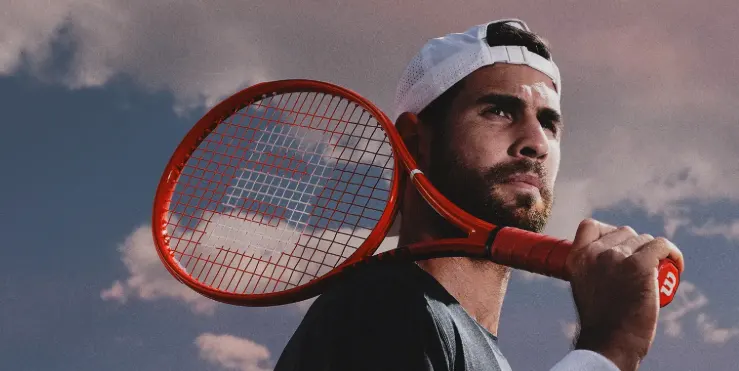
Pro tennis players are not all moving toward the same style of racquet because they do not all play the same style of tennis. That sounds obvious, but it is easy to forget when one new frame suddenly becomes the focus of the equipment world.
The Defyer is doing well. The Blade is still doing considerably better in terms of sheer numbers. We will revisit this situation at the end of the year and see where we are then.
Wilson Ultra and Pro Staff
The Ultra has four players: Alex de Minaur, Learner Tien, Coleman Wong and Hugo Gaston (De Minaur is using the 99 Ultra Pro, but Tien has an unreleased mold and Wong and Gaston are using an old 100-square inch mold. That is a smaller group than Blade or Defyer, but still significant.
The Pro Staff, meanwhile, is represented here only by Jiri Lehecka. For a racquet family with such an enormous historical reputation, seeing just one player in this particular Top 100 snapshot is striking.
It illustrates how far professional racquet preferences have moved away from the traditional Pro Staff archetype and toward more forgiving head sizes, more modern geometries and racquets that make defending and generating depth slightly easier.
The Pro Staff remains iconic, but in this ATP Top 100 count, the Blade has clearly taken over as Wilson’s dominant tour platform.
Yonex: 25 Players
Yonex is tied with Wilson at 25 Top 100 players.
Its distribution is:
VCORE: 12
Vacherot, Paul, Tabilo, Fonseca, Nakashima, Bergs, Shapovalov, Baez, Burruchaga, Machac, Majchrzak and Shimabukuro.
EZONE: 8
Shelton, Ruud, Munar, Altmaier, Faria, Gea (with a blacked-out racquet) Fucsovics and Hijikata.
PERCEPT: 5
Tiafoe, Darderi, Etcheverry, Carabelli and Giron.
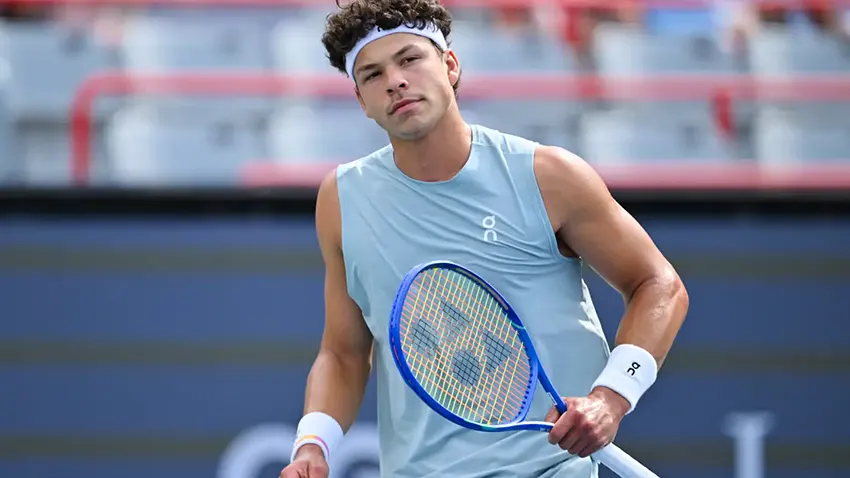
The VCORE Is Yonex’s Biggest Tour Racquet
Perhaps the biggest surprise of the entire count is the strength of the VCORE. When people think of Yonex, many may immediately think of the EZONE. But in this sample, the VCORE is clearly ahead:
VCORE: 12
EZONE: 8
PERCEPT: 5
The VCORE is therefore not just doing well; it is one of the most represented individual racquet families in the ATP Top 100. Only the Wilson Blade has more players in this dataset, which is a serious achievement for Yonex.
The player list is strong as well. Tommy Paul, Joao Fonseca, Brandon Nakashima, Denis Shapovalov, Sebastian Baez and Tomas Machac are all counted within the VCORE family.
These are players with different stroke mechanics and different tactical preferences, but there is a common theme that makes the VCORE concept understandable at tour level: the racquet is designed around spin, shape and aggressive ball production. For the modern baseline game, that is an attractive combination.
The EZONE Remains Very Strong
The EZONE has eight players, including Ben Shelton and Casper Ruud. That remains a substantial number, and again, it shows one of Yonex’s biggest strengths: they are not relying on one model family.
Wilson has 14 Blade users out of its 25 players. Yonex has a more even spread. The VCORE leads, but the EZONE and PERCEPT are both contributing meaningful numbers. From a brand perspective, that is an impressive position to be in.
PERCEPT Has Five Players
The PERCEPT is represented by Frances Tiafoe, Luciano Darderi, Tomas Martin Etcheverry, Camilo Ugo Carabelli and Marcos Giron.
Five players might not sound huge compared with the Blade’s 14 or VCORE’s 12, but for the most control-oriented Yonex family, it is a healthy figure. It also reinforces the point that control racquets remain relevant even in a game increasingly obsessed with spin and power.
HEAD: 21 Players
HEAD has 21 players in the Top 100, which puts it third overall behind Wilson and Yonex.
The interesting thing about HEAD is not one dominant racquet family. It is the opposite. HEAD’s representation is spread across six different lines:
Radical: 5
Cobolli, Fritz, Arnaldi, Borges and Bellucci.
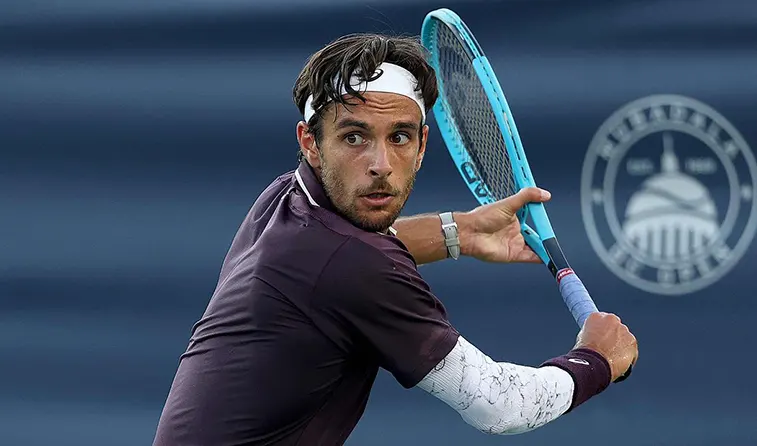
Extreme: 4
Fokina, Berrettini, Struff and J. Cerundolo.
Prestige: 4
F. Cerundolo, Hanfmann, Kopriva and Cilic.
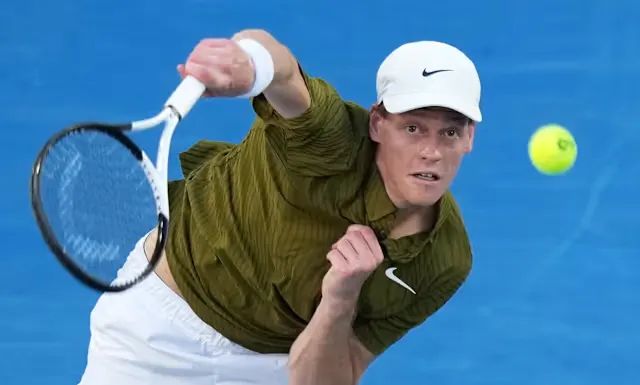
Speed: 3
Sinner, Jodar and Djokovic.
Boom: 3
Musetti, Navone and Trungelliti.
Gravity: 2
Zverev and Rublev.
This distribution makes HEAD perhaps the most interesting brand structurally. There is no equivalent of the Wilson Blade dominating the company’s numbers. Instead, almost the whole racquet catalogue is represented.
The Radical Leads HEAD
The Radical has five players, making it the most represented HEAD line in this count. That might come as a slight surprise considering the huge visibility of the Speed, but the Radical has always sat in a useful middle ground between control, maneuverability and attacking potential.
Five players is enough to make it HEAD’s number-one line in this dataset.
Only Three Speed Players – But Look at the Names
The Speed only has three players in the count, but those three include Jannik Sinner, Novak Djokovic and Rafael Jodar.
So this is a good illustration of why raw player count and marketing visibility are not necessarily the same thing. A racquet can have relatively few users while still receiving enormous exposure if those users happen to be among the biggest names in tennis.
The Speed does not dominate HEAD numerically, but it hardly lacks visibility.
Four Prestige Players Is Impressive
One statistic I found particularly interesting is that the Prestige still has four players in the Top 100: Francisco Cerundolo, Yannick Hanfmann, Vit Kopriva and Marin Cilic.
For such a traditional control-oriented racquet family, that is impressive. The modern ATP game requires so much defending, spin and physicality that you might expect Prestige-style racquets to disappear gradually. Yet they remain.
Again, elite players who create enormous speed themselves can prioritize confidence and control in ways recreational players cannot always afford.
Gravity Has Only Two Players in This Count
The Gravity is represented here by Alexander Zverev and Andrey Rublev. That is fewer than I might have expected, considering the profile of the line.
But it is important to remember that this is a snapshot of the Top 100 on one particular date. There are other Gravity users outside this exact group, and the same applies to all of these numbers.
Rankings move, players enter and leave the Top 100, and equipment changes. This should therefore be treated as a snapshot rather than a permanent census.
Babolat: 17 Players
Babolat has 17 players represented, but the distribution is extremely lopsided:
Pure Aero: 13
Fils, Alcaraz, Auger-Aliassime, Collignon, Michelsen, Mannarino, Quinn, Maroszan, van de Zandschulp, Choinski, Royer, Walton and Prizmic.
Pure Strike: 2
Norrie and Medjedovic.
Pure Drive: 2
Duckworth and Perricard.
The message here could hardly be clearer: At ATP Top 100 level, Babolat is overwhelmingly an Aero brand in this dataset.
The Pure Aero Dominates Babolat
Thirteen out of Babolat’s 17 players are using the Aero family. That is more than three quarters of the brand’s total representation.
And with 13 users, the Aero is the second-most represented individual racquet family in the whole sample, behind only the Wilson Blade. That is impressive, but it is also easy to understand.
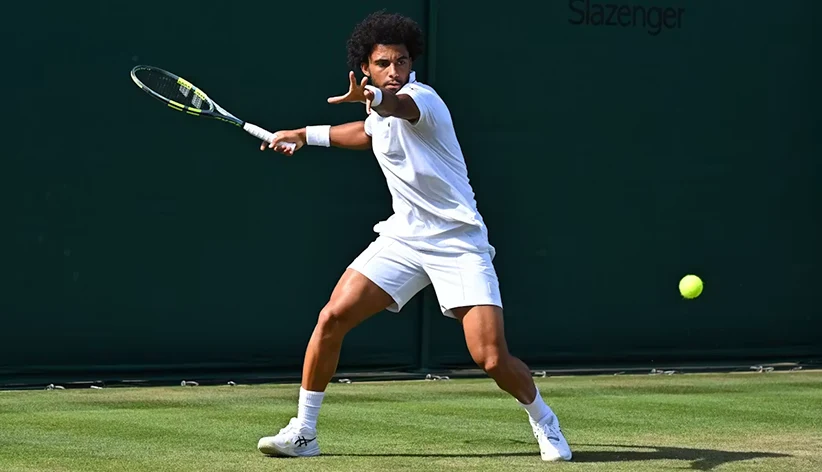
The Pure Aero concept suits a large part of contemporary professional tennis extremely well. Modern players need to generate heavy spin while maintaining enough margin over the net to survive long baseline exchanges. They also need the ball to jump off the court and push opponents backward. The Aero philosophy is designed for exactly that.
And of course, Carlos Alcaraz gives the line enormous visibility. But the important part of this count is that the Aero is not merely attached to one superstar. There are 13 players here. That is genuine tour adoption.
Pure Strike and Pure Drive Are Much Smaller
The contrast with Babolat’s other two families is dramatic. Pure Strike has only two players in the count, while Pure Drive also has two.
Again, that does not mean those racquets are unsuccessful products. Retail popularity and professional-tour usage are completely different measurements. But if you look only at the ATP Top 100, the Aero is clearly Babolat’s tour racquet.
Tecnifibre: 7 Players
Tecnifibre has seven Top 100 players in this count.
The breakdown is:
T-Fight: 5
Medvedev, Blockx, Griekspoor, Svajda and Shevchenko.
TF40: 1
Rinderknecht.
Fire: 1
Moutet
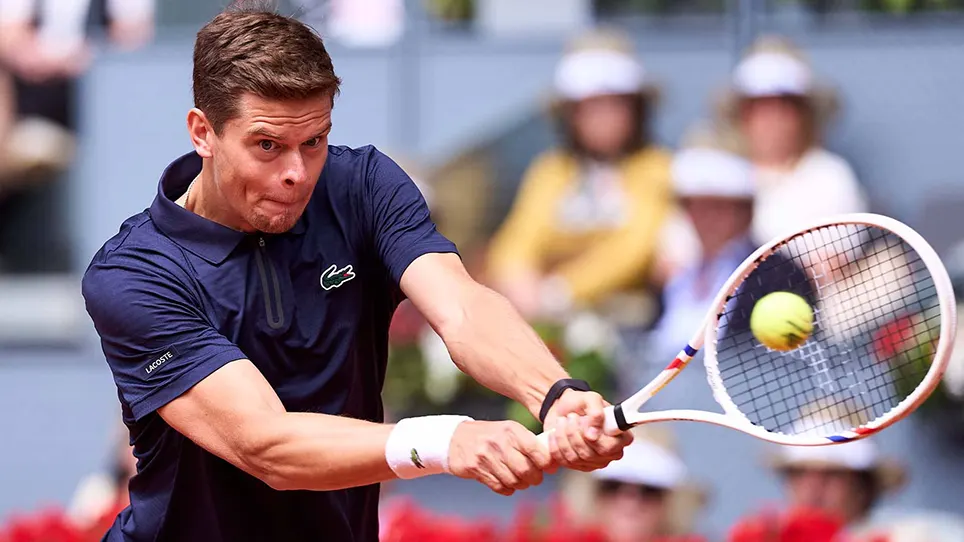
For a smaller racquet brand compared with Wilson, Yonex, HEAD and Babolat, seven players inside the Top 100 is a respectable showing. The T-Fight is clearly the brand’s main professional platform with five of those seven players, while Daniil Medvedev also gives the line considerable visibility.
Dunlop: 4 Players
Dunlop has four players represented:
CX: 2
Merida and Brooksby.
FX: 1
Kecmanovic.
SX: 1
Vallejo.
The numbers are obviously much smaller than the four largest brands, but Dunlop at least has representation across all three of its major performance categories. The CX leads with two players, while FX and SX have one each. It is a nicely balanced distribution within a small overall sample.
Diadem: 1 Player
Diadem has one player in the ATP Top 100 in this count: Alexander Bublik.
Bublik’s racquet situation is particularly interesting because a move involving a player at his level gives a smaller brand enormous visibility. With only one player, Diadem obviously cannot compete numerically with the major brands, but having a Top 100 player – especially a player with Bublik’s profile – is significant. (Check out the new Project Bublik from Diadem)
The Most Popular Racquet Lines in the ATP Top 100
If we ignore brands for a moment and simply rank the individual racquet families, an interesting hierarchy appears.
At the top we have Wilson Blade – 14 players, followed very closely by Babolat Aero – 13 and Yonex VCORE – 12.
Those three racquet families alone account for 39% of the ATP Top 100 in this dataset. That is perhaps the most interesting statistic of the whole exercise. Despite all the racquets available, almost four out of every ten Top 100 players in this count fall into just three families.
And those three families also represent three slightly different interpretations of the modern performance racquet. The Blade emphasizes control and precision. The Aero emphasizes spin and aggressive launch. The VCORE also emphasizes spin, but with a distinctly Yonex interpretation of that modern baseline formula.
After those three comes the EZONE with eight players, followed by the Defyer with six.
The Top Individual Racquet Families
Based on this count, the leading racquet lines are:
- Wilson Blade – 14
- Babolat Aero – 13
- Yonex VCORE – 12
- Yonex EZONE – 8
- Wilson Defyer – 6
- Yonex PERCEPT – 5
- HEAD Radical – 5
- Tecnifibre T-Fight – 5
- Wilson Ultra – 4
- HEAD Extreme – 4
- HEAD Prestige – 4
Then we move into the smaller groups.
This distribution shows how difficult it is to talk about one dominant type of modern tennis racquet. Spin-oriented frames are clearly successful, but so are control racquets. Power-oriented racquets have their place, and highly customized professional versions blur the boundaries even further.
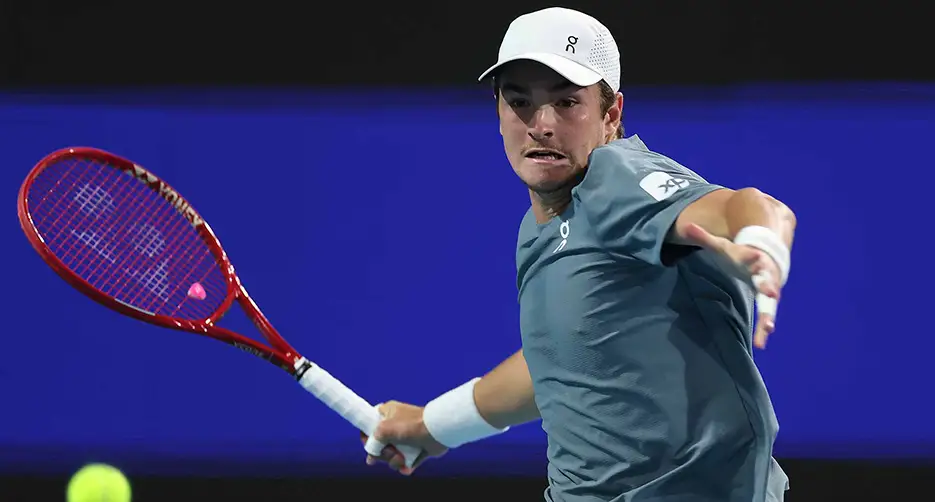
Blade vs Aero vs VCORE: The Three Big Racquet Families
If there is one broader equipment trend that stands out, it is the strength of the Blade, Aero and VCORE. All three are everywhere, but they achieve success in different ways.
The Blade continues to demonstrate that professional players still value directional control and confidence at high racquet-head speeds. The Aero demonstrates the value of spin, launch angle and creating a heavy rally ball. The VCORE sits in a similar modern spin category while offering a different feel and response.
There is no evidence here that the entire tour is converging on one racquet philosophy. Instead, the best players are choosing different tools for different games. And that is probably the most useful lesson for recreational players as well.
Does Tour Popularity Mean You Should Buy That Racquet?
Not necessarily.
This data is interesting, but it should not become a shopping list. Professional racquets are often heavily customized, and the specifications being used on tour may be radically different from the retail racquet hanging in your local tennis shop.
Players may add considerable weight. They may use older molds underneath newer cosmetics. They may use string tensions and firm polyester setups that would be unnecessarily demanding for many club players.
So if 14 Top 100 players use a Blade, that does not mean the Blade is automatically the best racquet for you. And if 13 players use an Aero, it does not mean you need to buy an Aero to play modern tennis.
What the statistics do tell us is that these racquet concepts work at the highest level. From there, you still need to work out which concept fits your own game.
What Can Club Players Learn From the ATP Top 100?
The most important lesson may actually be diversity. There is no single winning specification.
Top players are using:
- control-oriented racquets
- spin racquets
- power racquets
- 98-square-inch frames
- 100-square-inch frames
- traditional designs
- newer high-launch concepts
That should give recreational players some confidence to choose based on their own tennis rather than hype.
If you hit flatter and want predictable directional control, a Blade-type racquet might make sense. If you want more shape and height over the net, an Aero or VCORE-style frame could be a better fit. If you need easier depth and power, an EZONE or Ultra-type concept might appeal more.
There is no universally correct answer. Even among the best 100 players in the world, there clearly isn’t one.
Brand Share of the ATP Top 100
Looking at the overall brand numbers again:
Wilson – 25%
Yonex – 25%
HEAD – 21%
Babolat – 17%
Tecnifibre – 7%
Dunlop – 4%
Diadem – 1%
Wilson and Yonex together account for 50% of the Top 100. Add HEAD and the three brands account for 71%. Add Babolat and the four biggest brands account for 88% of the entire Top 100 in this count.
That leaves just 12 players between Tecnifibre, Dunlop and Diadem. So although there is plenty of racquet choice at retail, professional men’s tennis remains heavily concentrated among a handful of manufacturers.
Yonex’s Rise Is Particularly Impressive
One of the biggest stories for me is Yonex. To be tied with Wilson at 25 players is impressive on its own, but what makes it even more interesting is the breadth of the representation.
There are 12 VCORE users, eight EZONE users and five PERCEPT users. All three main racquet lines are represented convincingly, which is a very healthy position for a brand.
It means Yonex is not dependent on one racquet family or one superstar. And the VCORE becoming the largest Yonex racquet line in this dataset is perhaps something not everyone would have predicted.
HEAD Has the Most Diverse Lineup
If Yonex’s story is balance, HEAD’s story is variety.
Twenty-one players are distributed across six racquet lines. The largest group, the Radical, has only five players, which means no individual HEAD family represents even a quarter of HEAD’s total count by a wide margin.
Compare that with Babolat, where 13 of 17 players are in the Aero family. They are almost opposite strategies: Babolat has one dominant tour identity, while HEAD has several.
Neither is necessarily better, but the contrast is interesting.
Final Thoughts
Wilson and Yonex lead with 25 players each. HEAD remains very strong with 21, while Babolat has 17, largely thanks to the extraordinary popularity of the Aero. Tecnifibre has seven, Dunlop four and Diadem one.
At individual racquet level, three families stand above everything else:
Blade – 14
Aero – 13
VCORE – 12
Perhaps the biggest surprise is how strong the VCORE has become. Perhaps the least surprising result is that the Blade refuses to go away. And perhaps the most important observation is that the much-hyped Defyer, while already doing well with six users, has certainly not taken over the professional tour.
Control racquets remain relevant, spin racquets are thriving, and different styles still demand different equipment. Which is exactly why there will probably never be one “best” tennis racquet.
There is only the racquet that works best for the player swinging it.
What surprises you most about this ATP Top 100 racquet list? Did you expect the Blade to remain number one, or the VCORE to be ahead of the EZONE? Let me know in the comments.



Now do weighted by current ranking, say 100 weighting for #1 and 1 for #100. I’m guessing Head would be #1, followed by Yonex and then maybe Babolat. Head is loaded with GS seeds.
Interesting point!
Thanks for the analysis. Is the split similar for doubles players or are they playing different rackets?
We will have a look at the doubles tour as well; the racquet distribution is for sure different there.
Please do a similar survey of the Top 100 from the WTA?!
The video is up! Post coming soon.