

I’ve watched a lot of tennis from my couch over the years. Too much, if you ask my wife. But I finally made it to the Australian Open in January, and it had a big impact on how I think about the whole screen vs physical debate. Spoiler alert: both have their place. Read on for a full breakdown of the pros and cons of watching tennis on TV vs in-person.
Watching tennis in-person: The pros
- Sound
This was the biggest shock for me in Melbourne. On TV, you hear a nice clean pop when the ball hits the strings. In person it’s much more nuanced, and gives you a far better idea of how cleanly the ball was struck. I was sitting way back during a Sinner match yet his forehands still sounded like a gunshot when he connected.
You also hear the grunting way more clearly, the shoes squeaking, the ball boys scrambling around. Even the players muttering to themselves between points. There’s a whole world of detail that just doesn’t translate through TV speakers.
- Speed, spin & angle
For me this is one of the biggest differences between TV and in-person tennis watching. Obviously, it depends where you’re sitting, but in-person, you’re able to get a much greater appreciation of how hard shots are being struck, and the spin on them. This is particularly true if you’re sitting in-line with the net – here, the way that a topspin shot curls into the court is truly amazing, and nothing like the way it appears on TV.
Same with the angles of shots. Yes, this can be seen to a degree on TV with the behind-the-baseline view, but when you’re down at court level, you get a much better understanding of just how sharp some angles can be, and how tough wide shots are to track down.
- Atmosphere
This is an obvious one, but it’s a huge part of what differentiates the two viewing experiences. When you’re watching tennis in person, there’s not only what’s happening on court – there’s also the energy of the entire audience. Depending on the match and court, this can number in the thousands, and completely transforms the experience.
Much of what I remember from watching Stan Wawrinka vs Taylor Fritz in Melbourne this year isn’t about the actual shots that were hit. It’s about how the crowd were chanting and pumping Stan up between points, and the comradery I had with the two strangers on either side of me as we willed him on in the fourth set.
- Choice
TV directors love cutting to crowd reactions and player boxes. This is all good for the casual fan, but for those who are really eager to analyze a match, it can be frustrating.
When you’re at the tennis in person, you have complete autonomy over where you look. You can keep your eyes locked in on one player and examine their body language and rituals between points, or even just focus on watching footwork for a period of time. The options are endless, and it gives you a lot more freedom to understand the game on your own terms, rather than being spoon-fed by a broadcast.
- All the non-tennis stuff
What’s amazing about tennis is the majority of tournaments have put in a huge focus on all the non-tennis stuff. The result is an experience more akin to a festival, than a sports match. Between watching tennis, you can sample wine, relax on bean bags, have gourmet sandwiches, shop for merchandise, network, enjoy the sun… The list goes on. There’s typically heaps for kids too, making it a great family occasion.
In my experience, few sports come close to replicating this full package experience in the way that tennis does.
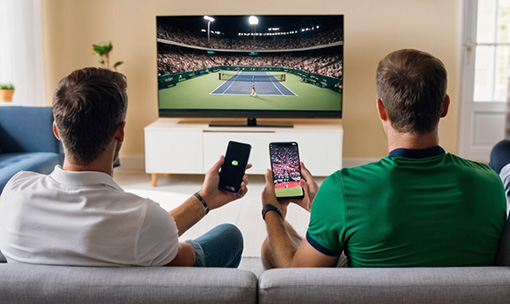
Watching tennis in-person: The cons
- Price
There’s no denying that heading to the tennis in person costs a fair bit more than staying home and watching on TV. It’s not just the tickets – which aren’t too exorbitant, surprisingly – but it’s all the other stuff. Transport to-and-from, accommodation, drinks, food… It all adds up. It’s fun, and it’s a great experience, but it’s not necessarily sustainable for everyone to do frequently.
- Physical toll
Watching tennis in person can be physically tough, particularly if it’s an outdoor event in a warm country. When I hit the Australian Open in Melbourne, several days had temperatures pushing 40 degrees Celsius. I’m pretty young and fit in the scheme of things, but even for me, watching back-to-back men’s matches in that kind of weather took its toll on me.
Between the potential heat, all the walking around, the seats that aren’t as comfortable as your couch back home – there’s no denying that watching tennis in person is much more demanding physically than staying back home.
- Restricted view
Sometimes you get lucky and have a perfect view of the court in person, other times, you’re not so lucky. The umpire’s chair, changeover umbrellas or cameras can block part of the court, or there might be structural supports that get in the way of your view (image below…). You’ll also be limited to a certain perspective in person, whereas on TV you get a range of different shots.

- Lack of commentary
This is a contentious one. Some people – myself included – aren’t big fans of tennis commentary. Still, at times, its absence is felt when you’re watching a match in person. For example, when a player takes a medical timeout, often the commentators are able to deduce and pass on important details about what it is the player is having treated. That’s missing when you watch the tennis in person.
In saying that, this can largely be accommodated by using social media. For me, I was checking X between games for live updates on the match I was watching, and there I’d glean extra tidbits about the match that I’d missed in person.
Tennis on TV: The pros
- Range of angles & replays
I sung the praises of getting a better perspective of the tennis in person, but the range of views available on TV is unmatched. Sure, the majority of the action is shown for the classic behind-the-baseline angle, but there’s also replays and a bunch of close ups or side angles too. When an epic point is played, seeing it from different angles is something you rarely get in person (unless you’re at a big showcourt that has a large screen).
- Commentary
The inverse of my point above. On TV, you’ve got a pair of guides that are there to enrich your viewing experience – they’ll load you up with stats, context and live updates in a way that simply isn’t available when you’re sitting in the stands at a match.
- Way more comfortable
The comfort of watching tennis at home is absolutely unmatched. You can be snuggled into your couch with a fridge full of snacks, wearing your comfiest clothes in an airconditioned room. That’s a level of comfort that not even $5,000 seats can match at the tennis.
There’s also the comfort of being able to watch matches delayed on replay, if they don’t suit your timezone. Or pausing when nature calls.
- Less commitment
This is an odd one, but watching tennis on TV is a lesser commitment, which can be a good thing in some circumstances. If a match ends up being uncompetitive, or ends early due to injury, it’s no big deal when you’re watching from home – you can just switch to another, or jump into something else.
In person, it’s way more disappointing. You’ve committed a lot to being there, so you’ve just got to ride it out, good or bad.

Tennis on TV: The cons
- Lack of perspective
TV compresses everything, makes the court look smaller and the rallies slower. This is unavoidable, but it almost waters down how epic tennis is. Watching on a screen, you miss out on so much nuance, and never fully grasp just how hard a ball is being hit or how quickly a player scrambled to retrieve a shot.
- Lack of atmosphere
This is hard to put into words, but watching from your living room just doesn’t stick with you the same way. I remember specific points from my time in Melbourne, whereas I don’t really remember individual matches I watched on TV last year. They all blend together.
Inherently, sport is something communal, something we share with others and bond over. Of course, this can be done online, but the experience of doing it in person is unmatched.
- No choice
Earlier, I touched on how cool it is to be able to choose where to look in person. There isn’t that same flexibility when watching a match on the TV. Your viewing experience is dictated to you, which often means a lot of time watching coach reactions and generic crowd B-roll.
- No influence
When you’re at a match in person, you feel like you’ve got the ability to influence the result, even if it’s ever so slight. Your cheer, your chant, your specifically timed encouragement – that might actually will a player on to perform just that 1% better and win a point.
There’s no chance of this from your own living room. Sure, you can imagine that you’re willing your player on, but it’s all in your head. In person, you’re actually contributing.
My verdict: The best way to watch tennis
Clearly, there are pros and cons for how you watch tennis.
Of course, unless you’re retired or absolutely loaded, watching in person all the time isn’t a reality. But even if I was a billionaire, I don’t think I’d choose to only watch tennis in person.
A mix of the two is the best approach. Try to get yourself to some matches in person at least once a year. This keeps all the added nuance of watching in the flesh fresh in your mind, and helps you appreciate the tennis better on TV, which is by far the more practical and convenient option.














While I appreciate the comments related to TV watching, as a tennis player I enjoy the “ground level” viewing. This lower viewing is clearly superior to the much higher level viewing that we usually get. Giving the fans a view that tennis players get is the holy grail, in my humble opinion. I would encourage Tennis Channel to experiment more with the TV angles.