

If you’ve ever walked onto a public tennis court or joined a local league, you’ve likely heard someone ask, “What’s your rating?” Here is where the confusion might start.
In the United States, they are most likely referring to the NTRP system even though UTR is the most important number for any American player eyeing college tennis. (It is the official rating of the Intercollegiate Tennis Association.) In Australia, Canada and many other parts of the world they have come far with integrating the UTR system while in Europe it’s sort of a mix.
Data-driven systems
While the NTRP is the standard for many hobby players in the US (read more on this further down) and also adopted in other parts of the world, the tennis world has been moving toward more “universal” data-driven systems. If you travel to play tennis or play in high-level junior/college circuits, you’ll run into these three major systems.
The fact that we have different tennis rating systems all over the world creates a lot of confusion and is something that the UTR (Universal Tennis Rating) system is trying to fix. But adaptation is slow and for now tennis players have to deal with different standards of ratings depending on where we are in the world.
UTR (Universal Tennis Rating)
The UTR is widely considered the “gold standard” for accuracy worldwide. It was developed to solve the problem of different countries having different scales. We are seeing more and more countries in Europe also adopting this system nowadays.
- The Scale: 1.0 to 16.50 (calculated to two decimal places).
- How it works: It uses an algorithm similar to a chess ELO rating. It doesn’t care if you win or lose as much as it cares about games won.
- Key Feature: It is gender-blind and age-blind. A 14-year-old girl with a 7.0 UTR is theoretically an even match for a 45-year-old man with a 7.0 UTR.
- Where it’s used: Globally, but especially in US College recruiting and international junior circuits.
WTN (World Tennis Number)
Launched recently by the International Tennis Federation (ITF), the WTN is the newest attempt to create a single global standard.
- The Scale: 40 to 1.
- The Twist: Unlike other systems, lower is better. A beginner starts at 40, while a pro like Novak Djokovic would be a 1.
- How it works: Similar to UTR, it tracks match results in real-time. It provides separate ratings for Singles and Doubles, which is a helpful distinction for many players.
- Where it’s used: Adopted by over 140 countries, including the UK (LTA), Ireland, and the USA (USTA) as a secondary metric to NTRP.
Local/National Systems
Before the “Universal” systems took over, most countries had their own unique scales. Some are still very much in use for local league play:
- France (The French System): Famous for being complex but highly effective. It uses a tiered system (4th series, 3rd series, etc.) where you “climb” by beating players in the tier above you.
- United Kingdom (LTA): Historically used a 10.2 to 1.1 scale, but they have officially transitioned to the WTN for most competitive play.
- Germany (LK System): Uses a “Leistungsklasse” (LK) system from 1 to 25. Like the WTN, a lower number (LK 1) represents the highest skill level.
More info and conversions in the tables below:
| Level | NTRP (USA) | UTR (Global) | WTN (ITF/UK) |
| Beginner | 2.0 – 2.5 | 1 – 2 | 40 – 35 |
| Intermediate | 3.5 – 4.0 | 4 – 6 | 30 – 20 |
| Advanced | 4.5 – 5.0 | 7 – 10 | 15 – 10 |
| Professional | 6.0 – 7.0 | 13 – 16+ | 4 – 1 |
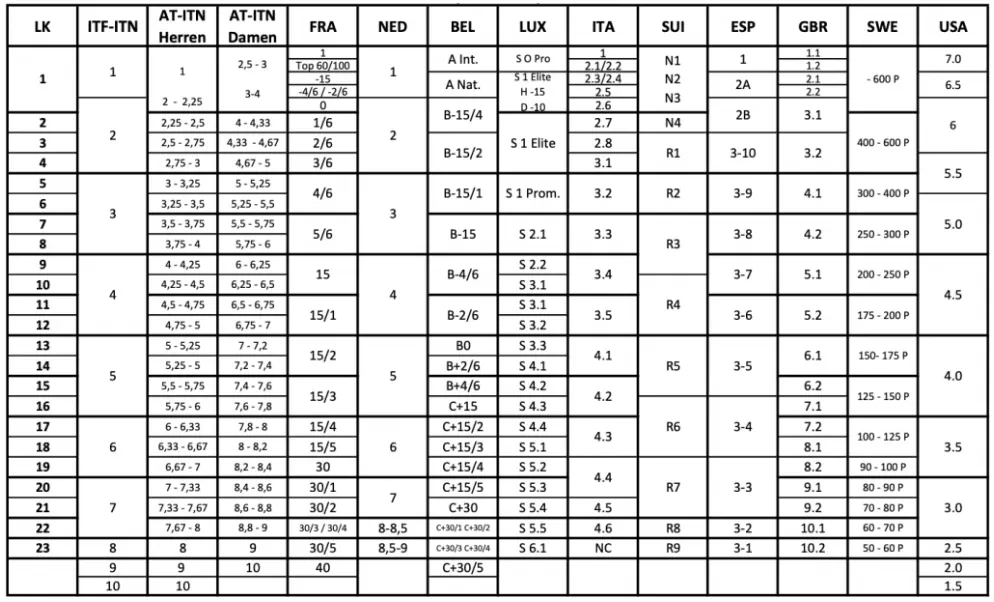
Because NTRP is “bracketed” (you are either a 3.5 or a 4.0), it’s a bit “clunky” compared to UTR and WTN, which update daily. If you are a 3.5 who is consistently winning, your UTR might rise to a 5.2 while your NTRP stays at 3.5 until the end of the year.
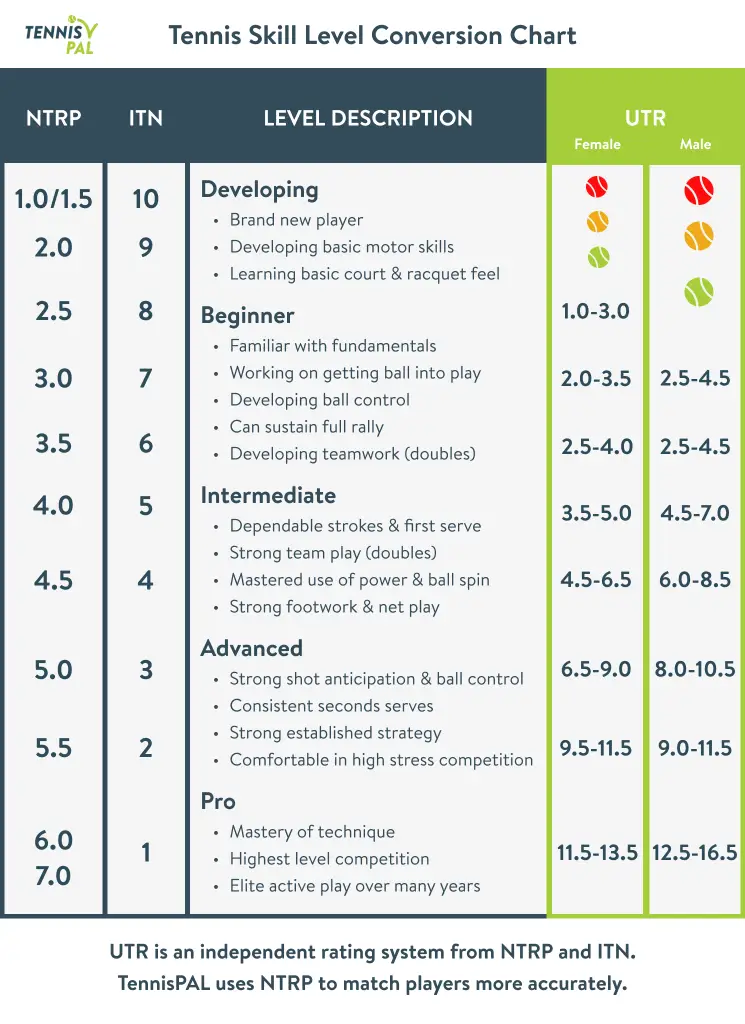
More info on the NTRP (National Tennis Rating Program)
Created by the USTA in 1978, the NTRP is a classification system used to group players by ability and it makes it easier to find playing partners at your own level. Below is a simple breakdown of how it works and how to find your number.
How the scale works
The NTRP scale runs from 1.0 to 7.0 in increments of 0.5.
- 1.0–2.0: True beginners or those just starting to learn the basics.
- 2.5–4.0: The “sweet spot” for most recreational and club players.
- 4.5–5.5: Advanced players, often former high school or college athletes.
- 6.0–7.0: Professional-level players and world-class touring pros.
| Rating | Level | Examples of Play |
| 2.5 | Beginner | Can sustain a short, slow rally; learning where to stand on court. |
| 3.0 | Low Intermediate | Consistent with medium-paced shots; lacks depth and “directional control.” |
| 3.5 | Intermediate | Dependable strokes; starting to use lobs and net play; improved teamwork in doubles. |
| 4.0 | High Intermediate | Reliable strokes with power and depth; can force errors with a second serve. |
| 4.5 | Advanced | Masters spin and pace; usually has a specific “weapon” (like a big serve or forehand). |
| 5.0+ | Elite | Excellent shot anticipation; plays with high intensity and strategy. |
How do you get a rating?
There are two main ways to enter the system and get a player rating:
1. Self-Rating
If you are new to organized play, you “Self-Rate” by reading the USTA’s descriptions and picking the level that best describes your game.
When in doubt, it’s usually better to rate yourself slightly higher. If you self-rate too low and then dominate your league, you might actually be disqualified and moved up mid-season!
2. Computer Rating (C-Rating)
Once you start playing official USTA league matches, a computer algorithm takes over. It calculates your “Dynamic Rating” after every match based on:
- The score: For example, a 6-0, 6-0 win helps your rating more than a 7-6 win.
- The opponent: If you beat a higher-rated player, your score jumps a lot.
- Year-End Calculations: Every December, the USTA publishes official year-end ratings based on your match history throughout the year.
Why does it matter?
The NTRP isn’t about bragging rights, it’s mostly a tool for compatibility.
- Leagues: USTA leagues are divided by NTRP (e.g., a “3.5 League”), ensuring matches are competitive and fun rather than blowouts.
- Tournaments: It prevents a former college star from entering a beginner tournament.
- Finding Partners: It’s the easiest way to tell a stranger, “Hey, I’m a 4.0 looking for a hit,” so you both know what to expect.
See also our previous guide on Understanding your level of tennis.