In this post we’re taking a closer look at two interesting training accessories from Xpand, the Gravity Belt and the Kinetic Band.
Short version: the Gravity Belt is the one to buy for footwork, leg strength and staying low; the Kinetic Band is the one to buy for rotation, weight transfer and effortless power. They solve different problems, and that is exactly why we like having both in the bag.
Most training aids in tennis promise a lot and end up in the back of a closet. These two from Xpand have stuck around in our sessions. Both are elastic resistance tools you wear while you actually hit balls, which is the key difference from gym work: you load the movement pattern you want to improve, in the context where it matters.
A quick naming note… Xpand sells the rotational product as The Kinetic Band, not the Kinetic Belt. Plenty of people (us included) call it a belt because it wraps around your body, but if you’re searching for it, look for “Kinetic Band.” The leg-focused product is The Gravity Belt 2.0, the current version of the original Gravity Belt.
Quick info
- Buy the Gravity Belt 2.0 if your problem is standing too tall, lazy split steps, poor balance on wide balls or legs that fade late in sets. It is the stronger leg and footwork tool by a distance.
- Buy the Kinetic Band if your legs are fine but your power leaks: arming the ball, big backswings behind the body, weight falling backwards at contact.
- Buy both if you coach, run a junior program or take your off-court work seriously. They overlap less than you would think.
Purchase the Gravity Belt or the Kinetic Band here, via this link you will automatically get 10% discount in the checkout.
What they are and how they work
Both products come from Xpand, a brand founded by former pro Rob Reynolds, and both are built on the same idea: Reactive Neuromuscular Training (RNT). In plain terms, an external force tries to pull you out of position, and your body learns to resist it. The difference is the direction of that pull.
The Gravity Belt 2.0: a vertical pull
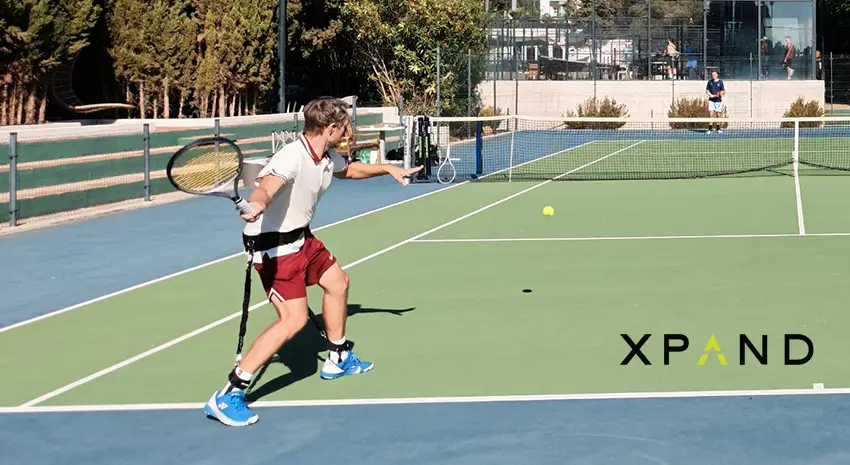
The Gravity Belt 2.0 is a padded waist belt with resistance bands that run down to your legs. The bands pull your hips toward the ground with 0 to 20 kg (0 to 44 lbs) of variable resistance. Stand tall and the bands fight you. Sink into a wider, lower athletic stance and the tension drops.

That is the clever part. You are not told to bend your knees; you are rewarded for it. After a few minutes most players settle into a lower base without thinking about it, and the legs start burning soon after.
There is an adult version and a junior version. The junior runs at roughly half the adult resistance and is aimed at ages 5 to 13. Xpand sizes by height: adult above 1.5 m (4.9 ft), junior below. It comes with a 3-year warranty and a set of 12 drills Xpand calls the “Build Your Base Blueprint.”
The Kinetic Band: a rotational pull
The Kinetic Band is a long elastic band that wraps around your body and attaches either to a fence or a partner. Instead of pulling you down, it adds 0 to 7 kg (0 to 15.4 lbs) of rotational resistance and, when anchored behind you, pulls you backwards.
To hit cleanly against it, you have to stabilise through your core, load the hips and transfer weight forward into the ball. If you arm the shot or let your weight drift back, you feel it straight away. Xpand says the method was first seen with Marco Panichi, Novak Djokovic’s long-time fitness coach. The product page credits the method to him rather than claiming a product endorsement, so read that line accordingly.
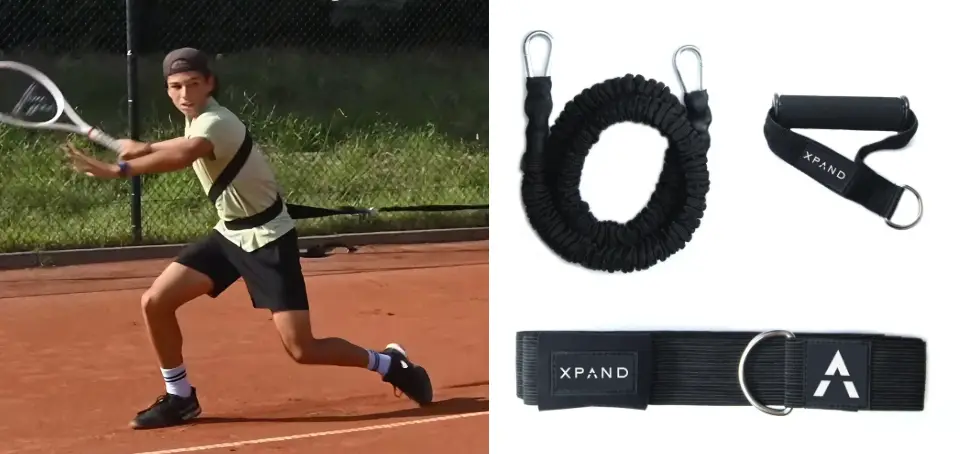
It is one size fits all with a sliding adjustment sleeve, and it starts at roughly 2 m wrapped around the body, stretching to around 5.8 m under tension.
Side by side
| Gravity Belt 2.0 | Kinetic Band | |
|---|---|---|
| Direction of resistance | Vertical: pulls hips down | Rotational and backwards |
| Resistance | 0–20 kg (0–44 lbs) | 0–7 kg (0–15.4 lbs) |
| Main target | Stance height, base, leg strength, footwork endurance | Hip-shoulder rotation, weight transfer, contact point |
| Anchor needed | No, fully self-contained | Yes: a fence or a partner |
| Sizing | Adult (over 1.5 m) and Junior (under 1.5 m) | One size, sliding sleeve |
| Included | Belt, bands, 12-drill program | Band, carry bag |
| Warranty | 3 years | Not listed |
| List price (USD) | $200 adult, $170 junior | $169 |
| Sports listed | Tennis, padel, pickleball, badminton, squash | Tennis, padel, pickleball |
Prices are from xpandstore.com in November 2026 and move around with promotions and regional stores, so check before you buy.
On court: what each one actually trains
Footwork and leg strength: Gravity Belt wins clearly
If footwork and leg strength are your priority, the Gravity Belt is the better tool, and it isn’t close. The Kinetic Band asks for a stable base, but it doesn’t load the legs the way the belt does.
What the Gravity Belt does well:
- Stance height. Most club players stand too tall between shots. The belt makes tall feel heavy and low feel easy, which is a far better teacher than a coach shouting “bend your knees.”
- Wider base. To lower your hips without collapsing forward, you naturally widen your feet. That gives you more stable deceleration on wide balls.
- Leg endurance. Twenty minutes of rallying in it is a proper leg session. Quads and glutes work the whole time, not just in isolated reps.
- First step. Moving out of a low, loaded position makes your first step more explosive once you unclip.
- Recovery steps. Getting back to the middle under resistance makes the same recovery feel quick when the bands come off.
The contrast effect is a big part of why it works. Rally in the belt for a few minutes, unclip and play on: you feel lighter, lower and faster. Xpand designed the bands to clip on and off quickly for exactly this reason.
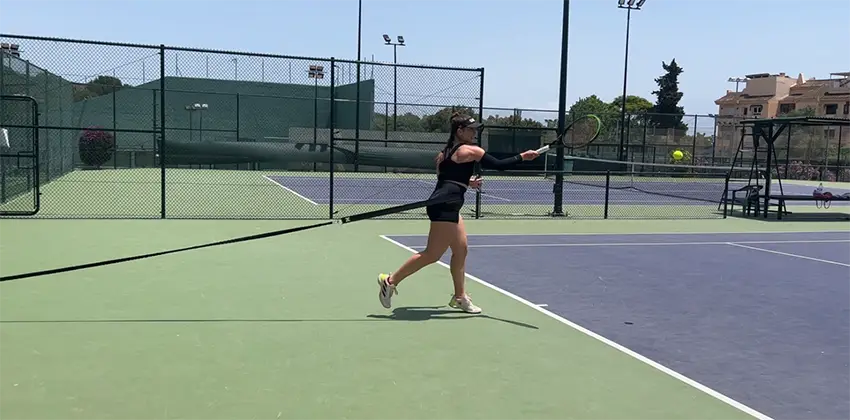
Rotation and power: Kinetic Band wins clearly
The Kinetic Band is about how energy moves from the ground through the hips and shoulders into the ball. It gives you physical feedback on a part of the stroke that is very hard to coach verbally.
What the Kinetic Band does well:
- Hip-led rotation. Against rotational resistance, arming the ball feels weak right away. Leading with the hips and letting the shoulders follow feels strong.
- Forward weight transfer. Anchored to the fence behind you, the band pulls you backwards. Fighting it trains you to move into the ball rather than falling away from it.
- Contact point in front. Xpand pitches it as a way to keep contact space in front of the body and shorten backswings that drift too far behind you. That matches our experience.
- Core stability. You cannot rotate cleanly against the band without bracing, so the core works throughout.
It will not make your legs much stronger. You need a stable base to resist it, but the load is a fraction of the Gravity Belt’s, and it is rotational, not vertical.
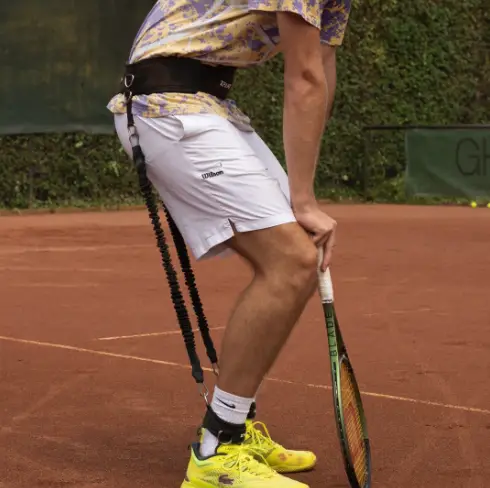
How they feel to hit with
The Gravity Belt is the more tiring of the two. Expect your legs to complain within ten minutes, and expect your rally tolerance to drop early on. Strokes can get a little stiff at first as you adjust to the lower position.
The Kinetic Band is less physically draining but more mentally demanding. You notice every inefficient swing. It is best used at slower, controlled rally pace or on fed balls before you try to go full speed.
Drills we like
Gravity Belt
- Low-base rally (5–10 min). Normal crosscourt rallying, belt on. Focus only on keeping your hips at the same height between shots.
- Wide-ball deceleration. Feeder alternates wide balls to each side. Plant, hit, recover. Hold balance at contact for a beat before recovering.
- First-step reaction. Start in a split step, partner points or feeds randomly. Explode out of the low position.
- Contrast sets. 3 minutes in the belt, 3 minutes without. Repeat 3–4 times and notice how the unloaded rounds feel.
- Xpand’s own drills. The included 12-drill program covers Base Control, Reach and Balance, and a Proactive First Step drill among others.
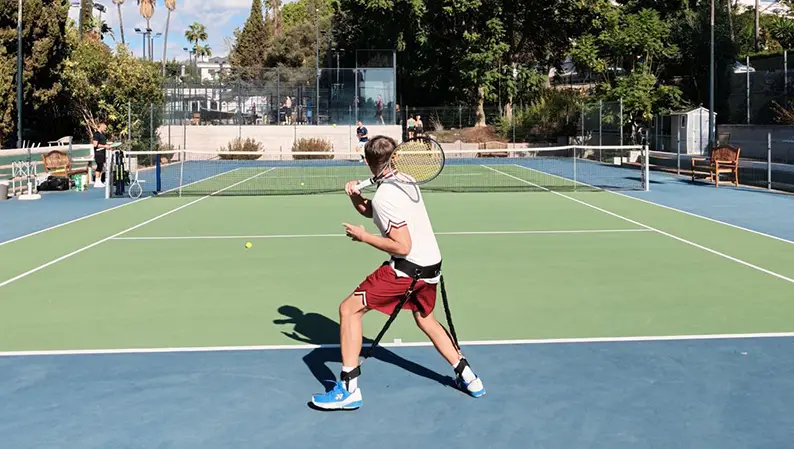
Kinetic Band
- Shadow swings first. Anchor to the fence, take 10–15 slow shadow forehands and backhands. Feel the hips lead.
- Fed balls into the court. Partner feeds at moderate pace. Hold the finish and check you didn’t get pulled backwards.
- Serve and first ball. Anchored behind you, work on driving forward into the first ball after the serve.
- Contrast hitting. Five balls with the band, five without. Most players feel the cleaner energy transfer immediately.
For both, keep the sets short and controlled at first. Resistance training on court is fatiguing, and fatigued reps are where technique breaks down.
Which one should you buy?
Start with your biggest weakness, not the product that looks coolest on Instagram. Most club players lose more points to poor positioning than to poor rotation, which is why we would point most people to the Gravity Belt first.
| If you… | Get |
|---|---|
| Stand too tall, get jammed or reach for balls | Gravity Belt 2.0 |
| Want stronger legs and better late-set endurance | Gravity Belt 2.0 |
| Train alone and have no fence or partner handy | Gravity Belt 2.0 |
| Are buying for a junior aged roughly 5–13 | Junior Gravity Belt |
| Move well but hit “armsy” or lack easy power | Kinetic Band |
| Fall backwards at contact or have a huge backswing | Kinetic Band |
| Coach, run a program or want a full on-court system | Both (Pro Bundle) |
Price and value
At around $200 for the adult Gravity Belt and $169 for the Kinetic Band, neither is cheap next to generic resistance bands. What you pay for is a tennis-specific setup that is quick to put on and comfortable to play in, and in the Gravity Belt’s case, a 3-year warranty and a drill program.
If you want both, Xpand’s Pro Bundle pairs them with a 3-pack of mini bands for a discounted price. Click banner below to get the best price.
Pros and cons
Gravity Belt 2.0
- Pro: Best-in-class for teaching a low athletic stance through feel
- Pro: Genuinely hard leg workout while you play
- Pro: No anchor needed, junior version available, 3-year warranty
- Con: Very tiring; strokes can feel stiff early on
- Con: Doesn’t address rotation or upper-body sequencing
- Con: Pricey for what is, mechanically, a belt and bands
Kinetic Band
- Pro: Immediate feedback on hip-shoulder sequencing and weight transfer
- Pro: Lighter load, easier to use for longer technical sessions
- Pro: One size fits all, packs small
- Con: Needs a fence or partner
- Con: Minimal leg-strength benefit
- Con: No warranty info listed on the product page
The verdict
We enjoy both, and we think they are among the more useful training aids you can bring on court. But they are not alternatives to each other. The Gravity Belt builds the base: lower stance, stronger legs, better footwork. The Kinetic Band builds what happens on top of it: rotation, timing and power.
If you buy one, buy the Gravity Belt, since footwork is where most of us leave the most points. Add the Kinetic Band once your base is solid and you want to turn that stability into effortless pace.
Below you can see my reviews on the previous model of the Gravity belt and the Kinetic band.
FAQ
Is it the Kinetic Belt or the Kinetic Band? Xpand calls it the Kinetic Band. People often say “belt” because it wraps around your body.
Can I use the Gravity Belt for pickleball or padel? Yes. Xpand lists tennis, padel, pickleball, badminton and squash.
Is the Gravity Belt safe for kids? Xpand makes a junior version with roughly half the resistance, designed for building movement habits rather than heavy loading. Sizing is by height, not age.
Do I need a fence for the Kinetic Band? You need an anchor point. A fence works, and Xpand also mentions partner use.
Can I wear both at once? Technically you could, but we wouldn’t. Each one changes how you move, and stacking them makes it hard to tell what you’re learning.
How often should I use them? We’d treat them as a short block within a session, 10 to 20 minutes, a couple of times a week, rather than wearing them for a full practice.
Check also our tennis training and fitness blog for more training tips on and around the courts.