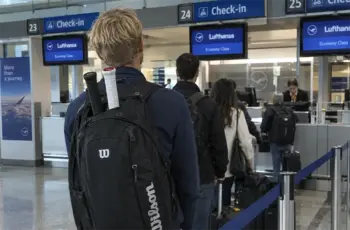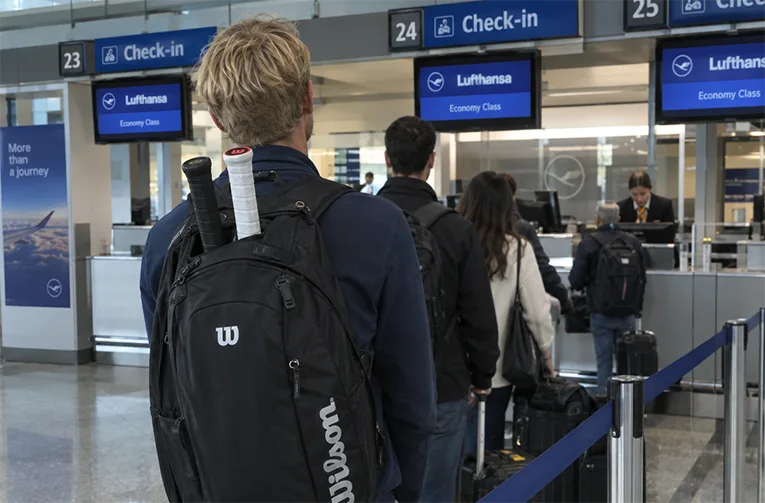
If you’re flying with tennis racquets, the thing to sort out before you leave for the airport is whether they travel in the cabin or in the hold. That depends on the airline, the aircraft, and how the racquets are packed – and it is rarely as straightforward as the published bag dimensions suggest.
I have been flying with racquets for years, and I have never had a racquet break. However, several of my tennis-playing friends have horror stories about racquets breaking from impacts during handling. One friend decides to take the racquets into the cabin, but only in a duffel or in his hand. He was traveling with Ryanair, and they told him he had to pay extra for the racquets, which amounted to 60 euros more. But on the way to Spain, he didn’t have this issue. So you can be lucky or unlucky with the crew.
I always check my racquets, either in a large hardshell case or in my tennis bag, and pad them with bubble wrap or clothing, since the bag will likely be thrown around a bit. That has worked well for me over years of traveling. Sure, it can be a risk in some cases, but as long as you are careful, I don’t think you will have an issue. If you really want them in the cabin, check the airline’s policy and be prepared to pay extra.
Racquet bags are not normal hand luggage
Most players assume a racquet bag will be fine because it looks like a normal piece of hand luggage. In practice, cabin limits are set by length as well as by weight, and a 12-pack or even a 3-pack sits close to the edge on many carriers. Some airlines treat racquets as sporting equipment with their own rules; others apply the standard cabin baggage policy and leave the decision to the crew at the gate.
This post covers what the main airlines actually allow, how to pack frames so they survive the hold, and what your options are if you’re stopped at the boarding door. It’s written for club and tournament players flying with one to twelve racquets, not for professional touring setups with their own logistics.
We hope to clear some question like; Which airlines allow racquets in the cabin? How to best pack a 3-racquet bag? What happens to frames and strings in a pressurised hold? Should we loosen the string tension before we fly etc.
If you’re interested in visiting any of the four Grand Slam’s or Masters tournament, visit P1 Travel here to see some really good travel packages.
Quick info
- A racquet bag can never meet a published cabin size limit. 27-inch racquet, 22-inch rule. It is oversize by definition.
- That means cabin carriage depends on a written racquet exception, not on the bin having space. The bin is not the rule. The sizer is the rule.
- The hold is pressurized and at roughly cabin temperature. Pressure is not why frames break.
- Do not loosen your strings. The flight is not the problem; the string job’s own creep and a hot car are.
- The actual damage risk is impact and crush, and a soft bag with no hard shell is your liability, not the airline’s.
Two different gates, and people confuse them
There are two separate tests, and passing one tells you nothing about the other.
Security is the first. In the US the TSA lists tennis racquets as permitted in both carry-on and checked baggage, with the usual caveat that the officer makes the final call. Canada’s CATSA says the same, and the UK allows them through screening. So the X-ray is almost never where you lose.
The airline is the second, and this is where it goes wrong. Your security clearance says nothing about your cabin allowance, and the airline’s allowance says nothing about security. A racquet bag can be perfectly legal to carry through the checkpoint and still be refused at the gate, because it is 8 inches too long for the fare you bought.
One practical note while we are here: put the string cutters in the checked bag. Blades are a screening problem, a decent set of cutters is not cheap, and the queue behind you does not need the delay.
The airline picture
The rules below were checked in November 2026. They change, they vary by fare, and on a connection the operating carrier’s rules usually win over the marketing carrier’s. Verify before you book, not before you board.
Note: Last checked 8 November 2026. These policies can change at anytime.
| Airline | Racquets in the cabin | The fine print |
|---|---|---|
| British Airways | Yes, 2 maximum | Slim protective case under 80 × 45 × 10 cm, counts as one of your two cabin pieces, nothing else inside the case. Three or more racquets must be checked. |
| Singapore Airlines | No | Racquets (tennis, squash, badminton, padel, pickleball) are accepted only as checked baggage, in a protective bag or hard case. |
| Air Canada | Yes, if within standard size | Accepted in both cabin and hold, but the standard size limits still apply, and a racquet carrier counts as one checked bag. |
| American Airlines | Not specified | One checked bag with multiple racquets and balls, standard bag fee, no oversize charge. |
| Delta | Not specified | Standard 22 × 14 × 9 in cabin limit, handles included. No racquet exception. |
| United | Not specified | Standard cabin limits. Sports equipment counts against your checked allowance. |
| easyJet | Only as a paid large cabin bag | 56 × 45 × 25 cm, and a 30-inch bag does not fit inside that. No racquet exception. |
| Ryanair | Only if it fits the cabin bag | Bigger items can travel in a purchased extra seat, or be checked for a fee. |
| Wizz Air | Pre-booked special baggage | Can go in the hold or the overhead, but it must be declared and approved in advance. |
| Emirates | No | Sports equipment travels as checked baggage, total dimensions under 300 cm. |
| Qantas | No | Sporting equipment is carried as part of your checked allowance. |
Read that table again and notice how few airlines actually say yes. British Airways is the outlier, and it is a genuinely useful one: two frames in a slim case, explicitly allowed, no argument. If your itinerary is BA-shaped and you only need two racquets, that is the path of least resistance in the industry.
Notice also what Delta, United and American are really saying. They are not banning racquets. They are saying the standard dimensions apply, and a 30-inch bag does not meet them. In practice you will usually get away with it, because gate agents are busy and the overhead bin is longer than the sizer. “Usually” is doing a lot of work in that sentence.
If you want certainty rather than luck, get it in writing. Message the airline before you fly, with the exact packed dimensions and weight:
I’m travelling on [flight, fare] with three racquets in a bag measuring [L × W × D] cm and [X] kg. Is that accepted in the cabin within my booking, or should I book checked sports baggage?
Screenshot the reply. It will not win an argument with a determined gate agent, but it changes the conversation from “you’re trying it on” to “your colleague said yes.”
Four legal ways to fly with three frames
1. The British Airways route. Two racquets in a slim case, in the cabin, by the book. If you need a third, it goes in the hold in a hard case.
2. Split the bag. This is what most travelling players actually do. Two frames checked in a padded bag inside a hard-shell suitcase, one frame in a slim cover as your personal item. You are never more than one broken string away from a usable racquet, and you are not gambling the whole set on one baggage belt.
3. Check the lot and pack properly. Perfectly rational, and covered below, as long as you accept that the liability is now yours.
4. Buy a seat. Ryanair and Wizz will sell you an extra seat for oversized equipment. It is an absurd solution that works, and for a long trip with a full tournament bag it can be cheaper than the excess baggage fees.
What I would not do is the thing I see most often: turn up with a 12-pack, hope, and then act surprised. The 12-pack is 32 inches long. You are asking a gate agent to ignore a third of a metre.
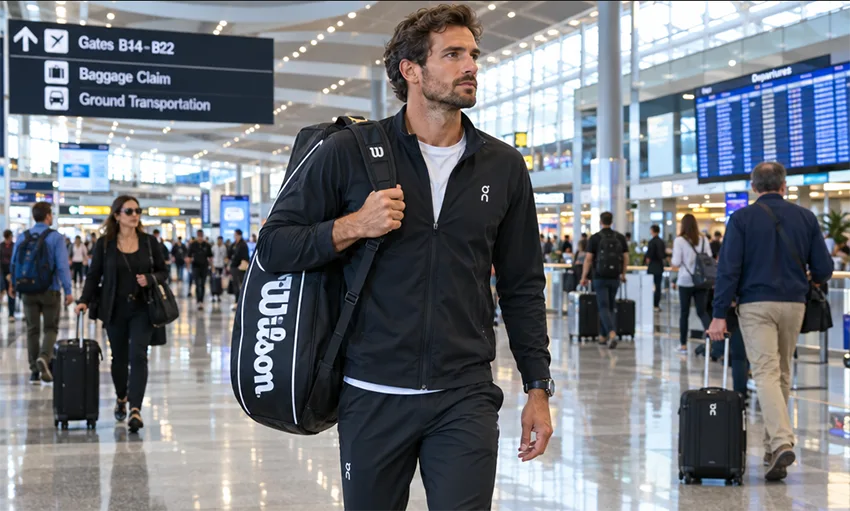
Packing a 3-racquet bag for the cabin
The bag fits the overhead bin on a 737 or A320 if you put it in along the fuselage rather than across it. That is why people get away with it, and it is also why you should board early. If the bin is full, your bag goes in the hold at the gate, and gate-checked bags are handled with the same tenderness as everything else.
- Take the shoulder straps off or clip them down. They snag on belt loaders and they add bulk at the sizer.
- Alternate the handles. One racquet handle up, one down, one up. It evens out the mass and stops all three grips pressing into the same corner of the bag.
- Use the racquet compartment, not the accessory pocket. Sounds obvious. It is the pocket people get wrong when the bag is overstuffed.
- Fill the void. A bag that shifts when you shake it is a bag that will rub the paint off three frames. Socks, a towel, a hoodie. Firm, not bulging.
- On a widebody, ask the crew about the wardrobe. Long-haul aircraft often have a closet near the forward door. A racquet bag takes up less space in there than you would think, and cabin crew are usually happy to help if you ask before departure rather than during the meal service.
- On a regional jet, assume gate-check. CRJ and Embraer overheads are not going to take a 30-inch bag, and no amount of polite insistence changes the airframe.
Packing a 3-racquet bag to be checked
Here is the method I use, and it has survived a decade of baggage belts.
The suitcase trick. Buy or borrow a large hard-shell suitcase, the 76 cm sort that still squeaks in under the 158 cm linear limit. Lay the racquet bag inside it, racquets in, and pack clothing around it. You now have a hard shell, a padded layer, and no sports-equipment fee, because a normal suitcase is a normal suitcase. This is the single best protection-per-euro in the whole article.
If the racquet bag is travelling on its own:
- Roll a towel and put it at each end of the bag. The ends are what hit the belt first.
- Nothing hard next to the hoop. No ball cans, no water bottle, no shoes. A metal bottle rolling against a frame for six hours is a paint job and sometimes a crack.
- Keep the frames in the middle of the bag, away from the edges and away from the wheels.
- Zip the pulls in, and tape the zip if the bag has a habit of opening.
- Weigh it before you leave. A 3-racquet bag with three frames, shoes and a towel is comfortably over 10 kg, and the limit on a checked piece is usually 23 kg, but the cabin limit on some carriers is 7 kg. Know your number.
A hard case is not a luxury if you fly often. A dedicated hard-shell racquet case, a hard ski bag, or a Pelican-style case will outlast three soft bags and will pay for itself the first time it saves a frame. The alternative, a soft bag wrapped in a hoodie, is a bet that the belt loader is having a good day.
The “fragile” tag is cosmetic. Ask for one, by all means. It does not change how the bag rides the belt, because the belt does not read tags. What changes the outcome is a hard shell and a bag that does not move inside it.
What actually happens to your racquet in the hold
This is where most of the internet gets it wrong, so let’s be precise.
Pressure is a non-issue. The cargo hold is inside the same pressure vessel as the cabin. The floor you walk on is the ceiling of the hold. Cabin altitude is typically held at or below 8,000 ft, which is roughly three-quarters of sea-level pressure, and the hold sees the same. A frame that routinely carries 50 to 60 lb of string tension across a 100 square inch hoop will not notice a pressure differential of a few psi. There is no trapped air in a graphite frame to “pop,” and no mechanism by which lower ambient pressure changes the tension of a string bed under mechanical load.
Temperature is mild. The hold sits somewhere around 5 to 15 °C in flight. It is not a freezer, and it is not unheated: airlines are required to keep animal compartments between roughly 7 and 29 °C, and the same conditioned air serves the hold. Your racquet will be cooler than your living room and warmer than the boot of your car in July.
Humidity is low. This matters for natural gut, which is hygroscopic, and barely at all for polyester or multifilament. A gut string bed that dries out over a long flight will feel a little deader and a little more brittle. If you play gut, keep the frames in a zip bag with the rest of your kit and stop worrying about the pressure.
So what does happen? Nothing dramatic. The frame cools down, the string bed comes out feeling slightly firmer than you left it, and the grip feels cold and slippery for the first ten minutes. That is it. Let the racquet come up to room temperature before you play, partly for the feel and partly so you do not get condensation on a cold frame in a humid city.
The one thing in your bag that does care about pressure is the balls. A pressurised ball is inflated to roughly 12 psi above ambient. Drop the ambient pressure and the pressure differential across the wall goes up, which is exactly why balls fly in Denver and why the ITF makes a high-altitude ball. Your can will not explode. It will just be livelier than it was at sea level. Buy balls at the destination. They are cheap, they will be fresher, and you are not carrying them.
Should you loosen the strings before you fly?
No.
The advice comes from two places, neither of which applies to you. The first is the string section, where orchestral players do loosen strings on instruments with a glued soundboard and a wooden neck under 70 lb of tension. The second is wooden racquets, which really could warp, and which stopped being relevant around the time graphite arrived.
The physics is simple. Your strings are not a sealed pressure vessel. They are under mechanical tension, and a change in ambient air pressure does not change that tension by any measurable amount. What does change tension is time, temperature and play, and the flight is the smallest of those three by an order of magnitude. A freshly strung frame will lose several pounds in the first 24 hours on its own, before it ever sees an aeroplane.
There is one narrow case for a hedge. If you are flying to altitude, and you are the sort of player who notices two pounds, string 1 to 2 lb tighter than normal. Rafael Nadal went from 25 kg to 25.5 kg at altitude, which is about a pound, and he is a professional who strings every day. If you are going to Denver or Bogota and you want a number, 2 to 4 lb is the range most coaches use, and the ball change will matter more than the string change. If you are flying to sea level, leave it alone.
What you should do instead:
- Do not string the morning of the flight. A string job needs a day to settle. Do it 24 hours out, hit with it once, then pack it.
- Keep a string log. Date, tension, string, hours played. Two lines in your notes app. It is the only way to know whether that dead feeling is the flight or the four weeks since you last restrung.
- Carry a spare set of string if you are going somewhere that will not have your string. A club stringer in another country is a wonderful thing. A club stringer with your string is better.
- Find the stringer before you need one. Ask the hotel, the club, or the tournament desk on day one. Not the morning of your first round.
Heat is the enemy, and it is not on the plane
The most damaging thing that will happen to your racquets on this trip is almost certainly a car.
A frame left in a boot in the sun will sit at 60 to 70 °C. Polyester does not like that. It is a viscoelastic material that has been pre-stretched at the factory, and heat accelerates the relaxation that eats your tension permanently. The flight does not do this. The taxi rank does. The hotel room with the sun on the window does. The beach bag does.
So: racquets in the shade, racquets out of the car, racquets out of the boot. If you take one thing from this article and forget the rest, take that. It will save you more tension than any pre-flight ritual.
Protecting against baggage handlers
Frames break in three places. The hoop at 12 o’clock, where a point load from another bag puts a crack through the top of the frame. The throat, where the Y meets the shaft, because it is a stress riser and a crush there writes the frame off. And the handle, where a side load can crack the pallet or shear the hairpin.
All three are impact and crush failures. None of them are pressure failures. That tells you exactly what to defend against.
- Hard shell over padding. Padding spreads a load. A hard shell refuses it. You want both, in that order of importance.
- Fill the bag so nothing moves. Movement is what turns a knock into a crack.
- Do not put the hoop against the end of the bag. The ends take the hits.
- Split your frames. Never check all of them. Ever. Two in the hold, one with you.
- Photograph the bag and the frames before check-in. A timestamped photo of the frames inside the bag is the difference between a claim and a shrug.
- Know the liability rules. American, for example, will only accept liability for sports equipment in a hard-sided case with visible external damage. Most carriers exclude fragile items packed in soft bags. That is not a reason to despair, it is a reason to pack a hard case and to check whether your travel insurance or home contents policy covers sporting equipment in transit. Many credit card policies quietly exclude it.
The pre-flight checklist
- Count the frames. Decide cabin or hold, and check the operating carrier’s rules for every leg.
- Measure the packed bag, handles and wheels included, and weigh it.
- If cabin: strip the straps, alternate handles, fill the void, board early.
- If hold: hard shell, towel at each end, nothing hard next to the hoop, zip tape, photo.
- String cutters in the checked bag.
- No fresh string job the morning of the flight.
- On arrival: let the frames come to room temperature, check the throat and the hoop for cracks, and find the stringer before you need one.
Flying with racquets is not actually a travel problem. It is a gear problem with a boarding pass attached. Treat the bag like a piece of equipment rather than a piece of luggage, and the travel part takes care of itself.