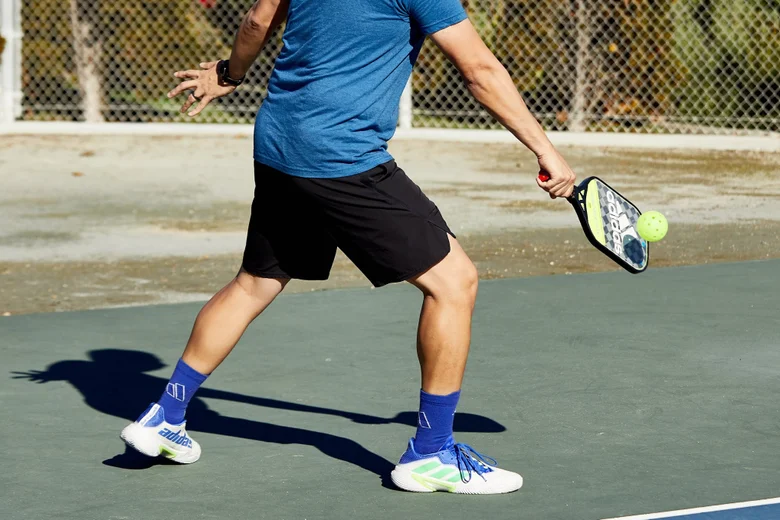
There are plenty of tennis players that once in a while heads to the pickleball court. Most of them are still wearing their tennis shoes to play pickleball, and most of them are right to. But the reasoning usually stops at “a court is a court,” and that’s where it gets interesting, because the two sports load a shoe in genuinely different ways, so how can your find the right crossover?
The load isn’t the same
Tennis, from the baseline, is a sport of long accelerations, hard braking and recovery. You cover ground, you load the outside leg, you stop from speed. On hard courts the outsole is being abraded continuously while it does all that.
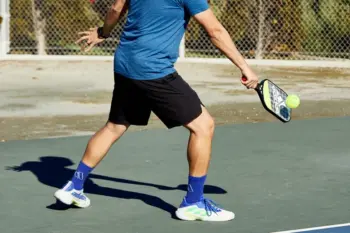
Pickleball is a sport of small adjustments. Around the non-volley zone you’re making repeated lateral shuffles, split steps and forward lunges, often from a low, wide stance, hundreds of times per game. The forces are shorter but they’re more frequent, and they arrive at more angles.
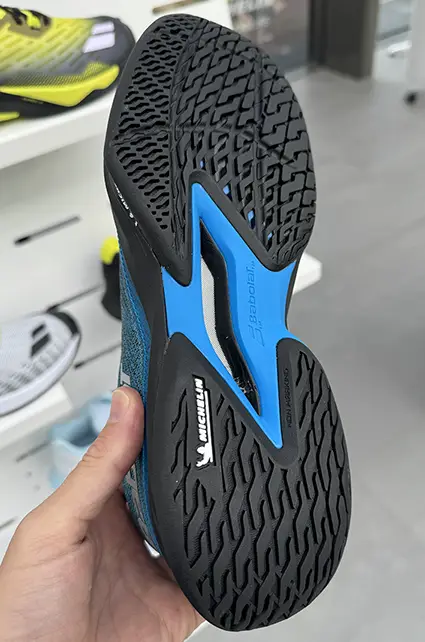
What both demand is the same: a platform that won’t let your foot roll over the outside edge, a shank that stops the midfoot folding, and rubber that survives abrasive surfaces. That overlap is why a good hard-court tennis shoe is a perfectly legitimate pickleball shoe, and why the reverse is only sometimes true.
Why the tennis shoe usually wins
If tennis is the more demanding half of your schedule, start there. A hard-court tennis shoe is built around exactly the loads pickleball applies, and it will usually have more midfoot structure and a tougher outsole than a pickleball-specific model.
The trade-off is weight and stack height. Stability shoes like the Gel-Resolution X sit high off the court and weigh upwards of 400 g. For a player who lives at the kitchen line, that’s a lot of shoe for a sport played in a five-metre box. If pickleball is 80% of your court time, a lighter specialist makes more sense.
There is no universally correct answer here, only a correct answer for your split.
The label trap
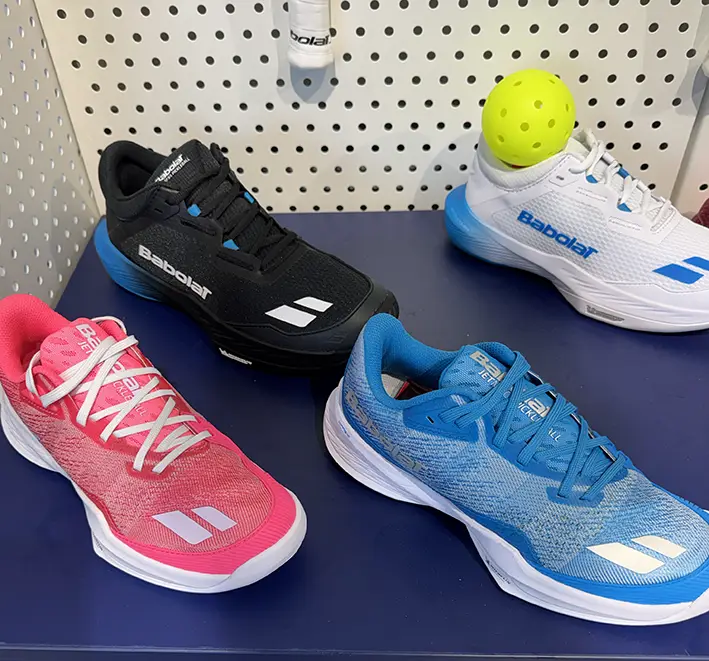
Here’s the part that should annoy you. A large share of what’s sold as a “pickleball shoe” by the big tennis brands is a tennis platform with a different badge and, occasionally, a softer rubber compound. That’s not a scandal (a tennis shoe is a fine pickleball shoe) but don’t pay a premium for the badge, and don’t assume the name on the box tells you anything about the last, the shank or the outsole hardness.
The genuine pickleball-specific designs are the ones with a visible lateral outrigger, a lowish drop and a full herringbone.
A few good brands and shoe models
ASICS Gel-Resolution X – the stability benchmark
The obvious starting point for a tennis-first player is the Asics Gel-Resolution X shoes. The tenth generation uses a two-piece midsole (FlyteFoam in the forefoot, FF Blast Plus Eco in the heel), a DYNAWALL support unit that now wraps all the way around the heel, and Dynalacing through the upper. The full-length AHAR Plus outsole is about as hard as court rubber gets (90.4 HC on the lab durometer, versus an 86.2 average) and in a Dremel wear test it lost 0.6 mm where the average shoe loses 0.8.
It’s also heavy: 417 g (14.7 oz) in a men’s 9, and over 16 oz in a 10.5. The X runs long, so if you’re between sizes, go down. A 2E wide version exists, and there’s a six-month outsole guarantee through US retailers.
For: players who put serious hard-court mileage on shoes and want the same pair for pickleball. Against: anyone who wants low stack and quick feet at the kitchen.

ASICS Court FF 3 – the movement shoe
If the Resolution is the tank, the Court FF 3 is the sports car with a roll cage. The outsole is split, with the heel separated from the forefoot so each section can move independently, and the two-piece TWISTRUSS system is designed to give you torsional support in the midfoot without locking out the forefoot – which is what lets the shoe slide and recover. PGUARD protects the toe, and the mono-sock bootie gives a very direct lockdown.
At 14.5 oz in a men’s 9 it isn’t light, and the toe box is tapered, so wide-footed players should look elsewhere. The Court FF 3 Novak is a slightly narrower last again.
One warning that matters more than any spec: the Court FF 3 exists in all-court and clay versions. The clay model’s herringbone is wrong for hard courts and hopeless for pickleball. This is something you need to check for all shoe models.
For: players who slide, or who want a performance tennis shoe that still feels quick. Against: wide feet, and anyone who won’t check which outsole they’re buying.
Read more in Chris review of the ASICS Court FF 3.
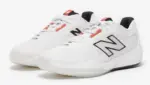
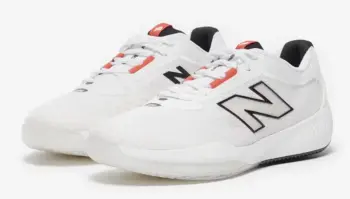
New Balance Fresh Foam X CT-Rally v2 – the comfort and width pick
This is the shoe I’d put under the feet of anyone with sore joints, a wide forefoot, or a schedule that mixes outdoor hard courts with indoor pickleball on wood.
Fresh Foam X is the softest midsole in this group by a distance, the lab measures it at 34.6 AC, well into the soft range, and it’s wrapped in a very stiff heel counter and an NDure upper with FantomFit overlays that survived a Dremel test with barely a mark. It’s available in standard width and 2E for men (D for women), and the toe box measures 71.3 mm, so it actually accommodates a splayed foot.
The crossover detail nobody mentions: the outsole is predominantly gum rubber and non-marking, with a modified herringbone and no aggressive pods. That makes it genuinely usable on a gym floor as well as a hard court – unusual, and useful.
The costs are real. It’s 405 g in a men’s 9, the drop is 13.1 mm, the toe box is low (23.1 mm), and the interior heel lining is the first thing to fail in durability testing. It runs slightly small.
For: comfort, width options, indoor/outdoor versatility. Against: low toe box, high drop, average outsole life at the heel.
Wilson Rush Pro 4.5 – the balanced all-rounder
A very well-judged middleweight. 13.2 oz in a men’s 9, a 9 mm drop, a wide and rounded toe box, and a Duralast outsole with the odd channel tread pattern Wilson has been refining – it grips hard courts and gives just enough to slide. The 4.5 added a tougher drag pad and a firmer medial mudguard, which is exactly where sliders wear through.
Comfort is excellent from the first hit; there’s essentially no break-in. The six-month outsole guarantee is there, and it’s needed: playtesters saw smoothing under the big toes within a few hours. Players with narrow heels may struggle to lock the shoe down without over-tightening the top eyelet.
For: a light-ish, comfortable, genuinely stable shoe at a sane weight. Against: fast-wearing rubber, and narrow heels.
More in our review of the Wilson Rush Pro 4.5.
Babolat Jet Mach 3 – the light option
At 325 g in a men’s 9, this is the shoe for the player who wants to feel fast at the kitchen. The Matryx Evo upper, a woven aramid and polyamide fabric, holds the foot laterally without the bulk of a synthetic cage, and the Michelin outsole is the real engineering story: zonal rubber thickness, more material where you wear, less where you don’t, with a nine-point flex pattern Babolat calls Active Flexion.
The ride is firm and low, which suits pickleball’s short movements but is less forgiving over three sets of singles. The fit is snug through the midfoot; try before you buy if you’re between sizes. There’s no outsole warranty, and the upper’s abrasion resistance is good rather than exceptional if you’re a toe dragger.
For: speed, weight, court feel. Against: firm cushioning, no outsole guarantee.
Skechers Viper Court Pro 2.0 – the specialist that behaves like a court shoe
Skechers sells this as a pickleball shoe, and it’s the most convincing argument that a pickleball-first design can still handle tennis. The outsole is a Goodyear Gold compound, measured at a 72 durometer, on the soft and tacky side, in a herringbone pattern with a pivot point under the ball of the foot, and it grips well on both concrete and gym floors. There’s a TPU midfoot shank and, unusually, a genuinely supportive Arch Fit insole with an APMA seal.
Blind testing wouldn’t identify it as a specialist. Stability is good rather than class-leading, cushioning is plush from the first wear, and the Relaxed Fit last gives real forefoot room. If you have a wide foot and don’t get on with Nike or ASICS lasts, this is worth trying.
Two caveats: the stock insole’s foam compresses long before the rest of the shoe wears out, and narrow-footed players will find the volume excessive under hard lateral load.
For: wide feet, comfort, indoor and outdoor grip from one pair. Against: soft insole, loose fit for narrow feet.
Selkirk CourtStrike Pro 3.0 – the pure pickleball option
Worth including because it’s the one shoe here that was designed for pickleball first and isn’t pretending otherwise. A lateral outrigger extends the contact patch beyond the upper, a TPU shank resists torsion, and the outsole is a deep four-way herringbone. The 2025 version had a rubber compound that wore prematurely; Selkirk paused production, reformulated, and re-released it – the current outsole is much better, and it’s covered by Selkirk’s own six-month sole warranty in the US and Canada.
The 3.0 dropped weight to 13.0 oz in a men’s 9 with a lighter mesh-weave upper. The ride is firm and responsive rather than comfortable, and the drop is around 8 mm, which is steeper than most tennis shoes.
For: a genuine pickleball platform with a real warranty. Against: firm cushioning, and no tennis-specific credentials if you play a lot of singles.
Nike GP Challenge Pro – the tennis shoe with pickleball credentials
Nike’s pickleball ambitions are no longer just a sponsorship story. After signing Anna Leigh Waters in January 2026, the brand has moved into dedicated pickleball footwear with the Zoom Challenge. But the GP Challenge Pro remains an interesting crossover option for players who prefer a traditional tennis shoe.
The GP Challenge Pro has a particularly wide 115.8 mm forefoot platform, prominent lateral outriggers and a stiff TPU shank. There’s also a heel Air Zoom unit and a relatively low 6.3 mm drop. Together, these features give it a stable base for aggressive lateral movements, making it a credible option for pickleball despite its tennis-first design.
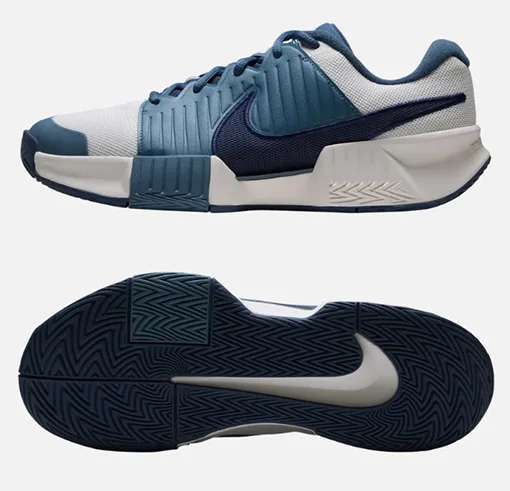
There are compromises. At 397 g in a men’s US 9, it isn’t particularly light, and the broad platform doesn’t translate into a roomy toe box: the forefoot tapers to 65.5 mm in laboratory measurements. Ventilation is also limited, and the fit runs slightly small.
For: players who want a stable, supportive tennis shoe with a broad platform and good lateral security. Against: narrow toe-box shape, limited ventilation and relatively high weight. If you’re specifically after a Nike pickleball shoe, the Zoom Challenge is now the more relevant model to investigate.
The shortlist at a glance
| Model | Weight (M9) | Drop | Widths | Outsole guarantee |
|---|---|---|---|---|
| ASICS Gel-Resolution X | 417 g / 14.7 oz | ~10 mm | Standard, 2E | Yes (US retail) |
| ASICS Court FF 3 | ~411 g / 14.5 oz | ~10 mm | Standard only | No |
| NB Fresh Foam X CT-Rally v2 | 405 g / 14.3 oz | 13.1 mm | Standard, 2E / D | Yes (US retail) |
| Wilson Rush Pro 4.5 | 374 g / 13.2 oz | 9 mm | Standard | Yes (US retail) |
| Babolat Jet Mach 3 | 325 g / 11.5 oz | Low | Standard, EE (select markets) | No |
| Selkirk CourtStrike Pro 3.0 | 369 g / 13.0 oz | ~8 mm | Standard | Yes (US/Canada) |
| Nike GP Challenge Pro | 397 g / 14.0 oz | 6.3 mm | Standard | Not published |
One qualification on that last column: these are largely retailer-backed guarantees in the United States, or brand programmes in Selkirk’s case, and they require you to wear through the rubber into the midsole.
European consumers generally benefit from a two-year legal guarantee against lack of conformity. This does not normally cover ordinary wear and tear, so a retailer’s six-month outsole durability programme can still offer additional practical value.
What to check before you buy
The outsole is the whole argument. For hard-court tennis and outdoor pickleball you want a hard-court or all-court outsole with a herringbone or modified herringbone. A clay outsole is a false economy, the pattern doesn’t grip hard courts and the compound is softer. And no, running shoes are not an option: they’re built for forward motion, with no lateral outrigger and no torsional shank.
Look for a shank and an outrigger, not adjectives. The two features that actually keep your foot from rolling are a midfoot shank (TPU, nylon or carbon) and a lateral outrigger that extends the platform beyond the upper. If a shoe has neither, it will feel nervous when you push off sideways.
Decision: stack and drop. Stack height and heel-to-toe drop influence court feel, cushioning and how a shoe feels during lateral movements. Lower-profile shoes may appeal to players who prioritise ground feel, while more cushioned models can suit those who prefer additional impact protection. Personal fit and stability matter more than choosing a particular number.
Width is a performance feature. A shoe that doesn’t match your foot will slide inside itself no matter how much structure it has. New Balance and ASICS both publish wide options; Nike and Babolat largely don’t, in most markets.
Toe drag. Pickleball players drag the toe on drives and lunges more than most tennis players do, and it’s a common failure point. Look for a rubberised toe bumper that wraps the medial side, not just a decorative cap.
Check the surface version. This cannot be repeated too often: Court FF 3 all-court versus clay, and the same applies across most performance ranges.
The indoor question
If a meaningful part of your pickleball is on a gym floor, outsole compound matters more than tread pattern. Non-marking gum rubber (as on the CT-Rally v2) is the safe choice. Very hard, tacky compounds grip beautifully on wood but can be almost too grippy, which is why some players need a couple of sessions to adapt.
Verdict
For a tennis player who plays pickleball a couple of times a week, most good hardcourt-shoes are ok to use. The Gel-Resolution X or the Rush Pro 4.5 is the sensible, low-risk answer, and the CT-Rally v2 is the one to try if you want cushioning, width options and indoor versatility from a single pair.
If you want one shoe that feels like a performance tennis shoe and still behaves at the kitchen line, the Court FF 3 is the best compromise in this group, provided you buy the all-court version. And if pickleball has quietly become your main sport while tennis is the occasional hit, the Viper Court Pro 2.0 or the CourtStrike Pro 3.0 is the better-shaped tool.
The shoe is not the label. It’s the outsole, the shank, the last and the drop – and once you know those four numbers, the decision stops being about branding altogether.