
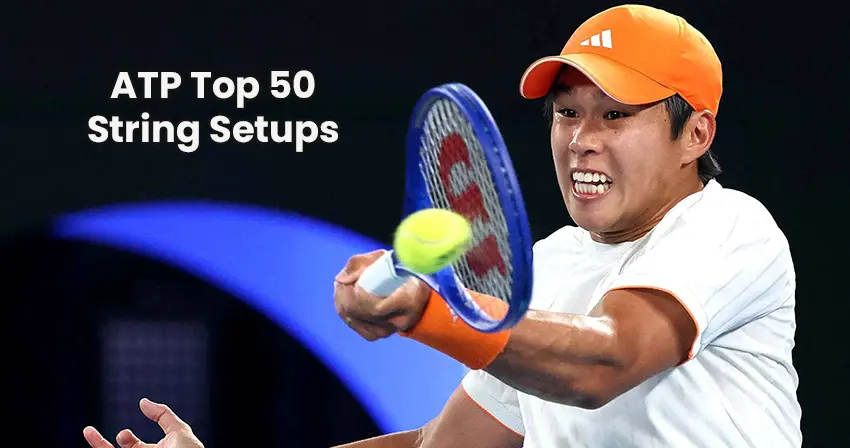
A while back I went down the rabbit hole of what racquets the ATP and WTA pros are actually playing with. This time I wanted to tackle something even messier: strings.
And trust me, if the racquet jungle felt chaotic, strings are a whole different animal.
Players test new stuff constantly, tweak tensions depending on the weather, run hybrids, sometimes go back to setups they used years ago, and occasionally use strings that are basically impossible to identify just from a photo. I piece this together from stringing sheets, chats with stringers, the odd DM from a player, and honestly just years of paying way too much attention to this stuff. So take everything below as a solid snapshot, not gospel. If you know something I’ve got wrong, tell me as I genuinely want to fix it.
With that disclaimer out of the way, there’s some fun stuff to pull out of this ATP top 50 data.
The average tension: 23.5 kg
This is the number I was most curious about going in.
Across the players where I actually have reliable tension info, the average lands right around 23.5 kg, or about 52 lbs. Not exactly low, but noticeably lower than the tensions we used to associate with pro tennis a decade or two ago. Most guys in this group are hovering somewhere in the 22–24 kg range.
Then you’ve got the outliers, and they’re wild.
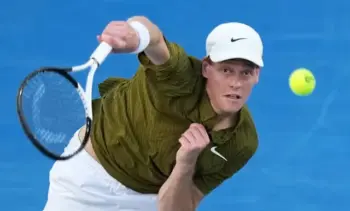
Frances Tiafoe is way down at around 19 kg with Yonex PolyTour Pro 1.25. Meanwhile Sinner is up at 28 kg with HEAD Hawk Touch, and Djokovic is right there with him at roughly 28 kg too, on his natural gut/Luxilon Alu Power Rough hybrid.
That’s a nine-kilo spread between two guys near the top of the same sport. Wild.
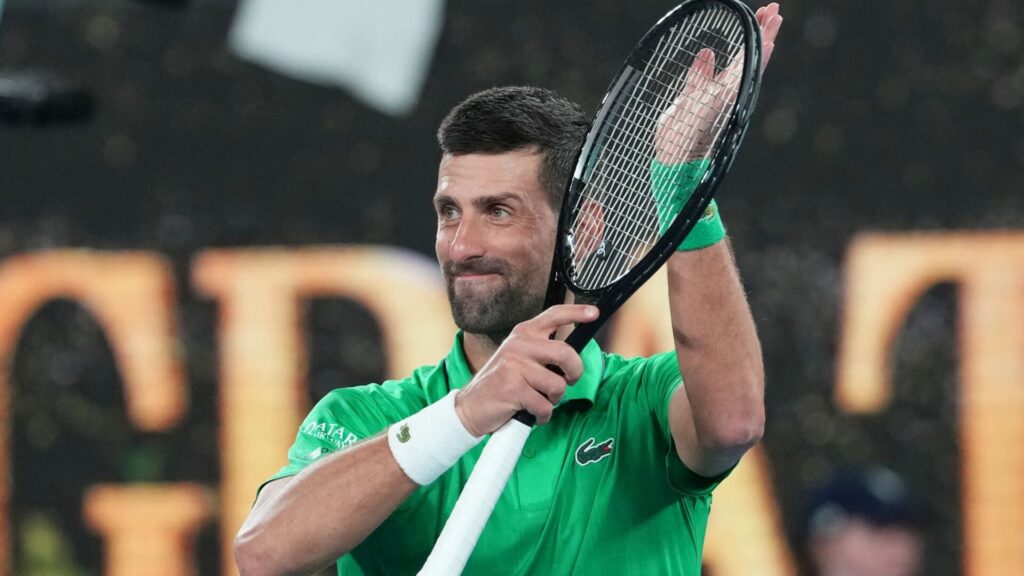
It’s a good reminder that “pro tension” isn’t really a thing. Two elite players can run near-identical string setups and still land many kilos apart because of technique, racquet, the trajectory they’re chasing, conditions, or just what they’ve gotten used to over the years.
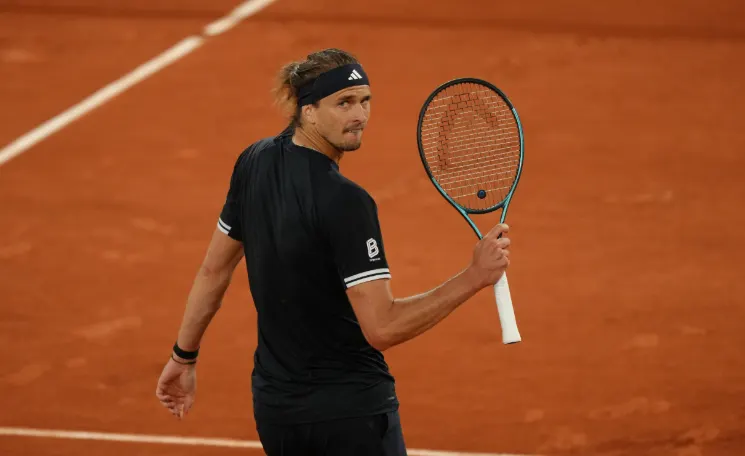
Pros also fiddle with this more than people assume. New tournament, new balls, different altitude, different humidity, different court speed. Some players barely touch their string bed from week to week, others are constantly adjusting. Zverev’s one of the more extreme cases here; he’s known for making pretty precise tension tweaks based on conditions.
Luxilon is still the king
On the brand side, one name refuses to go away.
Luxilon shows up in 17 of the 50 setups I looked at, making it the most represented string brand by a decent margin.
| String brand | Players in ATP top 50 |
|---|---|
| Luxilon | 17 |
| Yonex | 11 |
| HEAD | 10 |
| Babolat | 8 |
| Tecnifibre | 3 |
| Signum Pro | 2 |
| Kirschbaum | 1 |
| Dunlop | 1 |
(Hybrids let a player count toward more than one brand, so the numbers don’t need to add up neatly.)
Still, that’s an impressive showing for Luxilon. Alu Power has been around forever in string years, and it’s still everywhere you look. 4G’s doing plenty of work too.
The most popular individual strings
Break it down string by string and the old classics are still running the show.
- Luxilon Alu Power — 8 players
- Luxilon 4G — 7
- HEAD Hawk Touch — 6
- Yonex PolyTour Pro — 6
- Babolat RPM Blast — 5
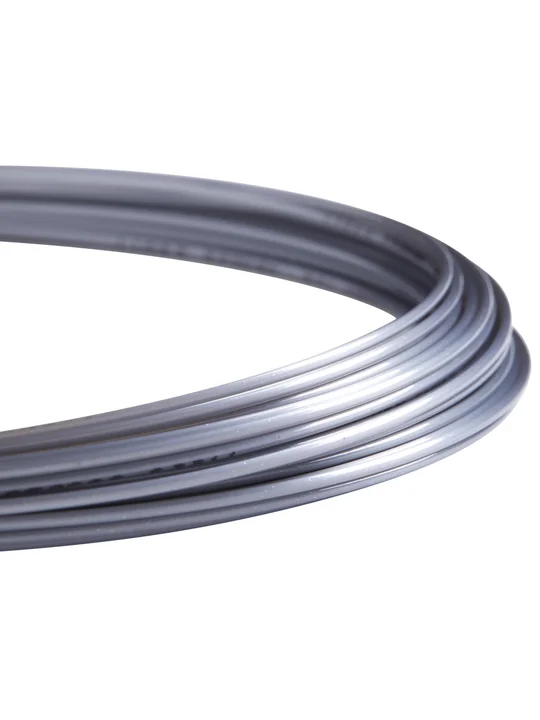
If you lump Alu Power Rough in with regular Alu Power, that’s around 10 out of 50 players on some version of it. One-fifth of the ATP top 50 on essentially one string family, which is kind of nuts when you think about how many options are out there now.
There’s a reason it’s lasted this long, though. Fresh out of the packet, Alu Power gives you a really nice blend of control, feel, power and response.
The catch, of course, is “fresh out of the packet.”
If you’re a pro getting restrung constantly, that’s a non-issue. If you’re a club player, it can turn into an expensive habit – and once it goes dead, it’s basically a different string.
1.25 mm is the sweet spot
Gauge-wise, where I’ve got solid data, 1.25 mm is comfortably the most popular, with 1.30 mm as the other real contender.
Makes sense to me. 1.25 hits a nice middle ground of feel, spin, control and durability, and most of these guys break strings often enough that going any thinner isn’t really worth the trouble. 1.30 tends to get picked by players chasing a bit more durability, or a firmer, more locked-in response.
A few of the hybrid setups are genuinely interesting here. Learner Tien, for instance, has been playing Alu Power 1.30 in the mains, 1.25 in the crosses – thicker where the string takes the most abuse, thinner in the crosses for a bit more movement and feel. There’s no universal rulebook with hybrids, and the more you look through pro setups, the more obvious that becomes.
Natural gut isn’t dead – not even close
This one surprised me a bit.
10 of the 50 players on this list are playing natural gut in a hybrid. That’s 20 percent.
Given how thoroughly poly has taken over the sport, having a fifth of the top 50 still running gut in some form says a lot. Djokovic, Zverev, de Minaur, Fritz, Nakashima, Paul, Arnaldi and Tsitsipas are among the gut users here.
Not hard to see why. Gut brings power, comfort, feel and tension maintenance that poly just can’t match on its own. Pair it with a poly cross and you get a setup that keeps more control and spin than a full gut job while holding onto some of that elasticity.
It’s not for everyone, though. Plenty of pros have tried gut/poly and just didn’t get along with the launch angle or the response. Equipment is personal, always has been, no matter how good it looks on paper.
Poly/poly hybrids are having a moment
One trend I’m personally a fan of: mixing two different polyesters.
Shaped string in the mains for bite and spin, smooth round poly in the crosses so the mains can move more freely. Nuno Borges runs a version of this with HEAD Hawk Rough in the mains and Hawk Touch in the crosses.
Casper Ruud and Jaume Munar both play variations of Yonex PolyTour Spin / PolyTour Pro, and Alejandro Tabilo has used that same combo too, though arranged a bit differently than you’d expect.
Which is sort of the whole point… there’s no single “correct” way to build one of these. The textbook answer is shaped mains, slick crosses, but if flipping it gives a player more confidence or better control, that’s the right call for them. Feel beats theory every time.
A few setups worth calling out
Some individual choices stood out while I was going through the sheet.
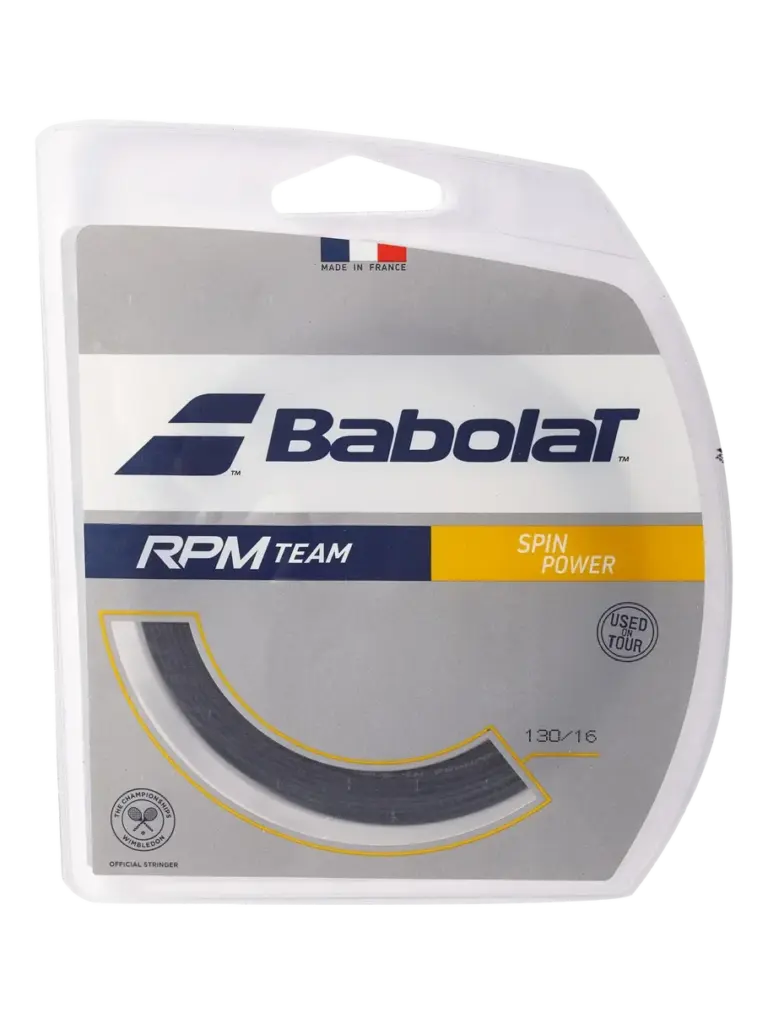
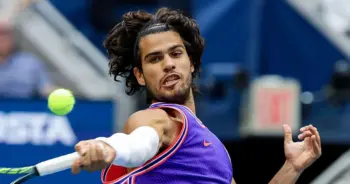
Carlos Alcaraz has moved off RPM Blast onto Babolat RPM Team 1.30, generally strung around 25/23 kg in this data. RPM Team is marketed as the softer sibling, though string stiffness on paper doesn’t always match what you feel on court.
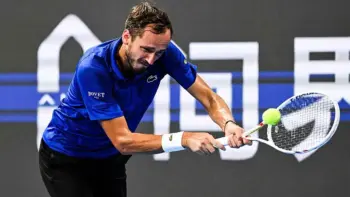
Daniil Medvedev has cycled through a lot of strings over the years and is currently on Tecnifibre Razor Soft, down in the low 20s.
Alexander Bublik is still showing RPM Blast 1.30 in this data despite switching to Diadem racquets, curious whether that changes going forward.
Joao Fonseca is on Yonex PolyTour Force 1.25, while Frances Tiafoe is sticking with PolyTour Pro at that eyebrow-raising 19 kg.
And then there’s the group making Alu Power look downright immortal: Lehecka, Mensik, Norrie, Bu, Fery, Struff and a handful of others, all showing up with some version of it.
What should the rest of us actually take from this?
Please don’t read this and go string your racquet with Hawk Touch at 28 kg because Sinner does it.
Pros hit the ball at a completely different speed and spin level, and they’re restringing far more often than any of us. A stiff poly can feel amazing fresh out of the machine. Leave that same string in for weeks or months, though, and it can get genuinely unkind to your arm once it goes dead.
Strings like Luxilon 4G, RPM Blast and HEAD Lynx Tour are firm – brilliant for a lot of tour players, but something club players should approach carefully at high tension, especially once they’ve lost life. Softer options on this list, like Yonex PolyTour Pro, HEAD Hawk Touch or Signum Pro Firestorm, tend to be friendlier starting points depending on your game and tension preference.
Honestly, the biggest lesson here might just be how much tension varies. If Tiafoe’s happy at 19 kg and Sinner’s happy at 28, there’s clearly no magic number waiting for the rest of us either.
So experiment a little. Drop a kilo or two and see what happens. Try a softer string. Try a hybrid. Pay attention to launch angle, depth, control and comfort, not just the old “tighter equals more control, looser equals more power” line, because it’s more complicated than that in practice. Also, check our overview of some of the best strings out there.
HEAD wins the racquet battle
Since the sheet has racquet data too, quick detour there.
| Racquet brand | Players | Share |
|---|---|---|
| HEAD | 15 | 30% |
| Yonex | 13 | 26% |
| Wilson | 11 | 22% |
| Babolat | 6 | 12% |
| Tecnifibre | 3 | 6% |
| Diadem | 1 | 2% |
| Dunlop | 1 | 2% |
So HEAD racquets tops the racquet chart while Luxilon tops the string chart – different companies leading different battles. Together, HEAD, Yonex and Wilson account for 78% of the racquets in this group.
Yonex in particular has quietly become a real force on both sides of the equation, and they seem to love getting a player on the complete package: racquet, strings, apparel, the lot.
If I had to sum up the “typical” ATP setup
It’d probably be something like: a 1.25 mm polyester, strung somewhere around 23–24 kg.
But honestly, the more interesting story is how many completely different paths lead there. Full poly. Gut/poly. Poly/poly. 19 kg. 28 kg. Thick mains, thin crosses, or the reverse. Shaped mains, round crosses, or the reverse of that too.
There are guidelines. There are very few actual rules. And that’s exactly why equipment stays this fascinating to nerd out over.
If you’d be into a WTA top 50 breakdown next, let me know, though fair warning, the research on that one might be even trickier. Could also go deeper into the ATP top 100 or 200 if there’s appetite for it.




You wrote “So HEAD racquets tops the racquet chart”, don’t you mean Wilson?
For the over 50 crowd, I am sticking with multifilament because I do find it easier on the arm and shoulder, but your analysis and breakdown is very interesting!
Nice text! What about the multifilament string? Any pro using it?
Not that I know of currently, no.
Top 100 juniors racquets and strings would be nice to know. At recent J200 it seems everyone was playing with Head. In the quarter finals 6 of the 8 were using Head. No Wilson in sight. One Yonex and one Babolat.