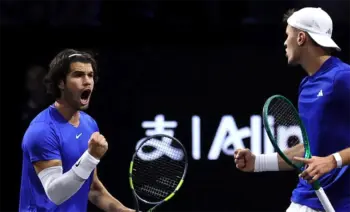
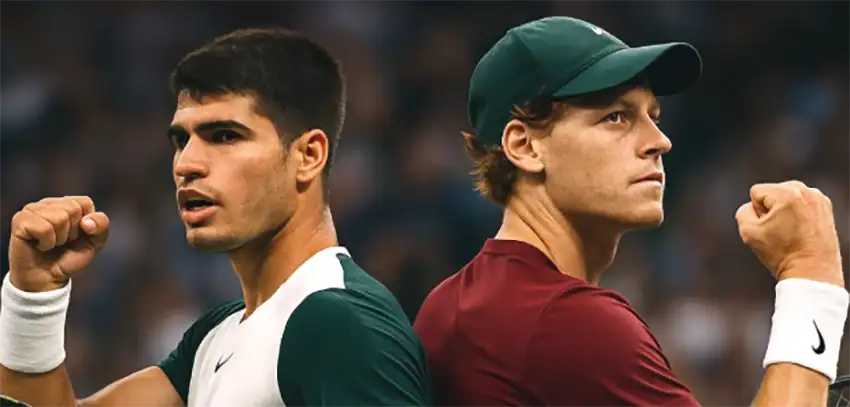
Carlos Alcaraz and Jannik Sinner have turned men’s tennis into a two-man show over the last couple of seasons. They’ve won all four Grand Slams together in 2025 and have played each other in six games this year alone, which is crazy for two players who are still in their early 20s. The time after the “Big Four” seems to be here, and it has a name. Sincaraz.
It doesn’t mean that everyone else in the changing room has left as well. Ross Hutchins, CEO of the International Tennis Federation, has already named Joao Fonseca, Learner Tien, and Jakub Mensik as a group of younger players he thinks can close that gap. History backs him up. When a duopoly happens, someone shows up before we expect them to.
In terms of betting and data, that’s just as important as it is for fans. Regular reviews of the best crypto betting sites show how quickly tennis markets change when new information comes out. Specifically, how Bitcoin-facing books price tennis outrights and live markets off form, surface splits, and injury news, so odds move the moment a new threat appears. The prices of Alcaraz and Sinner are already affected by the chance that one of these kids will turn a “shock” into a trend. If you pay close attention to tennis, you can see the same pattern in the scores and on the court.
A Duopoly at the Top – For Now
Sincaraz has already won ten majors and will complete a clean sweep of the four Slams in 2025. They’ve split the big titles, pushed each other into new gears, and pretty much taken the place of Federer, Nadal, Djokovic, and Murray as the men’s tennis world’s most important players.
Novak Djokovic, who is now 38 years old, is still making runs deep into Slams. But even he has admitted that the sport is moving toward a battle between Alcaraz and Sinner as he’s preparing for retirement.
But Hutchins really means that a healthy tour never stays a two-team race for long. You can be in charge of the present while the future is already getting ready on the courts outside. That’s where Fonseca, Mensik, and Tien come in.
Fonseca’s Basel Breakthrough and Brazilian Momentum
Joao Fonseca might still seem like a “Next Gen” name rather than a real threat if you only looked at his main-draw performance. In Basel, that changed. After beating Alejandro Davidovich Fokina 6–3, 6–4, the 19-year-old won his second tour-level event and first ATP 500.
Since Gustavo Kuerten won the Cincinnati Masters in 2001, Fonseca is the first Brazilian to win a title above the ATP 250 level. He is also the third-youngest ATP 500 winner since the series began.
Basel won his first Grand Slam top-10 match in the Australian Open, beating Andrey Rublev in straight sets in the first round. This was the end of a great year for him.
The lists show the same thing. The Infosys ATP Win/Loss Index shows that Fonseca starts the year 2025 outside the top 140 and ends the season around No. 28 after Basel. He has a 25–15 win–loss record at the tour level.
Most of the time, a rise that big in just one year means that a player isn’t just a good week trader. This is the type of person who will be a seed at Slams, in the running for the Masters quarterfinals, and in the running as soon as Sincaraz has two weeks off.
Mensik’s Miami Shock and the Djokovic Connection
Jakub Mensik made himself known in one match. As a child, Novak Djokovic was the Czech player’s hero. In Miami, the 19-year-old beat him 7–6(4), 7–6(4) to win his first ATP title, and it was at the Masters 1000 level, no less.
That result looks good on paper. While trying to win his 100th career title, Djokovic shut down these kinds of stories. He has built his reputation on doing the wrong thing and not being a part of them. Mensik came in ranked 54, which made him the lowest-ranked winner in Miami’s history. He used 14 aces and aggressive baseline patterns to keep Djokovic on the defensive the whole match.
Mensik’s career has taken a meteoric rise since then. He is said to have reached a career high of about No. 16 in the rankings and has a good record against top-10 opponents in 2025. He also goes deep at hard-court games, where his serve and first-strike forehand work best.
You definitely have a level that can bother Sinner and Alcaraz on the right day if you beat Djokovic in two close tiebreaks.
Learner Tien Shows Grand Slam Nerves of Steel
Tien Learner’s season wasn’t so much about one trophy as it was about one night of practice. When he played Daniil Medvedev in the second round of the Australian Open, he beat him in five sets: 6–3, 7–6(4), 6–7(8), 1–6, 7–6(10–7). The match ended after 2:54 a.m. on Margaret Court Arena.
Before that match, he was ranked 121st in the world. After that, he won really big. Even though Tien had match points and saw Medvedev serve for the match in the fifth, he still found a way to start over and win the tiebreak. That mix of making shots and not giving up is what sets potential top-20 players apart from those who just have a nice highlight reel.
That was proven by the rest of his year. Tien won his first ATP title in Metz, and the ATP’s Win/Loss Index shows that he had five top-10 wins in 2025.
He already looks at ease on the big courts, which is important in a world where Sincaraz has made crazy energy normal. If you can beat Medvedev in Melbourne, it’s not impossible to get a shot at Sinner or Alcaraz in the fourth round.
Why This New Wave Matters for Fans And for the Numbers
Mensik is known for his big serves and tough matches, while Fonseca is strong and hits heavy forehands. Tien, on the other hand, is good at patterns, being patient, and fixing problems. With their help, the tour doesn’t turn into a planned two-man show.
It also has a betting and data part to it. For two years, markets have been priced as “Sincaraz versus the field.” However, there is now a teenager who can beat Djokovic in a Masters final, a Brazilian who is winning titles on two continents, and an American who has shown he can handle one of the best hard-court players of all time in five sets.
That’s what people should really remember. When an 18- or 19-year-old drags a top-10 player into deep water, you can see the gap closing in real time. Sincaraz deserves all the attention they get. For those who are interested in the tour, the next age after Sincaraz is already beginning to take shape. This is true whether you care more about the stories, the stats, or the odds.