
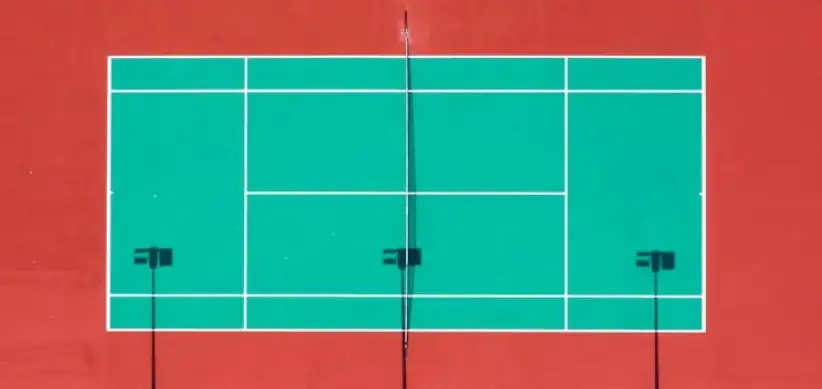
Here we will explain more in detail about the tennis court and all the official dimensions and areas. Other useful articles include guide to tennis stats, about ranking points and the different levels of tennis.
The game of tennis is played on a precisely measured rectangular court. These dimensions, standardized by the International Tennis Federation (ITF), are crucial for fair play and are identical whether the court is clay, grass or hardcourt. Understanding these measurements is key for players, coaches and fans of course.
Core Court Dimensions
The overall length of the tennis court remains constant for both singles and doubles play, but the width changes significantly to accommodate the extra players in a doubles match.
| Measurement | Imperial (Feet/Inches) | Metric (Meters) | Notes |
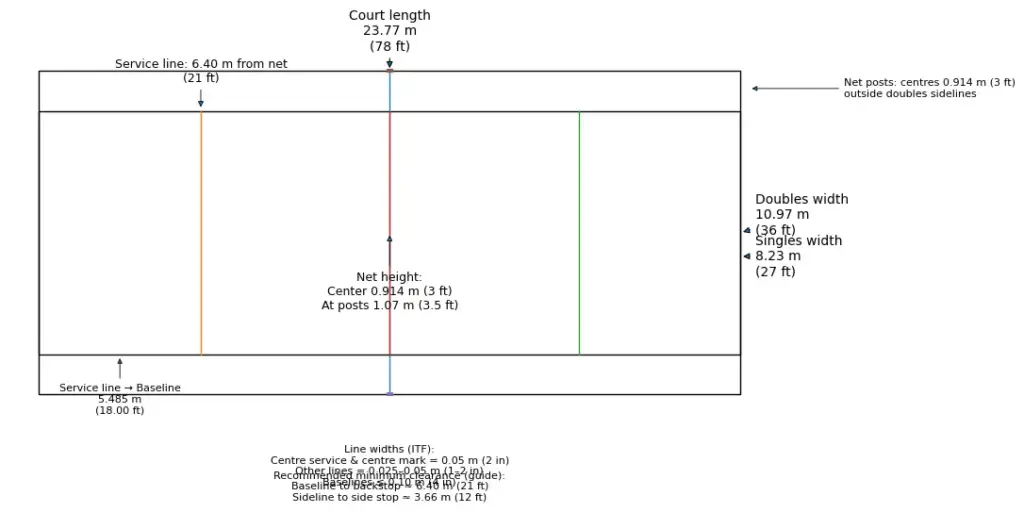
| Total Length | 78 ft | 23.77 m | From baseline to baseline. |
| Width (Singles) | 27 ft | 8.23 m | The inner sidelines are used. |
| Width (Doubles) | 36 ft | 10.97 m | The full court, including the doubles alleys, is used. |
| Doubles Alley Width | 4.5 ft (each side) | 1.37 m (each side) | The extra space used in doubles play. |
| Service Line from Net | 21 ft | 6.40 m | The front boundary of the service boxes. |
| Baseline to Service Line | 18 ft | 5.485 m | The depth of the backcourt area. |
| Net Height (Center) | 3 ft | 0.914 m | Held down by a white strap. |
| Net Height (Posts) | 3 ft 6 in | 1.07 m | The height at the net posts. |
Key Lines and Areas Explained
The court is a grid of lines, each with a specific name and purpose that dictates legal play.
- Baseline: The line at the very back of the court (78 feet apart). Players must stand behind this line when serving. A short center mark divides the baseline, indicating the legal area from which a player must serve.
- Sidelines:
- Singles Sidelines: The inner lines that define the width of the court for singles play (27 feet wide).
- Doubles Sidelines (Tramlines): The outermost lines that define the full width for doubles play (36 feet wide). The space between the singles and doubles sideline is called the Doubles Alley.
- Service Line: The line drawn parallel to the net, 21 feet away. This marks the boundary of the legal service area.
- Center Service Line: The line that runs down the middle, perpendicular to the net, connecting the two service lines.
- Service Boxes: The four resulting rectangles formed by the net, service line, center service line, and the sidelines. A legally served ball must land diagonally into the opponent’s service box.
The Net and Posts
The net is a critical dividing element of the court, suspended across the middle and parallel to the baselines.
- Net Height: The net is slightly lower in the center (3 feet/0.914 m) than at the posts (3 feet 6 inches/1.07 m).
- Net Posts: For a doubles court, the posts are placed 3 feet (0.914 m) outside the doubles sidelines. For a singles match played on a doubles court, two singles sticks are used to shorten the net width, ensuring the correct 3ft 6in height is maintained at a point 3 feet outside the singles sidelines.
Total Space Requirements
While the playing area itself is 78 ft by 36 ft, a significant amount of extra space is required around the boundaries for players to safely chase overrun balls, slow down, and for line judges/officials. For competitive and tournament play, the recommended minimum clearance area is:
- Behind each Baseline (Run-back): A minimum of 21 feet (6.40 m)
- Outside each Sideline (Run-side): A minimum of 12 feet (3.66 m)
This results in a total recommended area for an official court facility of approximately 120 ft (36.58 m) long by 60 ft (18.29 m) wide.